










PPAP returns to H1FY27 profit despite raw-material margin compression
Key highlights
- PPAP reported Rs 3.3 crore consolidated PAT in H1FY27 versus a Rs 2.3 crore loss in H1FY26.
- PPAP's consolidated H1FY27 revenue rose 31.8% year on year to Rs 334.2 crore.
- PPAP's H1FY27 gross margin fell to 40.7% from 45.4% as cost of goods sold reached Rs 198.2 crore.
- PPAP's working capital used Rs 12.9 crore in H1FY27, reducing operating cash flow to Rs 15.1 crore.
powered by IRIS
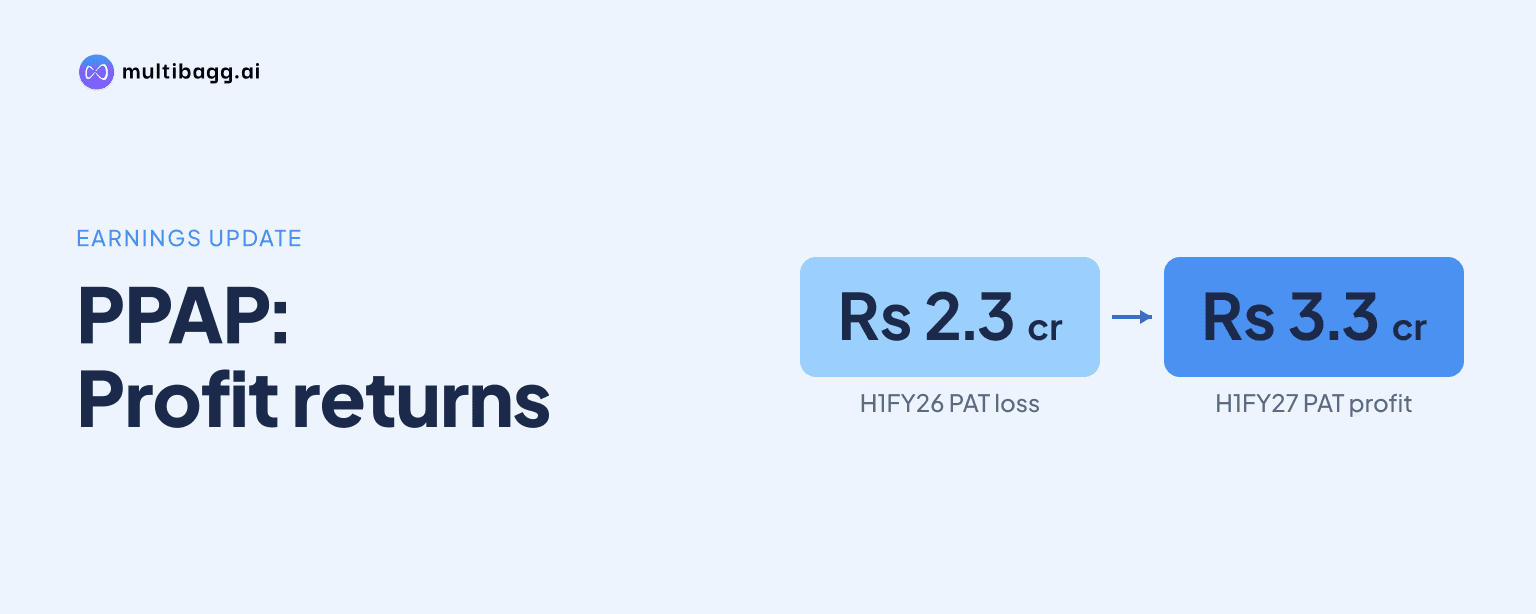
PPAP Automotive Parts returned to consolidated profit in H1FY27, reporting profit after tax of Rs 3.3 crore against a Rs 2.3 crore loss in H1FY26 as revenue from operations rose 31.8% to Rs 334.2 crore. The turnaround came while gross margin fell 4.7 percentage points to 40.7% because of higher raw-material costs.
Know PPAP Automotive inside out
Results, valuation, peers and who's buying, in one view.
How did PPAP return to consolidated profit in H1FY27?
Higher revenue and operating earnings returned PPAP to profit despite lower margins and increased depreciation and finance costs. Consolidated revenue increased by Rs 80.6 crore year on year to Rs 334.2 crore, while earnings before interest, tax, depreciation and amortisation, or EBITDA, rose 27.4% to Rs 28.1 crore. Profit before tax moved to Rs 4.5 crore from a Rs 3 crore loss.
The second quarter also recorded a profit. PPAP reported consolidated profit after tax, or PAT, of Rs 2.5 crore in Q2FY27, compared with a Rs 5 lakh loss in Q2FY26, as quarterly revenue rose 29.8% to Rs 177.8 crore. Q2 EBITDA increased 23.0% to Rs 15.7 crore and PAT margin was 1.4%, compared with 0.0% a year earlier.
Why did PPAP's margins decline despite revenue growth?
PPAP's gross margin declined because raw-material costs rose during H1FY27. Gross profit increased 18.1% to Rs 136 crore, trailing the 31.8% revenue increase, while the gross-profit margin fell to 40.7% from 45.4%. In Q2FY27, gross margin was 39.8%, down from 45.6% in Q2FY26, as cost of goods sold rose to Rs 107 crore from Rs 74.5 crore.
Management attributed the gross-margin reduction to higher raw-material costs and said the original equipment manufacturer, or OEM, pass-through mechanism has a time lag. Management expects margins to improve over coming quarters, but the presentation gives no specific recovery date or margin target. EBITDA margin declined less sharply, to 8.4% from 8.7% in H1FY27, while EBITDA rose by Rs 6.1 crore.
Depreciation and finance cost also absorbed operating earnings. Depreciation rose to Rs 18.3 crore from Rs 17.3 crore and finance cost increased to Rs 8.7 crore from Rs 8.5 crore in H1FY27. Other income rose to Rs 3.4 crore from Rs 0.6 crore, while PAT margin improved to 1.0% from negative 0.9% as the company returned to profit.
What did working capital do to PPAP's H1FY27 cash flow?
Working capital absorbed Rs 12.9 crore in H1FY27, compared with a Rs 1.8 crore contribution in H1FY26. Operating profit before working-capital changes increased to Rs 28.6 crore from Rs 22 crore, but cash generated from operations declined to Rs 15.7 crore from Rs 23.8 crore. Net cash from operating activities consequently fell to Rs 15.1 crore from Rs 23.2 crore.
Inventory was the largest visible increase among current assets between March 2026 and September 2026. Consolidated inventories rose by Rs 18.4 crore to Rs 115.1 crore, while trade receivables fell by Rs 5.5 crore to Rs 98.3 crore. Current investments declined by Rs 12.3 crore to Rs 80.3 crore, leaving total current assets almost unchanged at Rs 348.3 crore from Rs 348.9 crore.
Investing activities used Rs 15.2 crore in H1FY27, nearly matching operating cash inflow of Rs 15.1 crore. Net financing activities provided Rs 0.9 crore, compared with an outflow of Rs 1.2 crore a year earlier. Cash and cash equivalents increased by Rs 0.8 crore during H1FY27 to Rs 3.4 crore, although this was below the Rs 4.4 crore closing balance in H1FY26.
Got a follow-up? Ask IRIS
How did PPAP's borrowings change by September 2026?
PPAP's current borrowings increased by Rs 14.3 crore to Rs 174.1 crore at September 2026 from Rs 159.8 crore at March 2026. Non-current borrowings increased by Rs 1.4 crore to Rs 42.3 crore over the same period. Total equity rose by Rs 2.4 crore to Rs 343.5 crore, while total consolidated assets edged down to Rs 738.6 crore from Rs 741.3 crore.
Property, plant and equipment declined by Rs 7.8 crore to Rs 291.9 crore, while capital work-in-progress increased by Rs 6.7 crore to Rs 49.5 crore. Intangible assets under development rose to Rs 7.3 crore from Rs 4.8 crore. Current liabilities decreased to Rs 330.8 crore from Rs 340.7 crore, as trade payables fell to Rs 92.7 crore from Rs 100.2 crore and other current liabilities declined to Rs 44.8 crore from Rs 63.3 crore.
What is PPAP planning after H1FY27?
PPAP plans to execute its parts-business order book over the next five years while increasing content per vehicle through value-added and higher-margin products. Exports have commenced to the United States, and the company is exploring Gulf Cooperation Council countries. The plan also includes onboarding customers and increasing its share of business, without a disclosed revenue contribution from these initiatives.
For the aftermarket business, PPAP aims to grow topline by more than 20% annually and generate 10% of overall revenue from the division within the next two to three financial years. The company plans to increase stock-keeping units and strengthen domestic and international distribution. In tooling, PPAP plans to fulfil its auto and non-auto order pipeline, enhance capacity to 180 molds and increase utilisation to achieve operating leverage.
Conclusion
PPAP's H1FY27 results show a revenue-led return to consolidated profitability, with Rs 334.2 crore of revenue producing Rs 3.3 crore of PAT after a Rs 2.3 crore loss a year earlier. The increase in earnings occurred alongside lower gross and EBITDA margins, while the Rs 12.9 crore working-capital outflow reduced operating cash generation despite higher operating profit.
The next reporting periods will indicate whether the OEM pass-through mechanism delivers the margin improvement management expects. Progress can also be assessed against PPAP's five-year order-book execution plan, its aftermarket target of 10% of revenue within two to three financial years, and its tooling-capacity target of 180 molds.