










Prataap Snacks sees packaged shift as local supply tightens
Key highlights
- Prataap Snacks reported 17% Q2 transaction growth and 8% to 9% pricing growth.
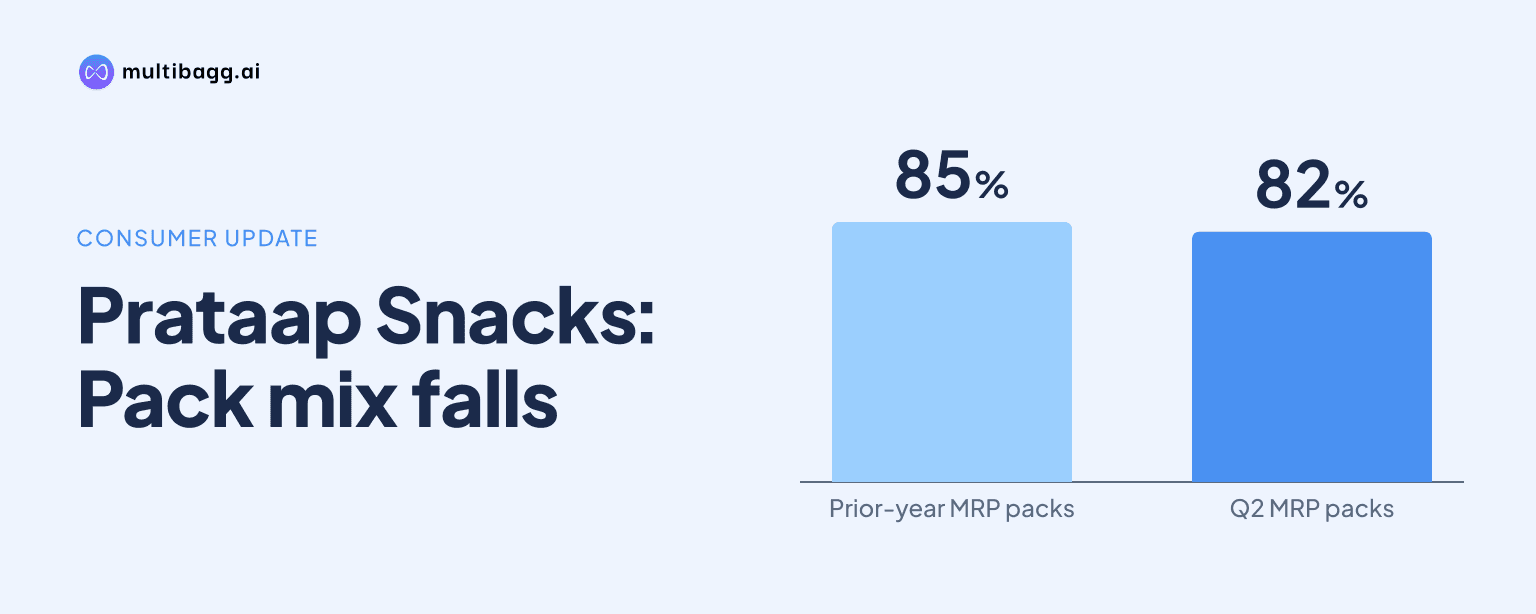
- Management said Rs 5 MRP packs fell to 82% of mix in Q2 from 85% a year earlier.
- Namkeen contributed about 25% of sales, up from 20% a year earlier.
- Quick commerce represented about 1.2% to 1.5% of sales, with a target of about 5% in three years.
powered by IRIS
Prataap Snacks said in Q2 that high input-cost inflation was shifting snack demand towards packaged brands because local makers were struggling to obtain palm oil and packaging laminate, while Prataap Snacks recorded 17% growth in packet transactions and 8% to 9% pricing growth.
Know Prataap Snacks inside out
Results, valuation, peers and who's buying, in one view.
Why is Prataap Snacks seeing a shift from local snacks to packaged products?
Prataap Snacks said the shift is running towards packaged snacks, rather than towards loose or local products, during the current cost inflation. Management attributed this pattern to local players being unable to manage supplies of palm oil and laminate, two inputs whose prices it described as elevated. It said this operating disruption was producing a market-share gain for Prataap Snacks.
Prataap Snacks nevertheless remained priced above local competitors in the example management gave. If a local player sells a comparable Rs 5 product at Rs 3.75, Prataap Snacks would be at Rs 4.15, according to management. That price difference indicates the claimed shift was not based on Prataap Snacks undercutting local suppliers, but on the availability and supply-management challenges facing them.
How has inflation changed Prataap Snacks' pricing and pack strategy?
Prataap Snacks responded to weighted inflation of about 8% to 9% with pricing and grammage actions in Q2. Management reported 8% to 9% pricing growth for the quarter alongside 17% growth in transactions, which it defines as the number of packets sold. It said it was selectively reviewing categories and competitors before rationalising grammage in certain stock-keeping units, or SKUs.
The pack mix has also moved away from the smallest price point. The share of Rs 5 maximum retail price, or MRP, packs fell to 82% in Q2 from 85% a year earlier, a decline of 3 percentage points. Management said it actively pushed larger packs, with Rs 10 to Rs 20 packs reaching 14.5% of the mix; quick commerce accounted for about 3.5%, while modern trade and other formats contributed to larger packs.
After Q2, management said packaging-material prices had risen further, citing continued pressure from crude oil. Prataap Snacks therefore planned another round of grammage rationalisation and price increases, as well as a review of trade schemes and discounts. Management said the objective was to maintain gross margin at a similar or slightly higher level, not to disclose a fixed percentage margin target for the immediate period.
Which product categories are contributing to Prataap Snacks' growth?
Prataap Snacks said growth was broad-based and led by namkeen and potato chips, while its traditional Rings product had faced category contraction after COVID. Namkeen contributed about 25% of the business at the time of the call, up from 20% a year earlier. Pellets represented about 19% to 20%, Rings about 10%, and the combined extruded category about 39%.
Potato chips also increased in importance during the latest quarter. Management said chips rose to 25% of contribution from 20% in the preceding quarter, supported by products that performed well and by capacity additions at plants other than Indore. It credited the resulting more-than-20% growth over the past two quarters to a combination of product-led momentum and distribution work.
The category comparison also shows remaining distribution headroom. Extruded snacks, Prataap Snacks' largest category, reach about 2 million outlets, whereas namkeen is available at roughly 25% of Prataap Snacks' total reach and chips at around 30% to 35%. Management said these gaps allow Prataap Snacks to add namkeen and chips to stores it already serves, rather than relying only on opening new outlets.
Got a follow-up? Ask IRIS
Can Prataap Snacks expand distribution while input costs remain high?
Prataap Snacks said it can expand category distribution because it reaches nearly 2.5 million outlets but has not yet placed every category in that network. Prataap Snacks has about 2,200 direct distributors and around 3,000 sub-distributors, taking the total distribution structure to about 5,500. It identified Uttar Pradesh, Gujarat, Rajasthan and Bihar as areas targeted for further expansion.
Management said sales-force automation, or SFA, is helping identify outlet-level gaps and measure field-staff productivity daily. This mechanism is particularly relevant for chips and namkeen, where distribution is lower than for extruded products. Over a three- to four-year period, management said it expects potato chips and namkeen to reach about 75% of the outlets in which Prataap Snacks is already present.
Emerging channels are another part of the plan, although they remain small. Quick commerce represented about 1.2% to 1.5% of overall sales, and management’s target is to lift that share to about 5% of revenue over the next three years. Prataap Snacks did not state that quick commerce is more profitable; its comments focused on growing channel contribution and larger-pack availability.
What margin measures has Prataap Snacks outlined?
Prataap Snacks is targeting 5% to 6% of benefits from several cost and supply-chain levers, according to management. It expects around 1% to 1.5% of that benefit to come from supply-chain measures. Some initiatives could begin contributing within a couple of quarters, while the full effect, particularly from a new plant, may take two to three years to reach the bottom line.
Management said these measures underpin its confidence in reaching a sustainable earnings before interest, tax, depreciation and amortisation, or EBITDA, margin of about 9% to 10%, even if palm oil, packaging laminate and other commodity prices remain elevated. This was a management target, not reported current profitability, and it rests on planned operational savings rather than an assumption that input prices will fall.
The planned Indore project is one such lever. Prataap Snacks has taken 50 acres of industrial land from the state government on a long-term lease, received possession in the month before the call and begun site work. Management was targeting commercial production in about 15 months, while retaining a broader 15-to-18-month timeline; funding drawdowns for the project had not materially begun at the time of the call.
Conclusion
Prataap Snacks' competitive message is that inflation has created an unusual opening for packaged-snack brands: smaller local makers may face greater difficulty securing palm oil and laminate, even as branded companies must raise prices or reduce pack grammage. Prataap Snacks paired that claim with 17% Q2 transaction growth, a 3-percentage-point reduction in Rs 5 pack mix, and increasing contributions from namkeen and chips.
The next issues to watch are whether additional price and grammage actions preserve the gross-margin level management seeks, whether chips and namkeen reach expands beyond their current 30% to 35% and roughly 25% outlet penetration, and whether the Indore plant begins commercial production within the stated 15-to-18-month timetable. Management’s three-year aim to take quick commerce to about 5% of revenue is another disclosed marker of execution.