










Premier Energies targets 40% BESS localisation without cells
Key highlights
- Premier Energies said cell-to-pack assembly, pack-to-container integration and software can provide 40% BESS local value addition.
- Management said BESS assembly equipment for cell-to-pack and pack-to-container lines faces no stated China-related ban.
- Premier Energies expects about Rs 700 crore of capital expenditure over the next two quarters and about Rs 2,400 crore for the financial year.
- Premier Energies said its approximately 10-gigawatt solar order book should be executed over 12 to 14 months.
powered by IRIS
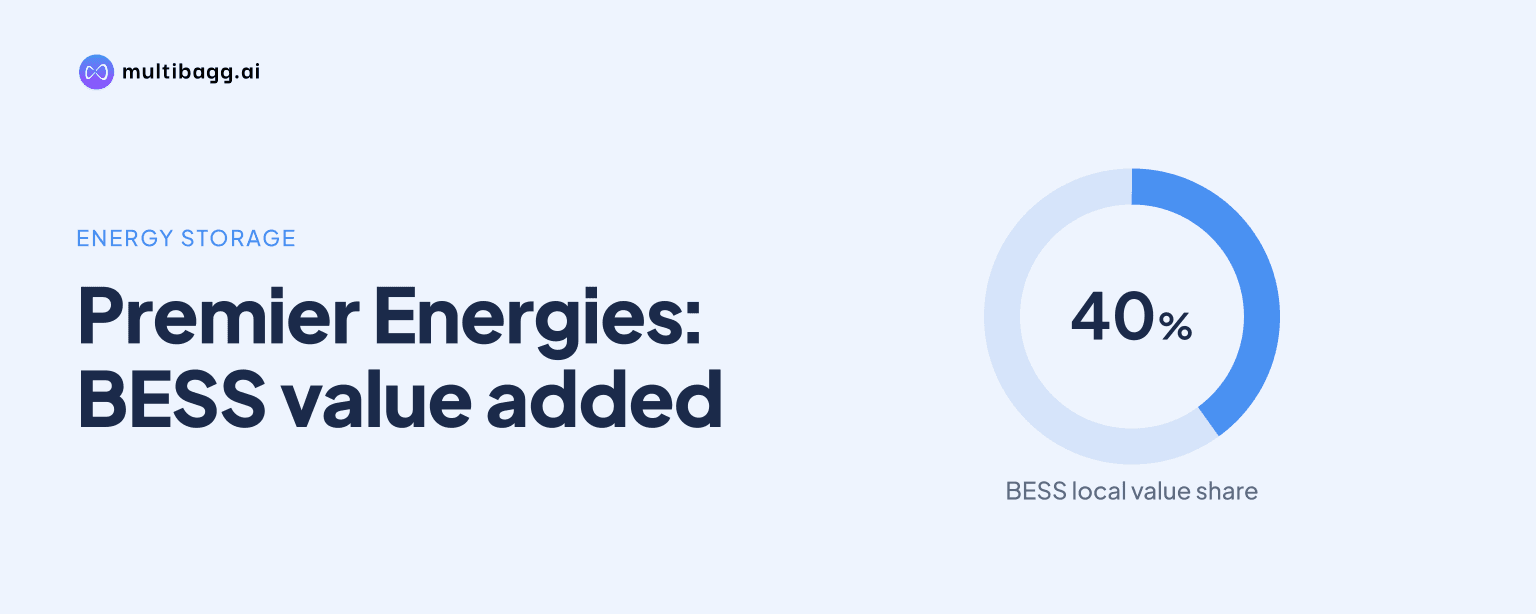
Premier Energies Limited said on November 5, 2026, that it expects to achieve 40% local value addition in battery energy storage systems, or BESS, through cell-to-pack assembly, pack-to-container integration and software, without manufacturing battery cells. Management said the model avoids the equipment-sourcing uncertainty it associates with BESS cell production.
Know Premier Energies inside out
Results, valuation, peers and who's buying, in one view.
What is Premier Energies' BESS manufacturing plan?
Premier Energies plans to enter BESS through cell-to-pack and pack-to-container operations rather than through battery-cell manufacturing. Cell-to-pack work combines battery cells into packs, while pack-to-container integration places those packs into containerised storage systems; management also included software in its BESS manufacturing model.
Management distinguished the assembly stages from BESS cell production in its November 5 call. It said China can supply equipment for cell-to-pack and pack-to-container lines and that there is no stated ban affecting those activities, while it identified greater technology and equipment-sourcing uncertainty in battery-cell manufacturing.
Premier Energies did not disclose a BESS assembly capacity, commissioning date, capital outlay or technology supplier. The plan is therefore a stated operating model rather than a quantified manufacturing build-out, unlike the company's solar operations, where management discussed its 5.6-gigawatt module line and planned ingot-wafer expansion.
How will Premier Energies reach 40% BESS localisation?
Premier Energies said it can comfortably achieve 40% value addition through cell-to-pack assembly, pack-to-container integration and BESS software. Management said this combination would allow it to qualify for 40% local content without requiring domestic production of the battery cells used in the system.
The 40% level was discussed after an analyst asked about indigenisation amid concerns over Chinese technology access. Premier Energies' answer was that the localisation calculation can rest on domestic assembly, integration and software, rather than on making cells locally. Management did not disclose the individual contribution of each activity to the 40% total.
The transcript does not identify the supplier, chemistry, origin or procurement terms for battery cells. As a result, Premier Energies' statement addresses the local-value-addition structure of the finished BESS product, but not the sourcing of the cells that will enter its cell-to-pack operations.
Why is Premier Energies not making BESS battery cells?
Premier Energies said it has been cautious about announcing large investments in BESS cell manufacturing because cell-production technology and equipment sourcing present greater uncertainty. Management contrasted that constraint with its stated ability to obtain equipment for the cell-to-pack and pack-to-container manufacturing stages.
Management also said Chinese BESS and solar companies have been operating under pressure from substantial overcapacity. It said an anti-involution policy in China was intended to stabilise prices, adding that polysilicon and wafer prices had moved upward and that battery-cell prices could stabilise over time. These were management observations, not a disclosed cell-price forecast.
The assembly-led model leaves Premier Energies dependent on externally sourced battery cells, even if it completes pack and container work locally. Management nevertheless said it considers the current period appropriate to invest in BESS, but it did not provide a dedicated BESS capital-expenditure amount or a battery-cell supply agreement.
Got a follow-up? Ask IRIS
Which BESS customers does Premier Energies expect to serve?
Premier Energies said it expects to win BESS business from independent power producer, or IPP, customers and commercial and industrial, or C&I, customers. Management cited the company's 32-year history and its market reputation as factors it believes can support sales to these customer groups.
The BESS plan is being presented alongside management's expectations for renewable-energy policy support. On the November 5 call, Premier Energies referred to a BESS initiative with a viability gap funding, or VGF, scheme, a Green Energy Corridor scheme, and possible announcements of KUSUM 2.0 and Surya Ghar 2.0 within the next one or two months.
Management said the policy measures could improve product mix and realisations for its solar business, particularly domestic-content-requirement, or DCR, modules. It did not disclose a BESS customer order, revenue target or order book linked to either policy programme, so the identified IPP and C&I opportunity remains unquantified in the call.
How does BESS fit Premier Energies' wider investment plan?
Premier Energies expects capital expenditure of about Rs 700 crore over the next two quarters and about Rs 2,400 crore for the financial year. Management said most spending on cell and module expansion had been completed, with remaining outlays including the Naidupeta cell plant, a battery and aluminium plant, and open-access captive projects.
The company did not split the Rs 2,400 crore financial-year estimate between BESS assembly, battery operations, solar capacity and other projects. The 40% localisation statement therefore does not establish the scale, timing or capital intensity of Premier Energies' BESS business from the information disclosed on the call.
In solar, Premier Energies said its approximately 10-gigawatt order book was expected to be executed over 12 to 14 months. Management also said the new 5.6-gigawatt module line would increase captive use of its solar cells and gradually reduce merchant cell sales, whereas BESS will use purchased cells as inputs for higher-level assembly.
Conclusion
Premier Energies' stated BESS approach is to seek 40% local value addition through cell-to-pack assembly, pack-to-container integration and software, while avoiding battery-cell manufacturing. The strategy separates BESS localisation from cell production and reflects management's view that assembly-line equipment can be sourced despite the uncertainty it sees around BESS cell-manufacturing technology and equipment.
The next disclosures to watch are BESS capacity, commissioning schedules, capital expenditure, battery-cell sourcing and customer orders, none of which were specified on the November 5 call. Management also said KUSUM 2.0 and Surya Ghar 2.0 could be announced in the next one or two months and guided to about Rs 700 crore of capital expenditure over the next two quarters.