










Premier Explosives targets 300 tonnes of RDX/HMX in FY28
Key highlights
- Premier Explosives expects commercial RDX and HMX production by the middle or end of December.
- Premier Explosives is expanding RDX and HMX capacity from 100 tonnes to 600 tonnes per year.
- Management targets around 300 tonnes of RDX and HMX production in FY28.
- Premier Explosives expects about 30 tonnes in the initial ramp-up, associated with around Rs 20 crore of revenue.
powered by IRIS
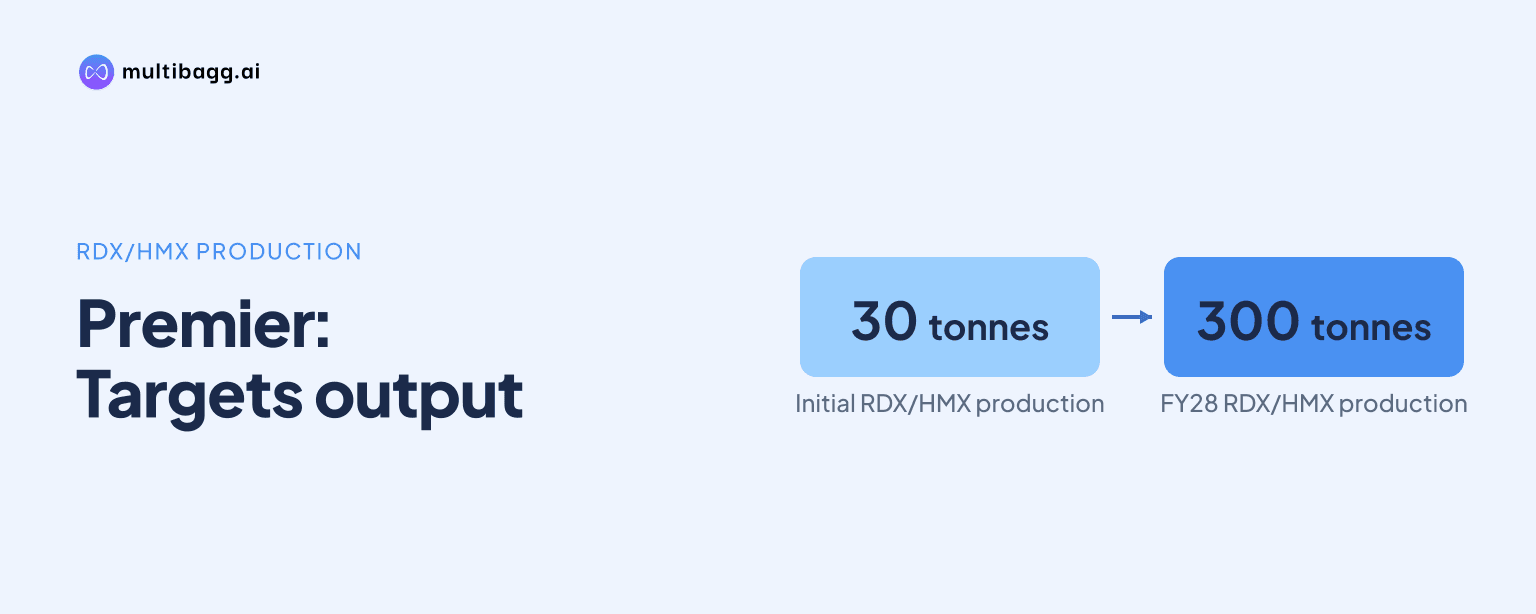
Premier Explosives expects its RDX and HMX plant to be ready for commercial production by the middle or end of December and is targeting about 300 tonnes of output in FY28. The target equals half of the expanded 600-tonne annual capacity, although management said the hazardous materials require a gradual ramp-up and export licences will shape external sales.
Know Premier Explosives inside out
Results, valuation, peers and who's buying, in one view.
When will Premier Explosives start commercial RDX and HMX production?
Premier Explosives expects to be ready for commercial RDX and HMX production by the middle or end of December. Management said water trials had started and were continuing when it provided the update, following its earlier expectation that those trials would begin by October.
The first production phase will be measured rather than a full-capacity launch. When an analyst asked whether 50 tonnes could be sold in the fourth quarter of FY27, management said output would not reach that scale immediately because RDX and HMX are hazardous materials that must be ramped up step by step.
Management instead indicated initial production of around 30 tonnes. It associated that volume with revenue of around Rs 20 crore, but this was an early-stage indication rather than a quarterly run-rate forecast, since output, internal consumption and export permissions remain variables.
How much RDX and HMX capacity is Premier Explosives adding?
Premier Explosives is increasing RDX and HMX capacity to 600 tonnes per year from 100 tonnes per year. Management described the expansion as an investment already under way, making the planned capacity six times the existing 100-tonne level.
Premier Explosives is targeting around 300 tonnes of production in FY28, or 50% of the stated 600-tonne annual capacity. The difference between the 300-tonne target and full capacity reflects the planned commissioning sequence, beginning with water trials and then a cautious commercial ramp.
Management also said around 50% to 60% of output could be consumed internally. That means the plant’s production volume will not translate one-for-one into external raw-material sales, as a portion may be used in Premier Explosives’ own products.
Why do export licences matter to Premier Explosives’ RDX and HMX sales?
Export licences matter because Premier Explosives said most RDX and HMX orders are export orders for raw materials. Management said it takes up production for an export order only after the relevant licence has been issued, making approvals a condition for serving those orders.
The process is handled order by order, rather than product by product. Premier Explosives said it must obtain buyer documents, including end-user certificates that customers secure from their governments, before applying to the Ministry of Defence and the Department of Defence Production.
Management said the government committee normally takes three to four months to issue a licence or provide a reply after an application is submitted. It also said approvals depend on the destination country and government policy under prevailing geopolitical conditions, even where potential orders are available.
An analyst suggested that RDX and HMX were in short supply across domestic and international markets, but management did not confirm that all production could therefore be sold. Instead, it reiterated that licensing decisions are country- and order-specific, limiting certainty around external volumes.
Got a follow-up? Ask IRIS
What revenue visibility has Premier Explosives provided for FY28?
Premier Explosives has provided a 300-tonne FY28 production target but has not given a fixed FY28 revenue forecast for RDX and HMX. Management declined to convert potential capacity into a firm sales value because export licences, internal use and international pricing remain unsettled.
Management said current international RDX and HMX pricing was fluid, indicating a range of US$60 to US$70 per kilogram. It attributed the movement to demand and availability, meaning the range was not presented as a contracted realisation for Premier Explosives’ FY28 output.
The early estimate of around Rs 20 crore from approximately 30 tonnes provides an indication of the initial ramp-up stage only. It should not be extrapolated automatically to the 300-tonne target because management expects 50% to 60% of output could be used internally and export clearances may affect external sales.
Premier Explosives also discussed Rs 32 crore of FY27 capital expenditure in response to an analyst’s question. Management said it expected to complete the previously discussed spending before the financial year-end, covering RDX, HMX, logistics and reconstruction of earlier magazines, without disclosing a separate final amount for the RDX and HMX project.
How does RDX and HMX fit into Premier Explosives’ defence pipeline?
RDX and HMX are part of Premier Explosives’ wider high-energy-materials portfolio, alongside mines, warheads and drone payloads at different commercial stages. Management said warheads were already being produced and exported, while land mines were the closest newer opportunity to commercialisation.
For Nipun mines, Premier Explosives said samples incorporating committee-requested changes had been accepted and production clearance had been received. Production had restarted, and management said it hoped to begin bulk supplies during the current financial year; it also said the Nipun order in hand was for more than 1 lakh pieces.
Adrushy and Ulka mines remained in qualification, while drone-payload supplies were being made on a trial basis pending qualification of the relevant drones by the Air Force and Army. Management did not provide FY27 or FY28 revenue guidance for those programmes.
Premier Explosives said bombs were at an early tender-participation stage, while its 40 mm ammunition programme remained constrained by unavailable raw materials, primers and propellants. It also said it had no facility or plans to establish a facility for 155 mm artillery shells, which use TNT-based explosives that it does not make.
Conclusion
Premier Explosives’ RDX and HMX plan combines a substantial capacity increase, from 100 tonnes to 600 tonnes annually, with a deliberately controlled start. Commercial readiness is expected by the middle or end of December, initial output is expected at around 30 tonnes, and management is targeting around 300 tonnes in FY28 rather than immediate use of the plant’s full annual capacity.
The next milestones are the completion of water trials, the planned December commercial start and progress on order-specific export licences that management said normally require three to four months after application. Investors can also watch whether the planned 50% to 60% internal consumption mix, fluid US$60-to-US$70-per-kilogram pricing and completion of FY27 capital expenditure alter how the 300-tonne production target translates into external revenue.