










Premier Starts Nipun Production After Revised Sample Clearance
Key highlights
- Premier restarted Nipun mine production after revised samples were accepted and production clearance was granted.
- Premier holds a Nipun order for more than 1 lakh pieces, but did not disclose its rupee value.
- Adrushy and Ulka mine programmes remain in qualification, while Nipun is cleared for production.
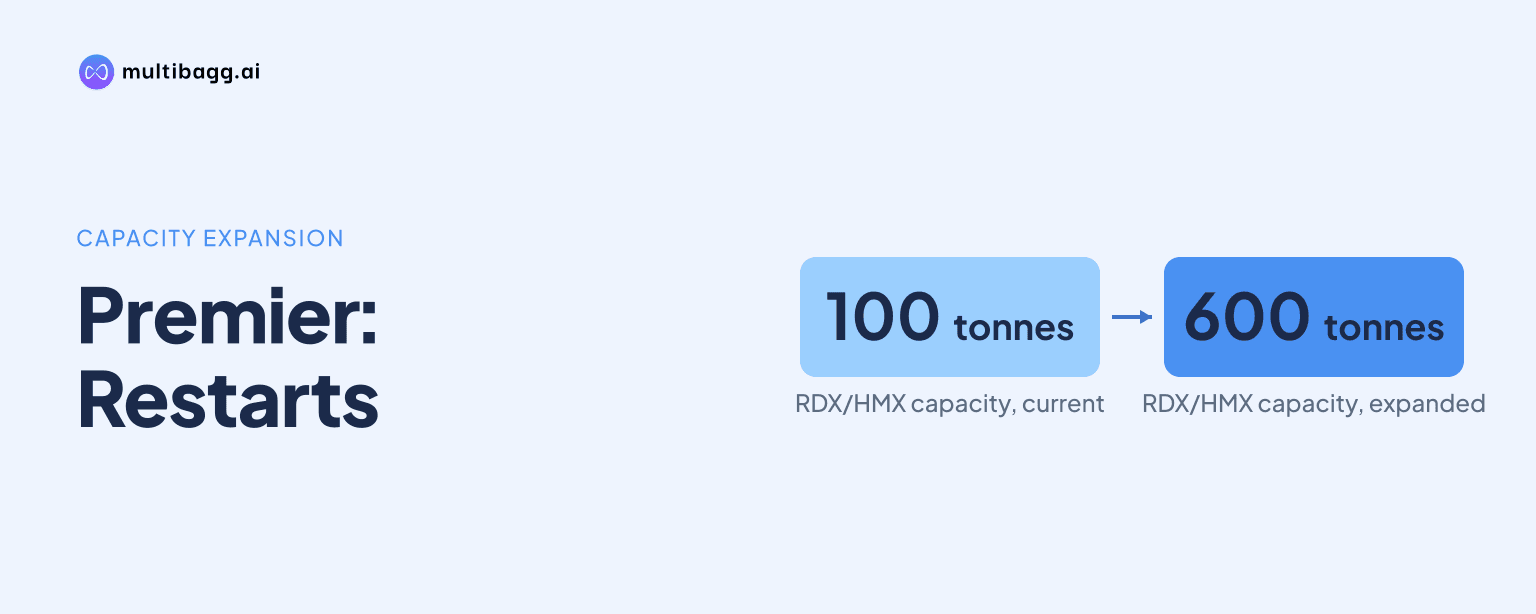
- Premier is expanding RDX and HMX capacity from 100 tonnes per annum to 600 tonnes per annum.
powered by IRIS
Premier Explosives Limited restarted Nipun land-mine production in FY27 after revised samples were accepted and cleared for production, with management expecting bulk supplies within the year against an existing order exceeding 1 lakh pieces. The clearance moves Nipun beyond sample revision, while Adrushy and Ulka remain under qualification.
Know Premier Explosives inside out
Results, valuation, peers and who's buying, in one view.
Has Premier restarted Nipun mine production?
Yes. Premier said it supplied samples made with changes requested by the committee, the samples were accepted, and production restarted after clearance was granted. Management said it hopes to begin supplies in bulk quantities during FY27, rather than reporting that bulk dispatches have already begun.
The programme required revised samples before the latest acceptance. Premier did not identify the committee, disclose the clearance date, or quantify Nipun’s production rate, but said the requested changes were incorporated before production resumed. The disclosed sequence places the product beyond revised-sample testing and into production.
Nipun also has an order in hand. Management said the production order exceeds 1 lakh pieces, while declining to disclose its rupee value because prices are competitively sensitive. This distinguishes Nipun from a prospective tender opportunity, although the transcript does not state a delivery schedule or revenue contribution for the order.
Which Premier mine programmes have reached production?
Nipun is the only named mine programme that Premier said has both production clearance and an order in hand. Adrushy and Ulka have not reached that stage, with management describing both as being in the qualification process. Premier said requests for quotation, or RFQs, are expected for the other programmes after qualification progresses.
The comparison shows that the three land-mine programmes are at different commercial stages. Nipun has crossed sample clearance and has a production order, whereas Adrushy and Ulka still depend on qualification and subsequent customer procurement. Premier did not disclose dates for their possible clearance or for the expected RFQs.
Management identified land mines as the product category closest to commercialisation among mines, ammunition, bombs and warheads. It also said it expects contribution from these areas in the next financial year, but did not separate a Nipun revenue forecast from potential revenue from warheads, drone payloads or the other mine programmes.
Got a follow-up? Ask IRIS
What is delaying Premier's other defence products?
Qualification is the main stated constraint on Premier’s drone payload business. The company said it is supplying payloads on a trial basis while the Air Force and Army qualify the drones themselves. Premier’s portion is the payload, and management said present quantities are small until those armed-forces trials are completed.
Warheads are at a later stage than drone payloads because Premier said it is already producing and exporting them. Bombs are at an earlier stage: management said Premier has participated, and continues to participate, in tenders, but described this activity as early stage. These positions make Nipun and existing warheads nearer-term production activities than bomb programmes.
A separate 40 mm ammunition programme remains inactive despite a technology transfer from the Armament Research and Development Establishment, or ARDE. Premier said raw materials, primers and propellants are unavailable from MIL, and it is trying to import the needed components. The company also said it has no facility or plan to establish a facility for 155 mm artillery shells, which use TNT-based filling explosives that Premier does not make.
Research collaborations with IIT Madras and BITS Pilani have not yet produced a commercial product. Management said the collaborations remain at the research stage, with no commercialisation disclosed. They therefore sit outside the FY27 bulk-supply expectation for Nipun and outside the current production activity for warheads.
How could RDX and HMX affect Premier's production plans?
Premier is expanding RDX and HMX capacity from 100 tonnes per annum to 600 tonnes per annum, but management linked output and sales to export licences. Water trials at the Katepally facility had started, and management said it expected commercial-production readiness by the middle or end of December, subject to a gradual ramp-up for a hazardous product.
For the fourth quarter of FY27, management said production could be around 30 tonnes rather than the 50 tonnes proposed by an analyst. It estimated that this output could generate around Rs 20 crore of revenue. For the following financial year, Premier said it was targeting around 300 tonnes, while adding that 50% to 60% of output may be consumed internally.
Export licensing is processed order by order rather than product by product. Premier said a buyer first needs to obtain documents, including end-user certificates, from its government; Premier then applies to the Ministry of Defence and the Department of Defence Production. Management said the committee normally takes three to four months to issue a licence or reply, and production for the export order begins only after the licence is received.
This mechanism separates installed capacity from export output that can be produced and sold. Management said most RDX and HMX orders are export orders, and licences depend on the destination country and government policy in current geopolitical conditions. Premier also said international pricing is fluid and did not offer a firm revenue estimate for the expanded annual capacity.
Conclusion
Premier has moved Nipun from revised-sample qualification to restarted production, supported by an order exceeding 1 lakh pieces and an expectation of FY27 bulk supplies. Nipun is ahead of Adrushy and Ulka, which remain in qualification, while drone payloads await armed-forces trials and warheads are already being produced and exported.
The next items to watch are whether Premier starts the stated FY27 bulk Nipun supplies, whether Adrushy and Ulka progress to RFQs, and the middle- or end-December commercial-readiness target for the expanded RDX and HMX facility. Export licences, which management said can take three to four months after documentation is submitted, remain an unresolved factor for RDX and HMX output.