










Prime Industries H1 Profit Rises 17% Despite Lower Revenue
Key highlights
- Prime Industries reported H1 FY27 consolidated profit after tax of Rs 7.686 crore, compared with Rs 6.544 crore a year earlier.
- H1 FY27 revenue from operations was Rs 33.951 crore, versus Rs 35.575 crore in H1 FY26.
- The manufacturing segment result rose to Rs 9.52 crore in H1 FY27 from Rs 6.203 crore in H1 FY26.
- Q2 FY27 revenue was Rs 24.99 crore and profit after tax was Rs 6.62 crore, according to the November 5 results release.
powered by IRIS
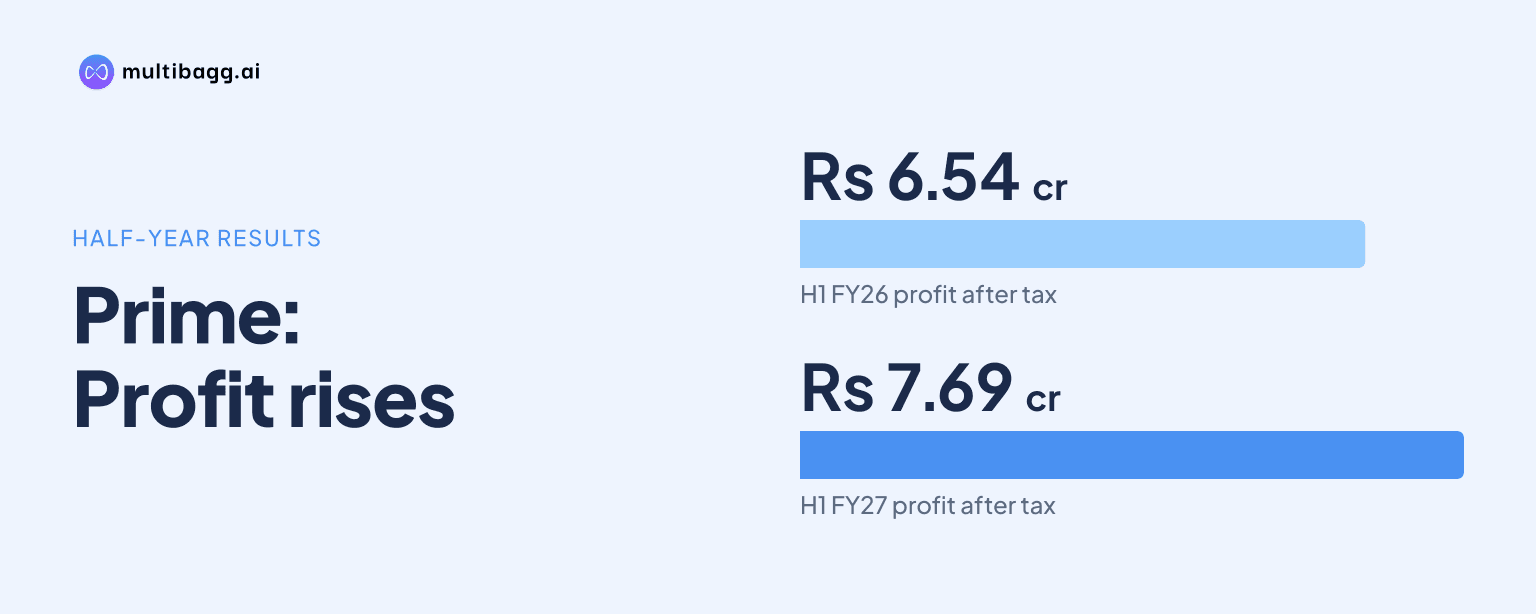
Prime Industries Limited reported H1 FY27 consolidated profit after tax of Rs 7.686 crore, 17.5% above Rs 6.544 crore a year earlier, despite revenue from operations declining to Rs 33.951 crore. The result indicates a higher reported profit for the six months ended September 30, 2026, even as the company recorded lower overall revenue from operations than in the comparable period.
Know Prime Industries inside out
Results, valuation, peers and who's buying, in one view.
What did Prime Industries report for Q2 and H1 FY27?
Prime Industries reported consolidated profit after tax of Rs 7.686 crore for the half year ended September 30, 2026, compared with Rs 6.544 crore in the corresponding period of the previous year. Consolidated profit before tax rose to Rs 10.634 crore from Rs 6.903 crore, while revenue from operations declined to Rs 33.951 crore from Rs 35.575 crore.
For the September quarter, the company reported consolidated total income of Rs 25.581 crore and profit before tax of Rs 9.198 crore. The company’s November 5 press release reported quarterly revenue of Rs 24.99 crore and profit after tax of Rs 6.62 crore. The results distinguish between revenue and total income, and the supplied disclosures do not provide a reconciliation between the two quarterly measures.
Why did H1 profit increase while revenue declined?
Prime Industries’ reported manufacturing segment result increased to Rs 9.52 crore in H1 FY27 from Rs 6.203 crore in H1 FY26. This increase of Rs 3.317 crore was reported before exceptional items and tax, alongside the rise in consolidated profit before tax for the half year.
Manufacturing was the only revenue source reported in the company’s segment disclosure for the half year. Manufacturing revenue was stated at Rs 33.951 crore, compared with Rs 31.906 crore in the corresponding 2025 period. This segment-revenue comparison differs from the consolidated revenue-from-operations comparison of Rs 33.951 crore versus Rs 35.575 crore, as presented in the supplied results summary.
The available disclosures establish that profit before tax and profit after tax rose during the half year, while consolidated revenue from operations was lower on the stated comparison. They do not specify individual cost, pricing, finance-cost, tax, or other drivers behind the profit movement. Investors therefore have limited basis to attribute the improvement to a particular operational factor.
How did quarterly performance change from Q1 FY27?
Prime Industries’ sales increased to Rs 24.99 crore in Q2 FY27 from Rs 8.97 crore in Q1 FY27, based on the quarterly sales series and the company’s Q2 results release. Operating profit rose to Rs 9.21 crore in Q2 from Rs 1.70 crore in the June 2026 quarter.
The June quarter had followed a steep decline from the preceding March 2026 quarter. Sales of Rs 8.97 crore in Q1 FY27 were 67.60% lower quarter on quarter, while net profit of Rs 1.07 crore was 64.81% lower, according to the supplied quarterly data. The September-quarter figures therefore represent a recovery from a comparatively low June-quarter base.
Got a follow-up? Ask IRIS
What did the board and auditor say about the results?
Prime Industries’ board approved the unaudited standalone and consolidated financial results for the quarter and half year ended September 30, 2026, on November 5, 2026. The company had earlier informed the stock exchange that its board would meet on that date to consider the results.
The consolidated results were subject to a limited review by Akshay Singhla & Associates, dated November 5, 2026. The auditor stated that nothing had come to its attention to indicate that the financial statement did not disclose the required information under applicable accounting requirements and listing regulations.
The audit report also said the auditor did not itself review the financial information of subsidiary Linga Agri Trading and Machinery Private Limited. The results and limited review report were to be filed with the stock exchange and made available on the company’s website.
What does the result mean for investors and company operations?
The half-year results show that Prime Industries reported higher consolidated profit even though revenue from operations was lower than the prior-year half. For investors, the key reported data points are the Rs 7.686 crore half-year profit after tax, Rs 10.634 crore profit before tax, and the manufacturing segment result of Rs 9.52 crore.
The quarterly sequence also shows variability in revenue. Sales declined sharply in the June 2026 quarter before rising in the September 2026 quarter. The company’s segment disclosure identified manufacturing as its only reported revenue source, making the performance of that business central to the reported consolidated results.
The company also announced the closure of its trading window for designated persons and their immediate relatives from October 1, 2026 until 48 hours after the results declaration. This was linked to the announcement of the unaudited Q2 and half-year results.
Conclusion
Prime Industries recorded a year-on-year increase in H1 FY27 consolidated profit after tax to Rs 7.686 crore, supported by a higher reported manufacturing segment result and a Rs 3.731 crore increase in profit before tax. At the same time, consolidated revenue from operations declined to Rs 33.951 crore, while the September quarter recovered from the weak sales level recorded in June 2026.
The next disclosed reference point is the company’s future financial reporting, which will show whether the September-quarter sales recovery is sustained and how manufacturing revenue develops. Investors can also monitor subsequent stock-exchange filings for further disclosures on the company’s operations and consolidated financial performance.