










Prime Industries half-year profit rises despite lower revenue
Key highlights
- Prime Industries reported half-year consolidated profit after tax of Rs 7.686 crore, compared with Rs 6.544 crore a year earlier.
- Prime Industries’ revenue from operations declined to Rs 33.951 crore from Rs 35.575 crore in the prior-year half year.
- Prime Industries’ manufacturing profit before tax increased to Rs 9.520 crore from Rs 6.203 crore.
- Prime Industries’ cash and cash equivalents were Rs 14.4 lakh at September 30, 2026, versus opening cash of Rs 40.535 crore.
powered by IRIS
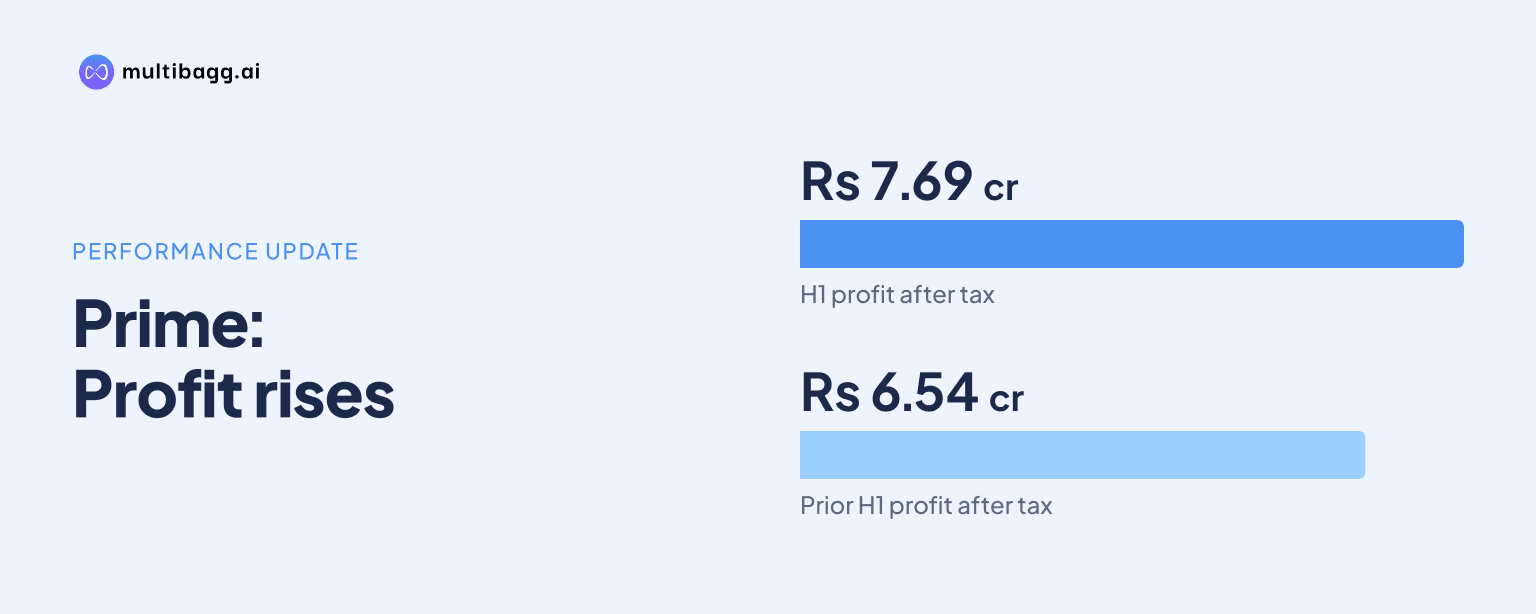
Prime Industries Limited increased consolidated profit after tax to Rs 7.686 crore for the half year ended September 30, 2026, from Rs 6.544 crore a year earlier, despite revenue from operations declining to Rs 33.951 crore from Rs 35.575 crore. Manufacturing segment profit before tax rose to Rs 9.520 crore from Rs 6.203 crore.
Know Prime Industries inside out
Results, valuation, peers and who's buying, in one view.
Why did Prime Industries’ half-year profit rise?
Prime Industries’ profit rose because expenses fell more sharply than revenue during the half year ended September 30, 2026. Profit before tax increased to Rs 10.634 crore from Rs 6.903 crore, while tax expense rose to Rs 2.993 crore from Rs 25.9 lakh, resulting in profit after tax of Rs 7.686 crore.
Revenue from operations declined by Rs 1.624 crore to Rs 33.951 crore, but total expenses fell by Rs 7.009 crore to Rs 24.144 crore from Rs 31.153 crore. Material consumption declined to Rs 21.747 crore from Rs 29.176 crore, while employee costs increased to Rs 32.5 lakh from Rs 28.8 lakh.
Prime Industries reported basic and diluted earnings per share of Rs 2.06 for the six-month period, compared with Rs 0.32 in the prior-year period. The filing states that the per-share figures are not annualised, and its equity share capital was Rs 10.538 crore, with a face value of Rs 5 per share.
Which business segment improved Prime Industries’ earnings?
Prime Industries’ manufacturing segment was the main contributor to the earnings increase, with segment profit before tax rising to Rs 9.520 crore for the half year from Rs 6.203 crore a year earlier. Manufacturing revenue was Rs 33.951 crore, compared with Rs 31.906 crore in the corresponding prior-year half year.
The segment disclosure shows manufacturing provided most of the consolidated Rs 10.634 crore profit before tax in the 2026 half year. The investment or trading in securities and other segment reported profit before tax of Rs 1.114 crore, while the filing does not show segment revenue for that business in the current half-year column.
Prime Industries’ second-quarter performance accounted for much of the half-year manufacturing result. Manufacturing revenue was Rs 24.985 crore in the quarter ended September 30, 2026, compared with Rs 8.965 crore in the June 2026 quarter, while segment profit was Rs 8.579 crore after Rs 84.1 lakh.
What changed in Prime Industries’ balance sheet?
Prime Industries’ total assets increased to Rs 175.562 crore at September 30, 2026, from Rs 171.065 crore at March 31, 2026. Current assets increased to Rs 154.844 crore from Rs 149.798 crore, while reported non-current assets declined to Rs 20.718 crore from Rs 21.267 crore.
Trade receivables rose to Rs 59.790 crore at September 30 from Rs 37.018 crore at March 31. Loans increased to Rs 32.499 crore from Rs 23.158 crore and other financial assets rose to Rs 43.870 crore from Rs 29.737 crore, while inventories declined to Rs 18.542 crore from Rs 19.849 crore.
Prime Industries reported equity attributable to owners of Rs 51.020 crore, compared with Rs 46.582 crore at March 31. The balance sheet also recorded non-controlling interest equity share capital of Rs 13.236 crore and preference share capital of Rs 24.048 crore, compared with Rs 9.888 crore and Rs 17.169 crore, respectively.
Got a follow-up? Ask IRIS
How did Prime Industries’ borrowings and cash flow move?
Prime Industries reduced current borrowings to Rs 46.071 crore at September 30, 2026, from Rs 73.080 crore at March 31, while non-current borrowings rose to Rs 4.420 crore from Rs 1.741 crore. Trade payables increased to Rs 27.890 crore from Rs 16.273 crore and provisions rose to Rs 5.353 crore from Rs 2.393 crore.
Prime Industries used Rs 14.128 crore in operating activities during the six months ended September 30. The cash-flow statement shows a Rs 22.772 crore increase in trade receivables and a Rs 14.733 crore increase in other financial assets, partly offset by a Rs 7.162 crore increase in trade payables.
Financing activities used Rs 25.348 crore during the half year, including Rs 27.005 crore of current-borrowing repayments and a Rs 9.341 crore increase in loans. Prime Industries received Rs 6.879 crore against share warrants or convertible preference shares and Rs 2.679 crore from non-current borrowings, while cash and cash equivalents fell to Rs 14.4 lakh from opening cash of Rs 40.535 crore.
What did the limited review say about Prime Industries’ results?
Prime Industries received an unmodified limited-review conclusion from Akshay Singhla & Associates, dated November 5, 2026. The auditor said nothing had come to its attention that caused it to believe the consolidated statement had failed to disclose required information or contained a material misstatement.
The review covered the period from April 1, 2026 to September 30, 2026 and was conducted under Indian Accounting Standard 34, or Ind AS 34, Interim Financial Reporting. The auditor stated that a review provides moderate assurance and has a substantially narrower scope than an audit.
Prime Industries’ consolidated results include subsidiary Linga Agri Trading and Machinery Private Limited. The review report states that the subsidiary had total assets of Rs 140.080 crore at September 30, 2026, revenue of Rs 33.951 crore and profit after tax of Rs 6.705 crore for the periods cited in the report.
Conclusion
Prime Industries reported higher half-year profit despite lower consolidated revenue because its expenses declined and manufacturing profit before tax increased by Rs 3.317 crore. The result also coincided with a reduction in current borrowings of Rs 27.009 crore from the March 31 level.
The next disclosed results will show whether the September-quarter manufacturing performance, which generated Rs 24.985 crore of revenue and Rs 8.579 crore of segment profit, can continue. Receivables of Rs 59.790 crore and cash and cash equivalents of Rs 14.4 lakh at September 30 remain relevant balance-sheet measures following the reported operating and financing cash outflows.