










Prime Industries Limited cash flow closes at Rs 14.4 lakh in H1
Key highlights
- Prime Industries’ cash-flow statement reported closing cash of Rs 14.4 lakh at September 30, 2026, after a Rs 40.492 crore net decrease.
- Trade receivables increased by Rs 22.772 crore to Rs 59.790 crore during the half year ended September 30, 2026.
- Net cash used in operating activities was Rs 14.128 crore and net cash used in financing activities was Rs 25.348 crore.
- Prime Industries’ balance sheet reported Rs 74.4 lakh of cash at September 30, 2026, Rs 60 lakh above the cash-flow statement figure.
powered by IRIS
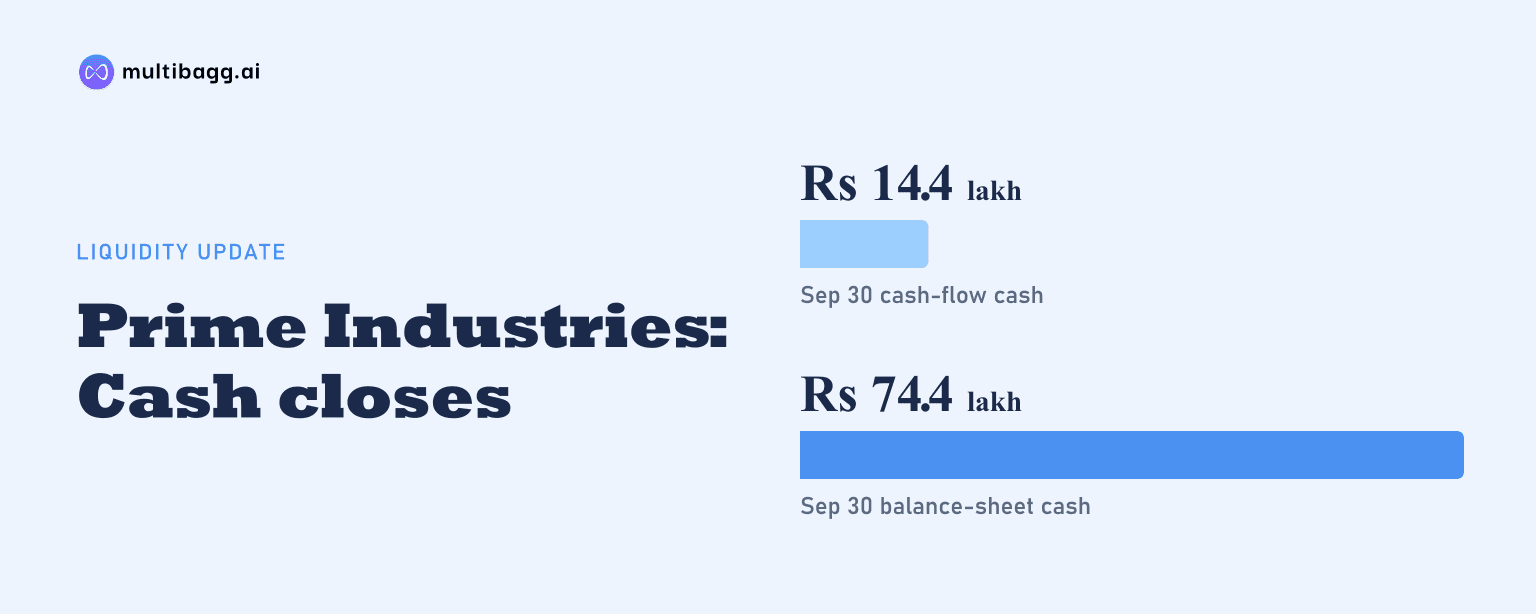
Prime Industries Limited reported closing consolidated cash and cash equivalents of Rs 14.4 lakh in the cash-flow statement for the half year ended September 30, 2026, after a reported net cash decrease of Rs 40.492 crore from opening cash of Rs 40.535 crore. Operating and financing activities used Rs 14.128 crore and Rs 25.348 crore, respectively.
Know Prime Industries inside out
Results, valuation, peers and who's buying, in one view.
Why did Prime Industries’ cash flow close at Rs 14.4 lakh?
Prime Industries’ cash-flow statement attributes the reduction chiefly to outflows from operating and financing activities during the half year ended September 30, 2026. Net cash used in operating activities was Rs 14.128 crore, while net cash used in financing activities was Rs 25.348 crore, compared with opening cash and cash equivalents of Rs 40.535 crore.
The statement reports cash generated from operations before working-capital changes of Rs 10.912 crore, against profit before tax of Rs 10.634 crore. Depreciation and amortisation of Rs 37.7 lakh and finance cost of Rs 92.8 lakh were among the adjustments, while interest income of Rs 1.026 crore reduced the pre-working-capital cash calculation.
Prime Industries recorded a net decrease in cash and cash equivalents of Rs 40.492 crore for the period ended September 30, 2026. Closing cash comprised Rs 2.6 lakh held as cash on hand and Rs 11.8 lakh in current bank accounts; the cash-flow statement did not show a balance for fixed deposits with an original maturity of less than three months.
How did receivables and financial assets affect Prime Industries’ cash?
Prime Industries used Rs 22.772 crore of cash through an increase in trade receivables in the half-year cash-flow statement. Trade receivables on the consolidated balance sheet rose to Rs 59.790 crore at September 30, 2026, from Rs 37.018 crore at March 31, 2026, which is the same Rs 22.772 crore movement.
Other financial assets represented another reported use of cash. The cash-flow statement recorded a Rs 14.733 crore increase in other financial assets, while the balance sheet’s current other financial assets increased to Rs 43.870 crore from Rs 29.737 crore, a Rs 14.133 crore change. The filing presents these figures in separate statements and does not provide a line-by-line reconciliation between them.
The following movements show the principal operating cash effects disclosed for the half year. Amounts are presented in crore, except where stated otherwise.
Prime Industries’ inventories fell to Rs 18.542 crore at September 30, 2026 from Rs 19.849 crore at March 31, 2026. The cash-flow statement records the inventory movement as a Rs 1.307 crore cash release. Trade payables increased to Rs 27.890 crore from Rs 16.273 crore, contributing Rs 11.617 crore of cash, but these inflows did not offset the receivable and financial-asset outflows.
What happened to Prime Industries’ loans and borrowings?
Prime Industries’ current borrowings declined to Rs 46.071 crore at September 30, 2026 from Rs 73.080 crore at March 31, 2026. Its cash-flow statement records repayments of current borrowings of Rs 27.005 crore, which were a significant financing use during the half year.
The group received Rs 2.679 crore from non-current borrowings and Rs 34.5 lakh from non-current financial liabilities. It also received Rs 6.879 crore against share warrants or convertible preference shares. These inflows were lower than the current-borrowing repayment, the Rs 9.341 crore increase in current and non-current loans, and other financing movements recorded in the statement.
Loans shown within current financial assets increased to Rs 32.499 crore at September 30, 2026 from Rs 23.158 crore at March 31, 2026. The cash-flow statement reports Rs 9.341 crore used through the increase in current and non-current loans, indicating that the balance-sheet change was also a financing cash use.
Non-current borrowings increased to Rs 4.420 crore from Rs 1.741 crore over the same period. Total current liabilities declined to Rs 82.476 crore from Rs 95.568 crore, despite higher trade payables and provisions of Rs 5.353 crore, compared with Rs 2.393 crore at March 31, 2026.
Got a follow-up? Ask IRIS
How did Prime Industries’ balance sheet change by September 2026?
Prime Industries’ consolidated total assets rose to Rs 175.562 crore at September 30, 2026 from Rs 171.065 crore at March 31, 2026. Current assets increased to Rs 154.844 crore from Rs 149.798 crore, led by higher receivables, loans and other financial assets despite the reported fall in cash.
Total equity and liabilities increased to Rs 175.562 crore from Rs 171.065 crore, matching total assets in each period. Equity attributable to owners rose to Rs 51.020 crore from Rs 46.582 crore, while the balance sheet listed non-controlling equity share capital of Rs 13.236 crore and preference share capital of Rs 24.048 crore at September 30, 2026.
Property, plant and equipment decreased to Rs 2.445 crore from Rs 2.805 crore, while deferred tax assets rose to Rs 3.238 crore from Rs 3.193 crore. The cash-flow statement records a Rs 1.6 lakh purchase of property, plant and equipment during the half year, but the supplied cash-flow table does not display a value for total net investing cash flow.
Why do Prime Industries’ cash figures differ within the filing?
Prime Industries’ consolidated balance sheet reports cash and cash equivalents of Rs 74.4 lakh at September 30, 2026, whereas its consolidated cash-flow statement reports closing cash and cash equivalents of Rs 14.4 lakh. The two reported closing figures differ by Rs 60 lakh, and the supplied filing does not explain the difference.
A difference also appears at the start of the period. The balance sheet reports cash and cash equivalents of Rs 40.636 crore at March 31, 2026, while the cash-flow statement reports opening cash of Rs 40.535 crore, a difference of Rs 10.1 lakh. Both statements are labelled as consolidated information in the filing.
The financial results were subject to a limited review by Akshay Singhla & Associates. In its report dated November 5, 2026, the auditor stated that nothing had come to its attention that caused it to believe the consolidated statement had not made the disclosures required under the applicable listing regulations; the report also states that a review is substantially less extensive than an audit.
Conclusion
Prime Industries’ half-year filing shows a substantial reported reduction in cash, with receivables increasing by Rs 22.772 crore, other financial assets using Rs 14.733 crore and current-borrowing repayments totalling Rs 27.005 crore. Inventory and trade-payable movements generated Rs 1.307 crore and Rs 11.617 crore, respectively, but did not offset the stated operating and financing outflows.
The next disclosure to watch is whether Prime Industries reconciles the Rs 14.4 lakh closing figure in the cash-flow statement with the Rs 74.4 lakh balance-sheet amount at September 30, 2026. The filing also discloses Rs 6.879 crore received against share warrants or convertible preference shares during the half year, but provides no future cash target, liquidity plan or scheduled financing event.