










Prism Johnson Limited halves effective net debt to ₹467 crore
Key highlights
- Prism Johnson’s effective net debt fell by ₹421 crore to ₹467 crore between March and September 2026.
- Prism Johnson completed the sale of its 51% RQBE stake for ₹325.87 crore on 1 July 2026.
- H1 FY27 EBITDA increased 15.1% year on year to ₹415 crore on revenue of ₹3,718 crore.
- Prism Johnson’s cash conversion cycle increased to 26 days in H1 FY27 from 22 days in FY26.
powered by IRIS
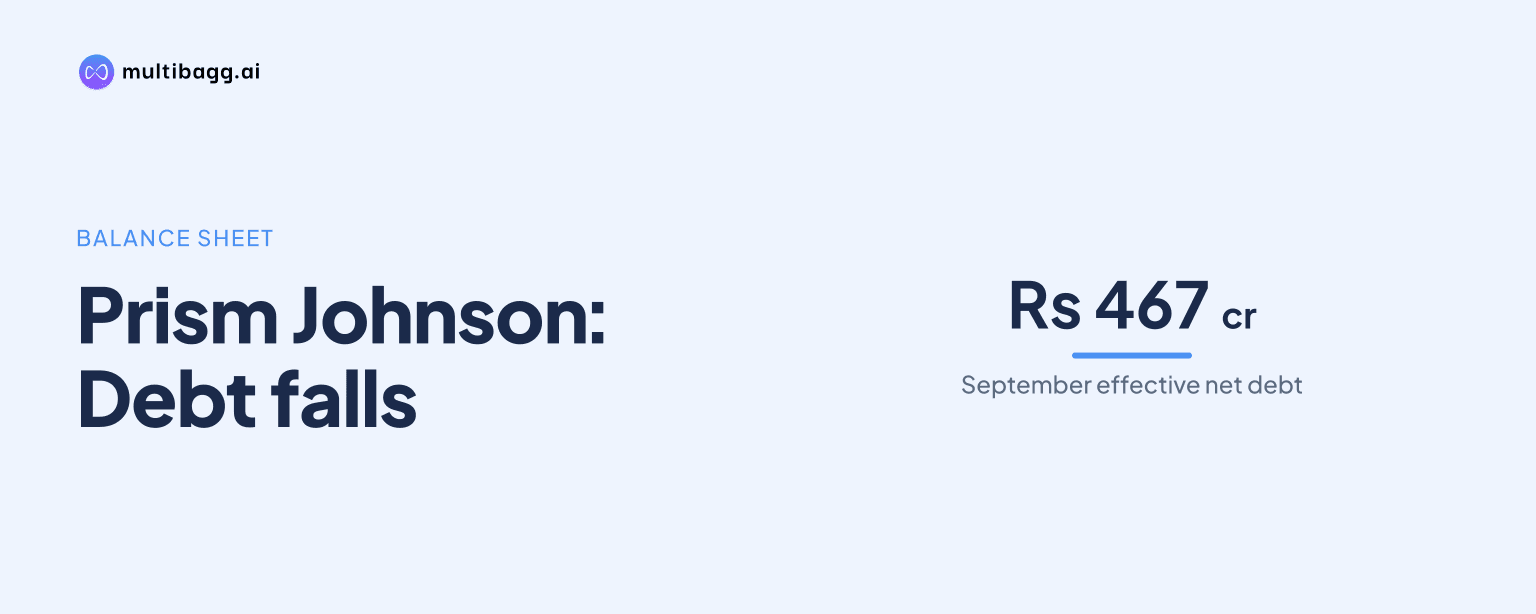
Prism Johnson Limited halved effective net debt to ₹467 crore at September 2026 from ₹888 crore at March 2026, supported by ₹325.87 crore from the RQBE stake sale and operating cash accruals. The reduction included lower long-term debt, financial obligations and letters of credit and cash-against-documents bills, although the cash conversion cycle rose to 26 days in H1 FY27.
Know Prism Johnson inside out
Results, valuation, peers and who's buying, in one view.
How did Prism Johnson halve effective net debt?
Prism Johnson reduced effective net debt by ₹421 crore over the six months to September 2026 through non-core asset monetisation and operating cash accruals. Its effective net debt measure combines reported net debt with financial obligations, letters of credit, or LC, and cash-against-documents, or CAD, bills.
The company completed the sale of its entire 51% stake in RQBE on 1 July 2026 for ₹325.87 crore. Prism Johnson recognised a gain of ₹161.56 crore in Q2 FY27 under discontinued operations, rather than in the profit and loss account for continuing operations.
Long-term debt decreased by ₹470 crore, to ₹533 crore at September 2026 from ₹1,003 crore at March 2026. Short-term debt increased by ₹14 crore to ₹124 crore, while cash, fixed deposits and bank balances declined by ₹222 crore to ₹326 crore, leaving reported net debt at ₹331 crore versus ₹565 crore six months earlier.
What changed in Prism Johnson’s funding obligations?
Prism Johnson’s financial obligations declined by ₹40 crore to ₹41 crore, while LC and CAD bills fell by ₹147 crore to ₹95 crore between March and September 2026. Together, these two items accounted for ₹187 crore of the ₹421 crore reduction in effective net debt.
Financial obligations primarily comprise trade payables and vendor-financing facilities used for working-capital requirements. Prism Johnson says LC and CAD bills are drawn from management information system records and may differ from reported balance-sheet values because interest is calculated until each instrument’s expiry without pro-rata accrued interest at the balance-sheet date.
The presentation says the effective net debt definition was revised to include LC and CAD bills alongside financial obligations. On that basis, the metric declined from ₹1,751 crore in March 2023 to ₹1,490 crore in March 2024, ₹1,202 crore in March 2025, ₹888 crore in March 2026 and ₹467 crore in September 2026.
Reported net debt, excluding the two additional obligation categories, was ₹331 crore at September 2026. Net debt to trailing-12-month earnings before interest, tax, depreciation and amortisation, or EBITDA, declined to 0.4 from 0.8 at March 2026, while net debt to net worth moved to 0.2 from 0.3.
Got a follow-up? Ask IRIS
Did operating performance support Prism Johnson’s deleveraging?
Prism Johnson reported H1 FY27 EBITDA of ₹415 crore, up 15.1% year on year, on revenue of ₹3,718 crore, up 5.4%. The EBITDA margin was 11.2% in H1 FY27, compared with 9.4% for FY26, although the presentation does not state an H1 FY26 margin.
The segment bridge shows H & R Johnson, or HRJ, adding ₹66 crore to H1 EBITDA, while Prism RMC added ₹23 crore. Prism Cement reduced H1 EBITDA by ₹35 crore, even as H1 revenue contributions were positive across the three businesses: ₹111 crore from Prism RMC, ₹79 crore from HRJ and ₹1 crore from Prism Cement.
In Q2 FY27, revenue rose 8.3% year on year to ₹1,874 crore and EBITDA increased 4.3% to ₹194.3 crore. HRJ added ₹37 crore to quarterly EBITDA, offsetting a ₹26 crore decline at Prism Cement and a ₹2 crore decline at Prism RMC; the consolidated EBITDA margin was 10.4%, compared with 10.8% in Q2 FY26.
Profit before tax before exceptional items increased to ₹57.3 crore in Q2 FY27 from ₹14.8 crore in Q2 FY26. Prism Johnson attributed the increase partly to lower finance costs and depreciation, with lower depreciation linked to assets substantially depreciated in earlier periods, assets at residual value and limited incremental capital expenditure.
What does working capital say about Prism Johnson’s cash conversion?
Prism Johnson’s cash conversion cycle increased to 26 days in H1 FY27 from 22 days in FY26. Inventory days increased to 39 from 34, while debtor days improved to 36 from 38 and creditor days fell to 49 from 50.
The company reported operating free cash flow before capital expenditure and investments of ₹0 in H1 FY27. It separately said free cash flow before capex and investments was ₹26 crore after excluding a ₹26 crore cash outflow towards financial obligations, showing that settlements of those obligations affected the reported half-year measure.
Capital employed increased to ₹2,337 crore in H1 FY27 from ₹2,110 crore in FY26. Return on capital employed, or ROCE, increased to 17.9% from 9.4%; the company annualises ROCE and includes other income in earnings before interest and tax for this calculation.
Conclusion
Prism Johnson’s September 2026 position combines a ₹421 crore reduction in effective net debt with a completed ₹325.87 crore RQBE divestment and higher H1 EBITDA. The balance-sheet movement was not limited to the asset sale: long-term debt, financial obligations and LC and CAD bills all declined, while reported net debt fell to ₹331 crore.
The next issue to watch is cash conversion, as the cycle increased by four days to 26 in H1 FY27 despite lower debtor days. Prism Johnson has said the RQBE exit sharpens its focus on core building materials, while ₹41 crore of financial obligations and ₹95 crore of LC and CAD bills remained within effective net debt at September 2026.