










Prizor adds 22 BIS-ER cameras, lifts capacity to 24 lakh units
Key highlights
- Prizor added 22 BIS-ER-certified camera models in H1 FY27, taking its total to 34.
- Prizor commissioned an assembly line that raised annual capacity 50% to 24 lakh units.
- Prizor opened zonal offices in Kolkata and Noida and engaged with more than 450 channel partners in H1 FY27.
- Prizor reported H1 FY27 revenue of Rs 106.501 crore, up 153.5% year on year.
powered by IRIS
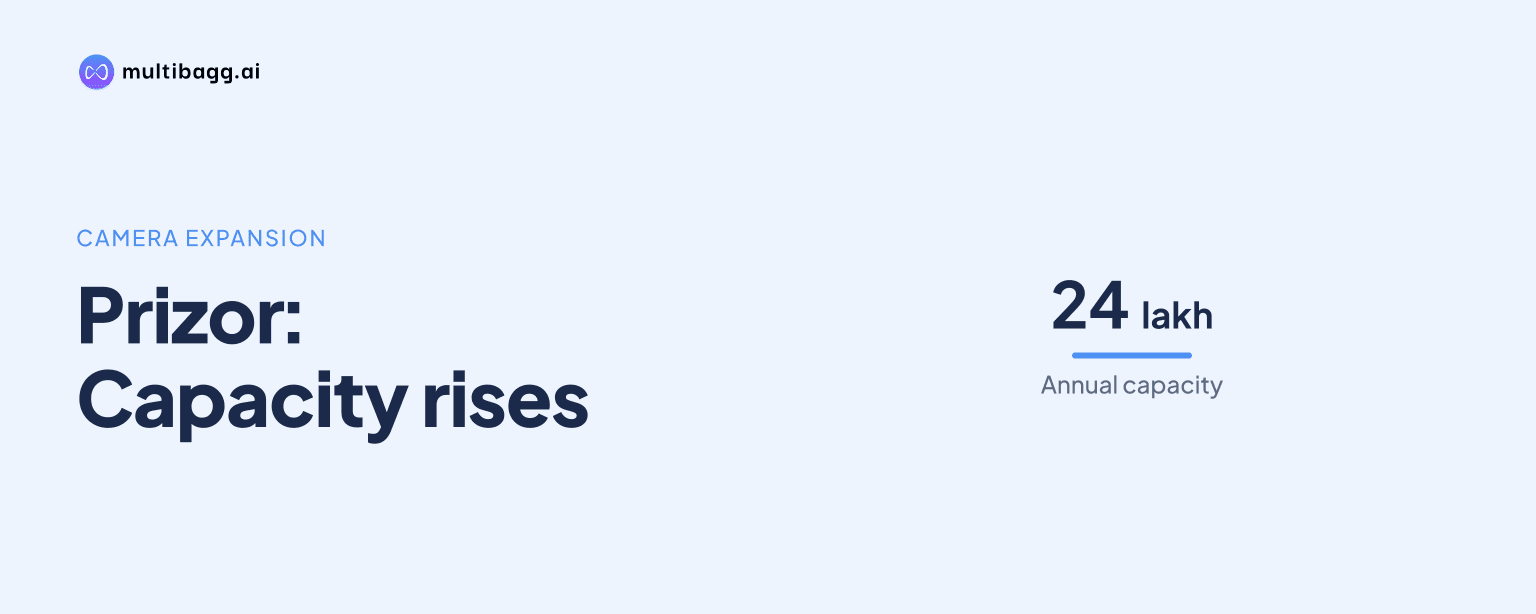
Prizor Viztech added 22 BIS-ER-certified camera models in H1 FY27, taking its certified range to 34, and commissioned an assembly line that increased annual capacity 50% to 24 lakh units. Management said the actions support readiness for demand shaped by Make-in-India requirements and regulatory compliance.
Know Prizor Viztech inside out
Results, valuation, peers and who's buying, in one view.
What changed in Prizor's certified camera portfolio?
Prizor expanded its BIS-ER-certified camera portfolio to 34 models in H1 FY27 after adding 22 models during the period. Based on the stated addition and closing total, the company had 12 certified models before the H1 FY27 expansion.
The added models sit within Prizor's stated product-development strategy. The presentation identifies face detection and energy-efficient designs as research and development priorities, while the PRIZOR PLUS AI series spans 3MP to 12MP and 4K and includes face recognition, automatic number-plate recognition and behaviour analysis.
The certification increase supports Prizor's stated compliance approach. Management said the government's increasing focus on Make-in-India products and regulatory compliance is creating a favourable environment for domestic manufacturers, while the presentation says Standardisation Testing and Quality Certification enforcement barred non-certified foreign brands.
How much assembly capacity has Prizor added?
Prizor's new assembly line increased annual capacity by 50% to 24 lakh units in H1 FY27. The stated percentage and resulting capacity imply annual capacity of 16 lakh units before commissioning, meaning the new line represents an implied addition of 8 lakh units.
The capacity expansion accompanies Prizor's manufacturing work in Gandhinagar. The company says in-house printed circuit board manufacturing is operational as part of backward integration, which the presentation says is expected to improve operational leverage and resilience against supply-chain disruptions. This is the company's stated expectation rather than a reported H1 FY27 financial result.
The line was commissioned during a period of rapid sales growth. Revenue from operations rose 153.5% year on year to Rs 106.501 crore in H1 FY27 from Rs 42.014 crore in H1 FY26, although the presentation does not disclose capacity utilisation, factory output or revenue produced by the new line.
How is Prizor expanding distribution alongside production?
Prizor opened zonal offices in Kolkata and Noida in H1 FY27, which management said strengthened its East and North India presence. It also engaged with more than 450 channel partners through dealer programmes during the period, according to management commentary.
These actions add to a dealer network reported at 13,000 in H1 FY27, compared with 11,000 in FY26, 6,100 in FY25 and 5,200 in FY24. Prizor reports a 45.4% compound annual growth rate for the network and says it currently serves more than 3,200 tehsils.
Prizor describes its dealer model as asset-light and focused on faster pin-code penetration, particularly in Tier 2 and Tier 3 towns. The presentation also reports more than 175 distributors and retailers across 25 states, but does not disclose revenue per dealer, sales from the new zonal offices or a channel-wise revenue split.
Got a follow-up? Ask IRIS
What demand case does Prizor link to compliance?
Prizor links its H1 FY27 certification and capacity measures to demand for compliant surveillance products. Its presentation identifies government mandates and smart-city initiatives as drivers of closed-circuit television, or CCTV, installations in schools, automated teller machines, transport and public spaces.
The company also identifies artificial intelligence, cloud, Internet of Things and mobile integration as surveillance-market drivers. Prizor's stated product plan includes automatic number-plate recognition cameras, face detection and energy-efficient designs, while its presentation notes a memorandum of understanding with IndieSmec for the ISC-S2-PZ system-on-chip.
The source does not provide a timetable, commercial terms or production volume for the IndieSmec arrangement. It also does not disclose model-level pricing, certification dates, customer orders or market-share data for the 34 BIS-ER-certified models.
How did Prizor's H1 FY27 financial performance change?
Prizor reported H1 FY27 revenue of Rs 106.501 crore, up 153.5% from Rs 42.014 crore in H1 FY26. Earnings before interest, tax, depreciation and amortisation, or EBITDA, rose 162.4% to Rs 25.085 crore from Rs 9.559 crore.
EBITDA margin increased 80 basis points to 23.6% in H1 FY27 from 22.8% in H1 FY26. Profit after tax rose 159.4% to Rs 15.339 crore from Rs 5.914 crore, and the profit-after-tax margin increased 30 basis points to 14.4% from 14.1%.
CCTV cameras represented 96% of Prizor's H1 FY27 category-wise performance, while display products represented 4%. The certified camera additions and increased assembly capacity therefore concern the company's principal reported category, although the presentation does not disclose separate category revenue or margins.
Conclusion
Prizor's H1 FY27 actions combine a 22-model increase in its BIS-ER-certified portfolio, a 50% rise in annual assembly capacity to 24 lakh units, and new sales infrastructure in Kolkata and Noida. These steps occurred as revenue grew 153.5% year on year and CCTV cameras accounted for 96% of reported category-wise performance.
The next disclosures to watch are progress on further certifications, product innovation, deeper market penetration and stronger distribution partnerships, all of which management identified as priorities. Capacity utilisation at the 24-lakh-unit facility and any update on the IndieSmec system-on-chip memorandum remain unresolved in the presentation.