










Prizor dealer base more than doubles to 13,000 in H1 FY27
Key highlights
- Prizor reported 13,000 dealers in H1 FY27, compared with 5,200 in FY24.
- Prizor says its distribution network serves more than 3,200 tehsils across 25 states.
- Prizor added 4,900 dealers from FY25 to FY26, its largest reported full-year increase.
- Prizor reported Rs 106.5 crore of revenue in H1 FY27 alongside its 13,000-dealer network.
powered by IRIS
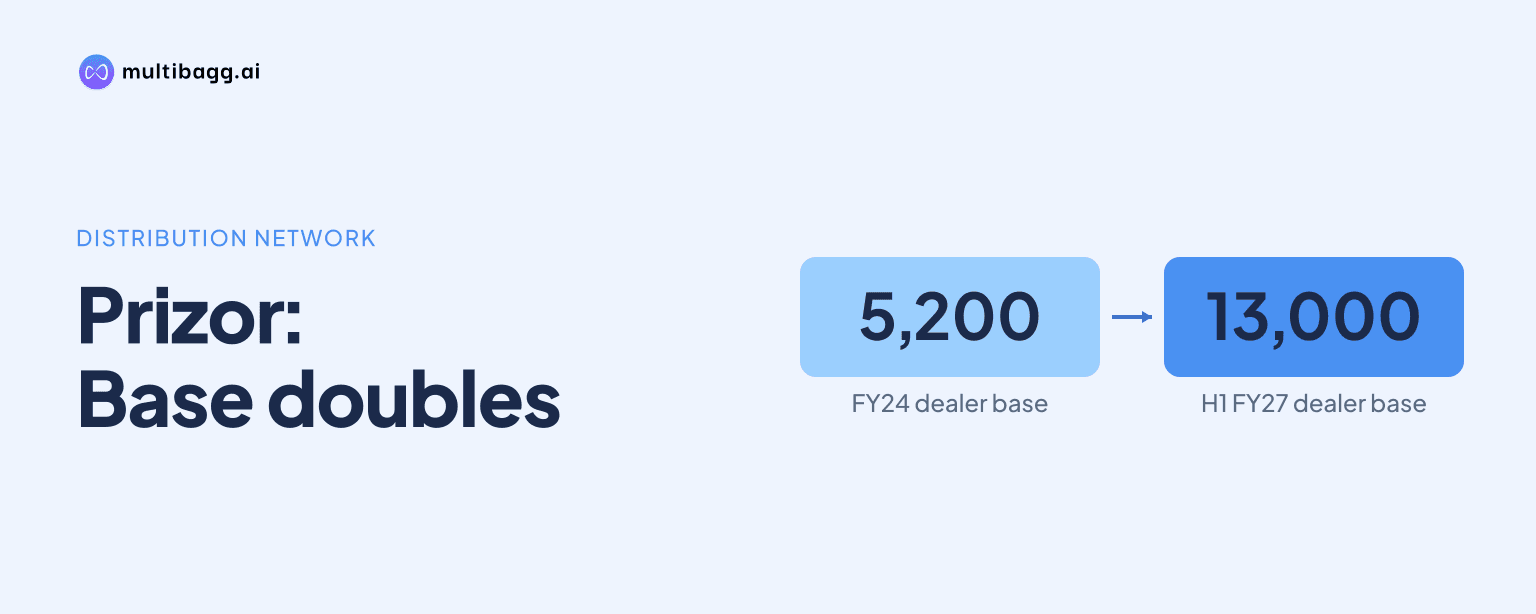
Prizor Viztech Limited reported 13,000 dealers in H1 FY27, compared with 5,200 in FY24, increasing its dealer base by 7,800 and extending its stated distribution reach to more than 3,200 tehsils across 25 states. The network was 2.5 times the FY24 level, making dealer expansion a measurable part of Prizor’s route-to-market strategy.
Know Prizor Viztech inside out
Results, valuation, peers and who's buying, in one view.
How quickly did Prizor's dealer network grow?
Prizor’s dealer network rose from 5,200 in FY24 to 13,000 in H1 FY27, an increase of 150% over the reported period. The presentation gives a 45.4% compound annual growth rate for the network, although its latest data point is H1 FY27 rather than a full financial year.
The pace of additions changed across the reported periods. Prizor added 900 dealers from FY24 to FY25, then 4,900 from FY25 to FY26, before adding another 2,000 in H1 FY27. The FY25-to-FY26 rise was the largest full-year increase shown, lifting the network by about 80% from 6,100 dealers.
The H1 FY27 figure was 18.2% above the 11,000 dealers reported for FY26. Dealer count is a distribution measure rather than a sales measure, but Prizor reported it alongside H1 FY27 revenue of Rs 106.5 crore, providing a view of channel scale at the latest reporting point.
Where does Prizor's network reach?
Prizor says its products are distributed across 25 states and serve more than 3,200 tehsils. The presentation specifically identifies Maharashtra, Gujarat, Tamil Nadu, Delhi, Andaman & Nicobar Islands, and Jammu & Kashmir as areas of presence, linking the 13,000-dealer network to geographic coverage.
Prizor’s India map also depicts presence in Punjab, Haryana, Rajasthan, Madhya Pradesh, Uttar Pradesh, Telangana, Karnataka, Kerala, Andhra Pradesh, Odisha, Assam and West Bengal. It distinguishes branch offices, display centres, manufacturing facilities and state presence, but does not disclose a state-wise dealer count or dealer density by tehsil.
Prizor identifies Tier 2 and Tier 3 towns as the next expansion frontier. The presentation does not quantify dealers in those towns, newly covered tehsils in FY26, or the number of locations added in H1 FY27; it therefore establishes overall coverage of more than 3,200 tehsils, not the contribution of individual regions.
Got a follow-up? Ask IRIS
How does Prizor's dealer model support last-mile reach?
Prizor says its dealer model enables asset-light and fast pin-code penetration. Its stated mechanism is that each new pin code adds a last-mile installer and recurring camera demand, connecting channel expansion with neighbourhood-level access to security and surveillance products.
The presentation separates retailers and installers from distribution. It describes retailers and installers as the last mile between a Prizor camera and a protected space, while distribution extends product availability across geographies. The 13,000 dealers reported in H1 FY27 and more than 3,200 tehsils served are the company’s disclosed measures of those two dimensions.
Prizor reported four branches and 238 employees in H1 FY27. The dealer count is therefore substantially larger than its direct branch structure, in line with the company’s asset-light description, although the presentation provides no data on sales per dealer, dealer retention, channel margins or the cost of opening a new pin code.
What does Prizor plan alongside dealer expansion?
Prizor pairs distribution expansion with plans to set up new display centres, strengthen customer relationships through new products, trade exhibitions and dealer meets, and develop automatic number-plate recognition cameras, face-detection products and energy-efficient designs. The presentation does not give a timetable or numerical target for display-centre additions or dealer meetings.
The company’s portfolio includes Internet Protocol cameras, analog cameras and artificial intelligence-enabled advanced cameras, as well as 4G standalone cameras, HD Colorview audio cameras, network video recorders and digital video recorders. Prizor also says it expanded in 2022 into light-emitting diode televisions, monitors and touch-panel displays marketed under the Prizor brand and made through third-party partners.
Prizor says it became Bureau of Indian Standards electronic-registration certified in 2026 through Software Technology Parks of India Quality Certification-accredited laboratories. It is also building an artificial intelligence-enabled advanced-camera range and says its memorandum of understanding with IndieSemic is intended to secure system-on-chip supply as part of its backward-integration plan.
Conclusion
Prizor’s dealer base rose by 7,800 from FY24 to H1 FY27, while its stated coverage reached more than 3,200 tehsils in 25 states. The increase from 6,100 dealers in FY25 to 11,000 in FY26 was the largest full-year step disclosed, followed by a further increase to 13,000 in H1 FY27.
The next disclosures to watch are progress in Tier 2 and Tier 3 towns, planned display centres, dealer meets and the artificial intelligence-enabled camera range. Prizor has not set a FY27 dealer target or disclosed sales per dealer, while the IndieSemic memorandum of understanding remains a stated plan to support system-on-chip supply and backward integration.