










PRO FX Tech Limited targets Rs 50-60 crore commercial audio
Key highlights
- PRO FX said commercial audio could generate Rs 50-60 crore of business within two to three years.
- Management said large commercial projects typically take one to two years from specification to equipment demand.
- PRO FX said headcount rose about 14% to 15% in five to six months to more than 150 people.
- Management said some residential projects took about 30% to 35% longer to complete than expected.
powered by IRIS
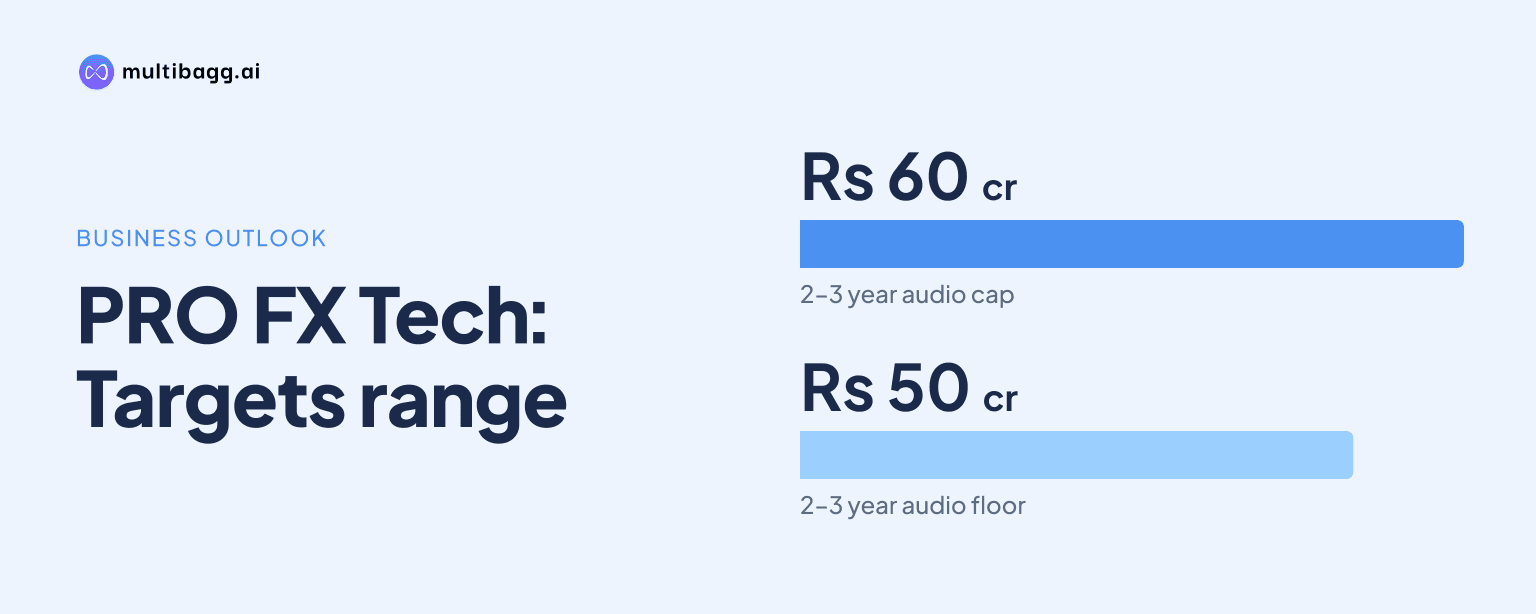
PRO FX Tech Limited said its commercial-audio business could generate Rs 50-60 crore within two to three years, supported by products being specified for large projects before installation demand arises. Management said deployments have begun, but auditoriums, stadiums, airports and other project-led installations typically convert over one to two years.
Know Pro FX Tech inside out
Results, valuation, peers and who's buying, in one view.
How large could PRO FX's commercial-audio business become?
PRO FX said commercial audio could “easily” become a Rs 50-60 crore business in two to three years. Management said the corporate and commercial-audio market is large and fragmented, and identified PV and Crest products as part of its opportunity in the segment.
The Rs 50-60 crore figure is a management ambition rather than reported guidance based on a disclosed order book. PRO FX did not provide current commercial-audio revenue, request-for-quotation value, pipeline value or a product-wise sales target for PV and Crest during the call.
Management also differentiated the emerging commercial operation from its established residential audio-visual business. PRO FX said residential audio will continue to contribute substantially during the initial commercial-audio build-out, and said its plan does not depend on commercial audio accounting for 30% or 40% of turnover in the early phase.
Why will PRO FX's commercial-audio sales take time to scale?
PRO FX said commercial-audio equipment needs to be specified into a project before it is purchased and installed. This process applies to projects such as auditoriums, stadiums, amusement centres, railway stations and airports, where a selected product can become the default equipment choice when construction reaches completion.
Management described these large projects as having a one-to-two-year cycle. Its current work involves discussions with project management consultants and audio-visual consultants, securing product recommendations and supporting early deployments, while equipment demand should rise nearer to a project’s completion stage.
The timing differs from an immediate-order model because product specification and revenue recognition are separated by construction progress. PRO FX said some project deployments have started, but also said the commercial operation remains in its early days compared with residential audio-visual, which it built over a longer period after learning the business in its first one or two years.
Management cited longer completion times in the wider residential-project market as another timing consideration. It said certain projects expected to finish at the start of a calendar year remained unfinished near year-end, taking about 30% to 35% longer as customers expanded project scale and added design, lighting and other requirements.
Got a follow-up? Ask IRIS
How is PRO FX seeking commercial-audio project orders?
PRO FX is seeking project orders through consultant specifications, trained sales teams, service infrastructure and technical support for integrators and end customers. Management said product movement has begun and that teams can guide customers through product selection, training and implementation for professional-audio installations.
After-sales service is a central part of the approach. Management said multiple professional-audio competitors do not have pan-India service coverage, whereas PRO FX has built service infrastructure for the segment; it did not disclose service-centre numbers, service revenue or conversion rates from specifications to orders.
PRO FX has chosen not to pursue the rental industry, despite management saying rental can scale quickly. Management said use in short-term events such as weddings may affect how equipment and brands are presented, so the company is concentrating instead on permanent, project-led commercial installations.
The commercial initiative sits alongside a wider channel-expansion plan. Management said distribution accounted for 67% of business and outlined a long-term aim of moving business-to-business and business-to-consumer activity towards a 50-50 balance; Chennai and Mumbai experience centres were under development for operationalisation in the current quarter discussed on the call.
What could affect PRO FX's Rs 50-60 crore target?
Project-completion timing is the main disclosed variable because commercial-audio products are specified before installation demand materialises. PRO FX said scale-up work is under way, but its near-term business plan is not solely reliant on the segment, leaving residential audio as a continuing contributor while commercial projects mature.
Staffing and operating investment are also occurring before the full revenue ramp. Management said headcount increased by about 14% to 15% over the prior five to six months to more than 150 people, while manpower cost rose by almost 21%, reflecting additions for experience centres, manufacturing and employee training.
Local speaker assembly is a separate initiative that could affect economics but was not presented as the basis for the commercial-audio target. PRO FX planned pilot production in January for select partner-brand models and said more noticeable financial effects should emerge in the following financial year.
Management estimated that finished-speaker import duty is about 22%, compared with about 11% for components, and said local assembly could create a 5% to 6% benefit after manufacturing costs. The company named KEF as its initial disclosed manufacturing partner, while saying partner brands require 100% testing in the initial phase rather than random testing.
Conclusion
PRO FX's Rs 50-60 crore commercial-audio ambition depends on converting specifications into equipment deployments across long-cycle commercial projects. The segment has progressed to product movement, consultant engagement and some deployments, but management did not disclose current segment revenue, a quantified order pipeline or a timetable for individual project conversions.
The next indicators are whether specified projects move to installation during the stated one-to-two-year cycle and whether PRO FX provides revenue or pipeline figures in a later call. Management's January pilot speaker production, planned operationalisation of Chennai and Mumbai experience centres in the current quarter, and the two-to-three-year commercial-audio target are the disclosed milestones to watch next.