










Puravankara targets at least Rs 15,000 crore GDV additions
Key highlights
- Puravankara targets at least Rs 15,000 crore of GDV acquisitions and said it had completed around Rs 14,000 crore this year.
- Management estimates Mumbai redevelopment costs around 40% of comparable land value, implying about 60% lower initial capital outlay.
- Puravankara generally seeks gross profit above 25% on new deals, with around 20% considered for lower-capital-risk joint developments.
- Puravankara reduced net debt by Rs 470 crore during the quarter, including Rs 250 crore linked to Purva Zentech.
powered by IRIS
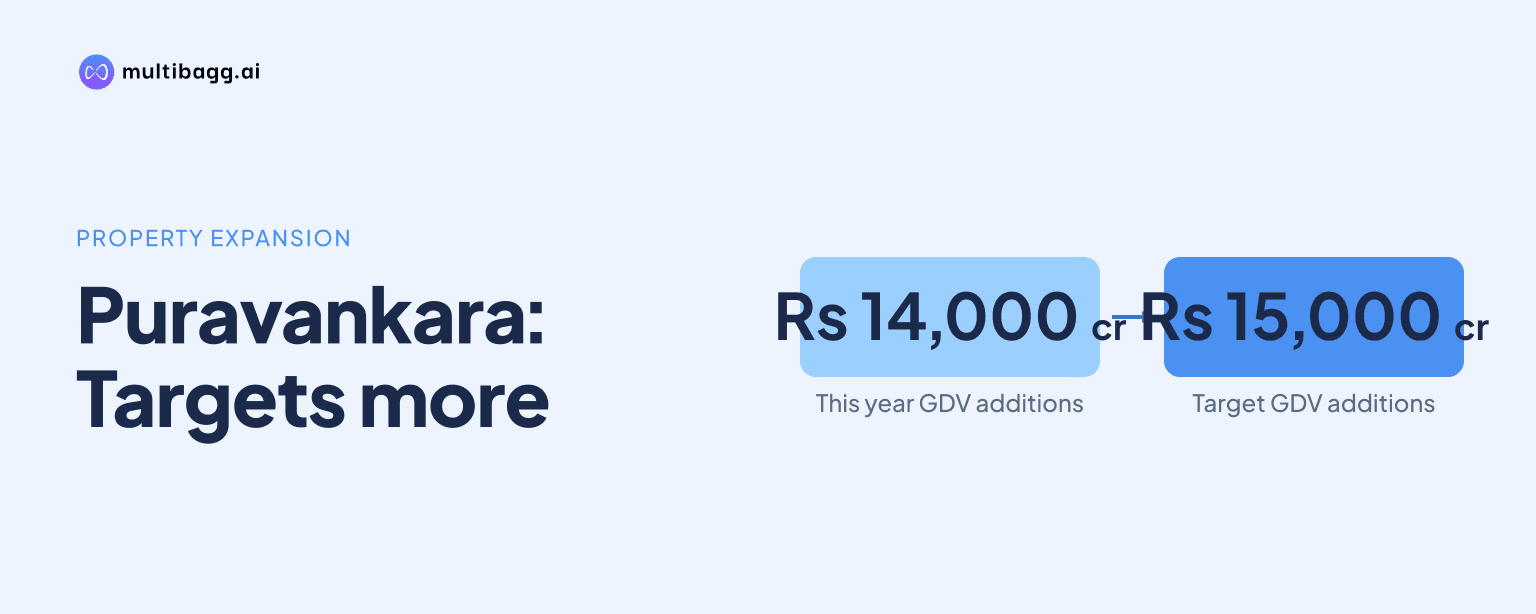
Puravankara is targeting at least Rs 15,000 crore of gross development value, or GDV, additions, after completing around Rs 14,000 crore of acquisitions this year, management said. The company also estimates that Mumbai redevelopment can reduce initial capital outlay by about 60% compared with buying land, even after tenant, member and corpus costs.
Know Puravankara inside out
Results, valuation, peers and who's buying, in one view.
What is Puravankara's GDV addition target?
Puravankara's target is at least Rs 15,000 crore of GDV acquisitions, intended to replace development potential sold and add further growth. Management linked the target to its Rs 11,200 crore sales guidance, which includes Rs 650 crore of commercial sales. It said Puravankara had already reached the Rs 15,000 crore acquisition objective “almost” after around Rs 14,000 crore of additions during the year.
GDV represents the potential value of development from a project rather than the immediate cost of acquiring a site. Puravankara said the aim is to replenish what it sells and add more development potential beyond that replacement requirement. Management did not provide a fixed allocation of the Rs 15,000 crore objective among outright purchases, joint development agreements and redevelopment mandates.
The additions disclosed in South India show the individual projects contributing to the larger acquisition programme. Mandur accounted for Rs 2,300 crore of GDV, Sanna Ammanikere for Rs 800 crore and a Southeast Bengaluru project for Rs 1,100 crore. Management also identified Doddagubbi and Sarjapur as projects exceeding Rs 1,000 crore of GDV each.
How will Puravankara choose between land purchases and joint developments?
Puravankara will select outright purchases or joint development agreements case by case, based on project margins, cost of funding, geography and landowner preference. Management said it would buy land where the purchase economics are better than the cost of money and where expected price appreciation supports ownership through a project cycle that can last four or five years.
Joint development agreements can produce larger GDV with less capital investment, according to management. Puravankara said it generally does not pursue new deals with gross profit below 25%, although it may accept around 20% in a joint development agreement where it does not bear the capital risk. These are management's underwriting parameters, not realised margins for all projects.
The transaction approach differs by market. In Noida, Puravankara bought land directly from the Greater Noida authority in the DMIC area, which management described as the normal structure for that market. The company was submitting design approvals and expected the project to launch by the end of quarter 4 or early quarter 1, within six to eight months, subject to approvals.
In Mumbai, Puravankara said redevelopment offers the primary opportunity rather than conventional greenfield acquisition. It had won mandates in the preceding month for two Goregaon West, Bangur Nagar societies under a 33(9) cluster scheme. Management estimated that development-agreement closure and approval submissions could support a launch in around eight to 10 months.
Got a follow-up? Ask IRIS
How much capital can Puravankara save through Mumbai redevelopment?
Puravankara estimates that redevelopment reduces initial capital outlay by approximately 60% against buying land for a comparable development. Management said that redevelopment costs, including payments to tenants and members and corpus amounts, are around 40% of the overall land value under a land-purchase route.
The 60% estimate does not exclude rehabilitation obligations. Management's 40% redevelopment-cost estimate specifically includes tenant, member and corpus payments, which an analyst asked about alongside statutory premiums. The stated saving is the difference between that 40% cost and the 100% land-value benchmark, rather than a claim that redevelopment requires no initial expenditure.
Management said this capital structure supports Puravankara's Mumbai strategy because redevelopment is where opportunities are available. It said greenfield development in Mumbai City offered hardly any good opportunities and was not directly comparable. In the wider Mumbai Metropolitan Region, management said greenfield projects can generate margins in the same 22% to 30% range cited for redevelopment.
Approval and agreement processes remain important to the redevelopment timeline. Puravankara expected the Goregaon cluster projects to take around eight to 10 months to launch. For Pali Hill, management said all requisite approvals had been received and expected Real Estate Regulatory Authority, or RERA, approval by November 20 or slightly earlier.
What return thresholds does Puravankara use for new development?
Puravankara generally seeks gross profit above 25% for new projects, while a lower threshold of around 20% can apply to joint development agreements with less capital risk. Management described these figures as the criteria used when underwriting projects, rather than as a reported company-wide gross-profit outcome.
For Mumbai redevelopment, management indicated a typical gross development margin of 22% to 30%. It said South Mumbai projects can produce margins around 30%, while suburban projects are generally in a 22% to 25% range. The difference reflects location and transaction terms, rather than a single redevelopment margin applicable to every project.
Puravankara is pursuing the acquisition programme while managing borrowings. Management said net debt fell by Rs 470 crore during the quarter, including Rs 250 crore of debt repaid against the Purva Zentech asset. Remaining proceeds were deployed toward working capital, acquisition costs and other debt repayments, and management said business development during the quarter and half year did not increase debt.
Conclusion
Puravankara's strategy combines a minimum Rs 15,000 crore GDV replenishment objective with a flexible mix of direct purchases, joint development agreements and redevelopment mandates. Direct land purchases are intended for locations where ownership economics justify the capital, while joint development and Mumbai redevelopment can expand GDV with lower upfront funding. The estimated 60% reduction in redevelopment's initial capital outlay is management's clearest economic rationale for the Mumbai push.
The next developments to watch are approval-led launches and the conversion of acquired GDV into active projects. Management expected the Noida launch by the end of quarter 4 or early quarter 1, subject to approvals, and estimated an eight-to-10-month launch path for the two Goregaon societies. It also said the Rs 11,200 crore sales guidance remained intact, although some South projects or Cuffe Parade could move into the next financial year.