










Radico Karnataka premium volumes more than double after duty cuts
Key highlights
- Radico said Karnataka premium volumes grew by more than 100% in Q2 FY27 after duty reductions and freer pricing.
- Karnataka accounted for 6% of Radico’s sales mix in Q2 FY27.
- Radico’s P&A volume growth was 36% in Q2 FY27, including about 49% growth in vodka.
- Radico retained FY27 EBITDA-margin guidance of 20% after a Rs 27 crore Q2 FY27 input-cost impact.
powered by IRIS
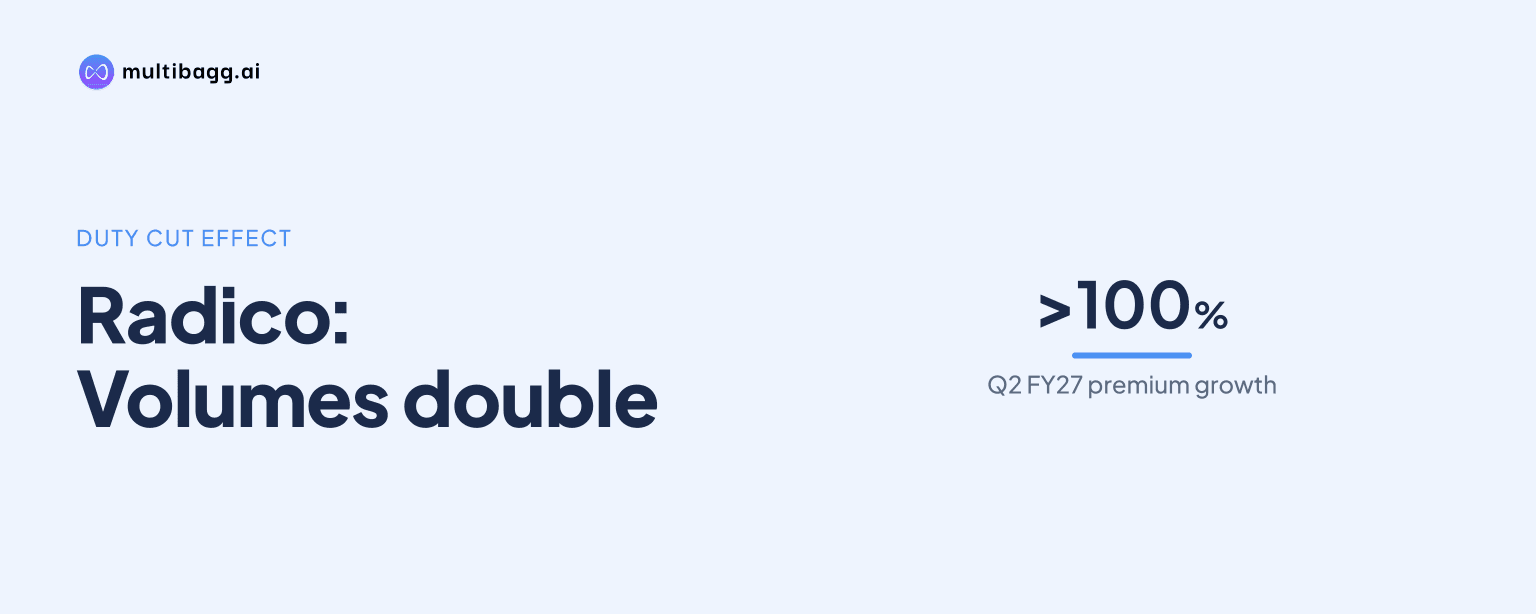
Radico said Karnataka premium volumes grew by more than 100% in Q2 FY27 after duty reductions and freer pricing, contributing to 36% companywide Prestige & Above, or P&A, volume growth. Karnataka represented only 6% of Radico’s sales mix, indicating that growth in vodka and other states also supported the quarterly result.
Know Radico Khaitan inside out
Results, valuation, peers and who's buying, in one view.
How did Karnataka policy changes lift Radico volumes?
Karnataka led Radico’s premium-volume growth in Q2 FY27 after duty reductions and freer pricing, with premium volumes rising by more than 100%, according to management. Radico did not disclose the exact reduction in duties, the volume base, or the number of premium cases sold in the state.
Management identified lower duties and pricing flexibility as the changes that improved the setting for premium spirits in Karnataka. The state was one contributor to Radico’s 36% P&A volume growth in the current quarter, although management also said it was receiving growth from across its markets. The disclosure does not establish that Karnataka policy changes alone caused the companywide P&A increase.
Karnataka’s growth came while Radico managed higher input costs in Q2 FY27. Grain and packaging costs had a negative impact of Rs 27 crore in the quarter, equal to roughly 155 to 160 basis points of gross-margin pressure. A basis point equals one-hundredth of a percentage point.
How much did Karnataka contribute to Radico’s overall growth?
Karnataka was an important driver of premium growth but accounted for only 6% of Radico’s sales mix in Q2 FY27. Saket Somani said other states were growing faster and contributing more meaningfully to Radico’s total result despite Karnataka’s more than 100% premium-volume increase.
That distinction limits what can be inferred from the state’s percentage growth. A small base can deliver a high growth rate without determining consolidated volumes, while Radico’s 36% P&A increase required contribution from markets beyond Karnataka. Radico did not disclose Karnataka’s revenue, cases sold, or share of its P&A portfolio, so the exact impact cannot be calculated from the call.
The comparison shows Karnataka’s premium-volume increase was above Radico’s overall P&A growth rate, but its 6% sales-mix share constrained its direct effect on consolidated sales. Radico’s approximately 20% non-vodka P&A growth also exceeded the 5.8% to 6% industry P&A growth cited by management, although the call provided no state-level industry comparison.
Got a follow-up? Ask IRIS
What other categories and states supported Radico’s P&A growth?
Vodka was Radico’s largest disclosed category driver outside Karnataka, growing about 49% in Q2 FY27. Management said vodka’s share of the Indian liquor market rose from 3.7% in 2025 to 4.5% in 2026 and 6.3% in the current quarter, citing demand from younger consumers and women consumers, as well as flavored and more mixable products.
Non-vodka P&A volumes grew about 20% in Q2 FY27, which management compared with industry P&A growth of 5.8% to 6%. That comparison indicates that Radico’s 36% P&A increase was not solely driven by vodka. Management also said Maharashtra returned to P&A growth during the quarter.
In Maharashtra, management said vodka had reached about 10% of the state’s industry and described Radico as the market leader in the category. It linked the state’s faster P&A growth to the shift toward vodka, but did not quantify Maharashtra’s contribution to Radico’s 36% P&A volume increase.
Tamil Nadu was another market identified as improving in September. Management said orders had begun coming on a tertiary basis and Radico’s volumes were up 20%; it also described Morpheus as the largest-selling premium brandy in the state and Tamil Nadu as Radico’s second-largest vodka market. The call did not provide a Tamil Nadu sales-mix figure.
New launches could add to the premium portfolio, though management did not provide sales data for them. It said Virasat Indian Single Malt, priced at about Rs 3,500 to Rs 4,000 a bottle, had received a positive response across states. Management also cited Jamun and Aam Panna, while saying After Dark’s new version had only started rolling out in many states.
What could affect Radico’s growth and margins next?
Radico retained its FY27 earnings before interest, tax, depreciation and amortisation, or EBITDA, margin guidance of 20% despite the Rs 27 crore input-cost impact in Q2 FY27. Management said it had built higher grain stocks to offset increased prices and expected the new crop season starting in November to stabilise the grain-cost environment.
Packaging costs remain uncertain in Radico’s account. Management linked increases in glass bottles, polyethylene terephthalate, or PET, resin, and laminate prices to the West Asia war, describing the situation as volatile. It said premiumisation, a better product mix and cost discipline supported its confidence in delivering the 20% FY27 EBITDA-margin guidance.
Radico also made a working-capital investment in Q2 FY27 to support premium-portfolio growth, new launches and inventories of raw and packaging materials. Management described this as temporary and said it expected working capital to normalise in the second half of FY27. That cash-cycle movement is separate from Karnataka’s policy changes but is relevant as Radico expands premium distribution.
Conclusion
Karnataka’s duty reductions and freer pricing coincided with more than 100% premium-volume growth for Radico in Q2 FY27, making the state a clear policy-linked contributor. Yet Karnataka’s 6% sales-mix share means Radico’s 36% P&A growth also reflected about 49% vodka growth, about 20% non-vodka P&A growth, and improving performance in Maharashtra and Tamil Nadu.
The next issues to watch are whether Karnataka sustains growth from its smaller base, whether Tamil Nadu’s September shift to tertiary ordering continues to lift volumes, and whether grain prices stabilise from November as management expects. Radico has retained 20% FY27 EBITDA-margin guidance and expects working capital to normalise in the second half of FY27, while it has not assigned a growth target for FY28 or FY29.