










RAIN says Carbon margins will normalise as inventory fades
Key highlights
- RAIN's Carbon Adjusted EBITDA was Rs 740 crore in third-quarter 2026, down from Rs 810 crore in the second quarter.
- Carbon Adjusted EBITDA was about 38% higher year on year in third-quarter 2026 despite the fading inventory benefit.
- Carbon net revenue rose about 22% year on year to Rs 3,980 crore in third-quarter 2026 despite lower volumes.
- Carbon capacity utilisation averaged 69% in the first nine months of 2026, matching the prior-year period.
powered by IRIS
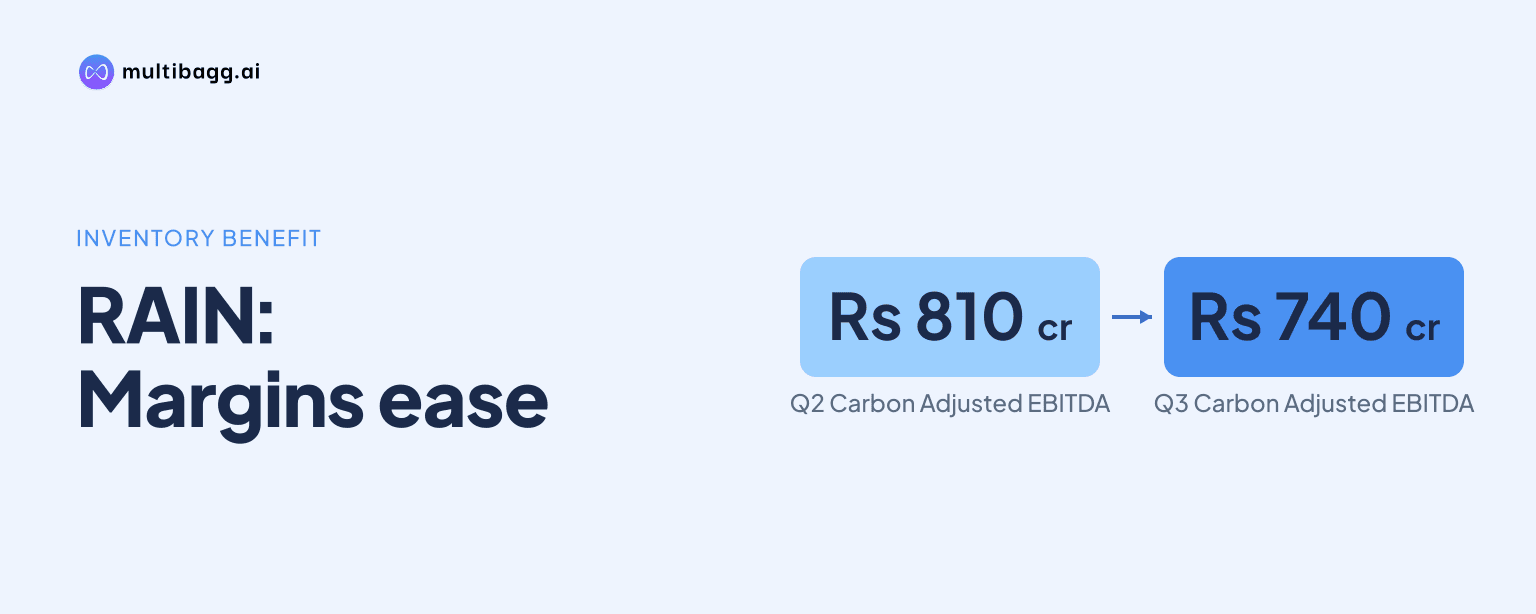
RAIN said Carbon Adjusted EBITDA was Rs 740 crore in the third quarter of 2026, about 38% above a year earlier, but margins will normalise as the benefit from lower-cost second-quarter raw-material inventory fades and higher replacement costs enter production.
Know Rain Industries inside out
Results, valuation, peers and who's buying, in one view.
Why did RAIN's Carbon margin decline in third-quarter 2026?
RAIN's Carbon margin declined sequentially because a temporary inventory-cost benefit unwound during the third quarter of 2026. Raw materials bought at lower costs in the second quarter supported results early in the third quarter, while selling prices adjusted ahead of replacement costs in the rising market. As that timing benefit faded, Carbon Adjusted EBITDA was Rs 740 crore, or about 19% of revenue, versus Rs 810 crore and 22% in the second quarter.
The sequential movement differed within the two Carbon businesses. Calcination margins improved from the second to the third quarter, while distillation margins declined as raw-material and energy costs increased. RAIN said the third-quarter result nevertheless remained about 38% above the corresponding quarter a year earlier, and attributed that year-on-year gain mainly to higher realisations, operating efficiencies and cost control rather than the inventory benefit alone.
How are CPC prices flowing into RAIN's Carbon revenue?
RAIN said quoted calcined petroleum coke, or CPC, prices do not directly match reported Carbon realisation per tonne because the segment combines calcination and distillation products across grades and regions. Its reported measure is a weighted average that can change with product and geographic mix. A significant share of CPC is sold under quarterly or longer-term contracts, meaning changes in market pricing reach customer contracts with a lag.
Carbon net revenue increased about 22% year on year to Rs 3,980 crore in the third quarter of 2026 despite lower sales volumes, which RAIN cited as evidence of meaningfully higher like-for-like CPC realisations over the preceding year. Reported realisations are also denominated in Indian rupees and therefore affected by currency movements. RAIN distinguished this revenue measure from raw-material costs, which affect margins rather than realisations.
Management also said Indian CPC market quotations are not directly comparable with RAIN's global average realisation. RAIN sells several CPC grades from India and North America into many markets, while Indian prices include import duties of 10% on green petroleum coke, or GPC, or 7.5% on CPC. CPC prices had trended upward in recent quarters and were stable in the third quarter, while the CPC-to-GPC spread remained broadly steady from the second quarter and above the level a year earlier.
Can RAIN protect Carbon margins as replacement costs rise?
RAIN expects some Carbon-margin moderation in the fourth quarter of 2026 as higher-cost raw materials flow through its operations. Management said it is aligning selling prices with replacement costs to limit that effect. It also said firm smelter demand and tight supply of anode-grade GPC should help higher realisations support margins after the early-cycle inventory advantage has passed.
The company did not quantify EBITDA per tonne for calcination or any individual Carbon product. It said competition from battery-anode-material producers for low- and medium-sulphur GPC has raised raw-material costs over the past two years and remains a factor. However, management said its ability to blend multiple GPC grades, use alternative feedstocks and maintain CPC prices had so far protected calcination margins.
RAIN's assessment is that margins should settle at sustainable levels rather than retain the elevated levels seen in the first half of 2026. The pace of normalisation depends on market prices and energy costs, including electricity and natural gas, according to management. The company said its efficiency programmes are intended to manage those energy inputs, while the third-quarter comparison shows that higher realisations and operating actions contributed alongside the temporary inventory effect.
Got a follow-up? Ask IRIS
What operating factors could affect RAIN's Carbon margin outlook?
RAIN's Carbon capacity utilisation averaged 69% in the first nine months of 2026, unchanged from the prior-year period. The company said interruptions were limited to planned maintenance and one brief unplanned outage caused by an electrical-grid issue in Europe. Indian GPC import quotas were not constraining utilisation, and the restart of an idled kiln at Lake Charles in the United States is targeted for December 2026.
The restoration of RAIN's global blending model has broadened sourcing options and improved procurement economics, management said. Under that model, the company can calcine alternative raw materials near their source, ship calcined product in larger vessels and blend it to customer specifications for India, the Middle East, Africa and Australasia. That mechanism is intended to optimise calcination plants while supporting flexibility when GPC availability or logistics conditions change.
Inventory valuation remains a separate risk if product markets reverse. RAIN tests inventory against expected realisable prices every quarter and said it saw no signs of a sharp near-term decline requiring write-downs at present. Industry forecasts cited by management indicated firm CPC and petroleum-coke prices for the rest of 2026, but RAIN said it would keep inventory under conservative review given uncertainty in the Middle East.
European energy and logistics conditions could also influence distillation costs. RAIN has temporarily stopped HHCR production in Europe because natural-gas costs remain high relative to Asian imports, although sales continue. Low river levels after a dry summer and autumn have required the company to retain the ability to shift freight from barges to rail or road, a change that management said carries a higher cost.
Conclusion
RAIN's third-quarter 2026 Carbon result combined a temporary inventory timing gain with factors management described as more operationally persistent: higher CPC realisations, improved calcination margins, efficiencies and cost control. The sequential decline from Rs 810 crore to Rs 740 crore of Carbon Adjusted EBITDA shows that higher replacement costs were already reducing the benefit, while the 38% year-on-year increase indicates the inventory effect was not the only driver.
The next indicators are fourth-quarter margin movement as higher-cost GPC enters production, the targeted December 2026 Lake Charles kiln restart and a potential second GPC quota tranche around January 2027. RAIN's Indian DTA CPC plant received an initial allocation of 598 thousand tonnes for financial year 2026-27, covering about 85% of its requirement, while management also plans to monitor energy prices, European logistics costs and inventory values.