










Ratnamani Metals & Tubes Limited Q2 Revenue Rises 13%
Key highlights
- Ratnamani reported Q2 FY27 consolidated revenue of ₹1,348 crore, up 13% from ₹1,192 crore a year earlier.
- Consolidated EBITDA was ₹220 crore and the EBITDA margin was 16.3% in Q2 FY27.
- The order book exceeded ₹2,600 crore, about 30% higher than the previous quarter.
- FY27 standalone revenue guidance was retained at ₹4,000 crore to ₹4,200 crore.
powered by IRIS
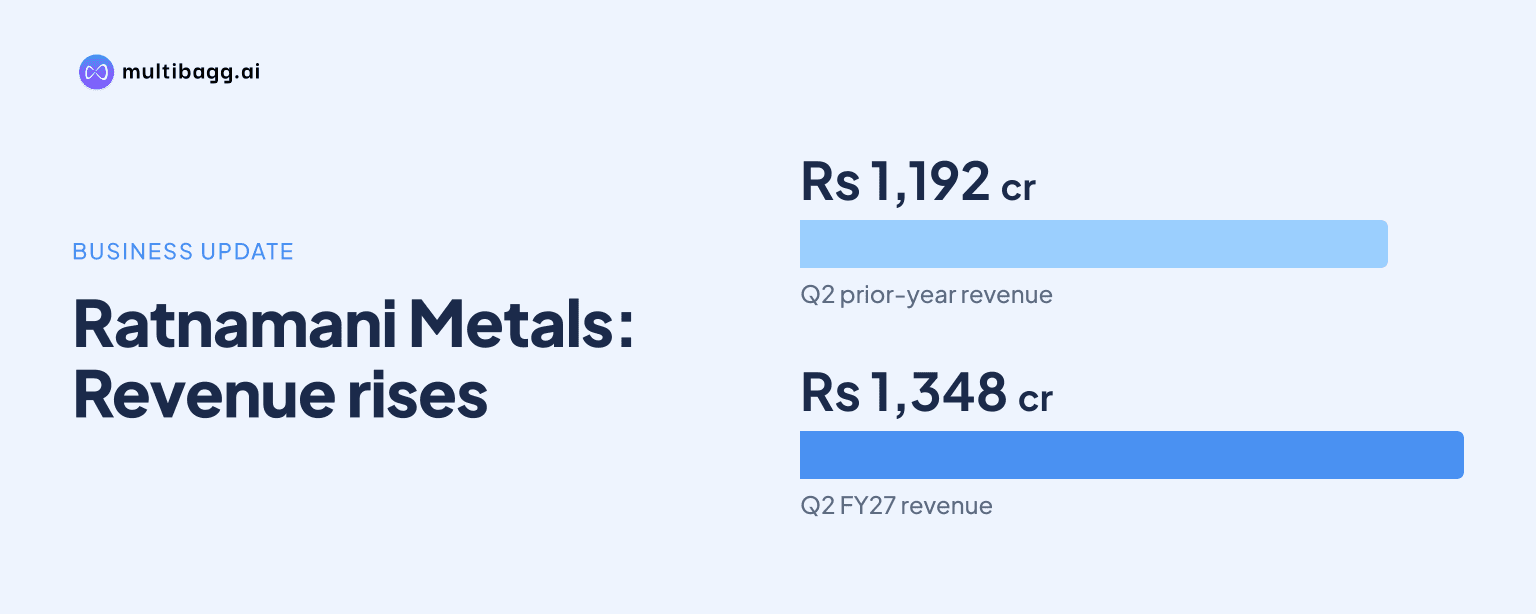
Ratnamani Metals & Tubes Limited reported consolidated revenue of ₹1,348 crore in Q2 FY27, a 13% year-on-year increase from ₹1,192 crore, while its order book exceeded ₹2,600 crore. The September-quarter update points to stronger order inflows and specialised-product demand, although higher freight and tariff-related costs continued to pressure profitability.
Know Ratnamani Metals & Tubes inside out
Results, valuation, peers and who's buying, in one view.
What did Ratnamani report for Q2 FY27?
Ratnamani Metals & Tubes Limited reported consolidated revenue of ₹1,348 crore for the quarter ended September 2026, compared with ₹1,192 crore in Q2 FY26. Consolidated EBITDA stood at ₹220 crore, translating into an EBITDA margin of 16.3%, while profit after tax was reported at ₹133 crore in the earnings-call summary.
On a standalone basis, Ratnamani reported revenue of ₹1,104 crore, up 18% year-on-year. Standalone EBITDA was ₹139 crore, with a margin of 12.6%. Standalone profit before tax was ₹106 crore and profit after tax was ₹80 crore. The company said gross margin was maintained and its overall cost structure remained broadly stable during the quarter.
Why did revenue grow while margins faced pressure?
Revenue growth was supported by improving demand and wins in specialised products, according to the earnings-call highlights. The order book increased by about 30% from the preceding quarter to more than ₹2,600 crore, providing a larger base of work for execution. Management also indicated that the US accounted for about 20% of the order book.
However, freight and forwarding costs rose significantly during the quarter. The company said shipping, tariff and geopolitical costs were weighing on profitability, particularly on existing orders where these costs were being absorbed. The call summary also noted that US exports under delivered-duty-paid arrangements can include tariff-inflated pricing, affecting reported revenue as well as other expenses.
Management described gross margins and the overall cost structure as broadly stable, but indicated that elevated freight-related costs could persist for six to 12 months. It expects Q3 margins to remain around Q2 levels, with any second-half improvement linked to better capacity utilisation.
What is Ratnamani's FY27 revenue guidance?
Ratnamani retained standalone FY27 revenue guidance of ₹4,000 crore to ₹4,200 crore and indicated consolidated revenue of approximately ₹5,000 crore to ₹5,200 crore. The guidance was confirmed during the question-and-answer session of the November 6 earnings call.
The current standalone range is lower than the ₹4,800 crore to ₹5,000 crore range cited in the Q4 FY26 call summary. The available Q2 FY27 material does not provide a detailed reconciliation for the change. Management's outlook in the current call was described as balanced, reflecting an improved order position but continuing caution on logistics costs, tariffs and margin pass-through.
The company also maintained its long-term EBITDA margin range of 15% to 18%, according to the call highlights. The Q2 consolidated margin of 16.3% sits within that range, though the near-term expectation for Q3 was for a margin broadly similar to the September-quarter level.
Got a follow-up? Ask IRIS
How does the order book affect Ratnamani's operations and investors?
The order book of more than ₹2,600 crore is important because it signals a stronger volume of contracted work than in the previous quarter. Management linked the increase to improving demand and specialised-product wins. For investors, this provides context for the company's retained FY27 revenue guidance, but it does not remove the cost risks identified during the call.
For operations, freight and tariff costs remain key variables because Ratnamani said these are being absorbed on existing orders. The company also reported negative operating cash flow in the first half due to inventory and receivables build-up. This indicates that working-capital requirements were higher even as the order book expanded.
The call also cited weak water demand as an area of concern. The available material does not quantify the impact on sales, but it shows that demand conditions were not uniform across all of Ratnamani's end markets. The company's performance will therefore depend on execution of its larger order book, capacity utilisation and its ability to manage logistics-related costs.
What background explains the Q2 FY27 performance?
Ratnamani's Q2 performance follows a year in which consolidated sales declined to ₹4,494 crore in FY26 from ₹5,186 crore in FY25, based on the prior-call summary included in the source material. The current quarter's 13% revenue growth comes against that backdrop, with management identifying improved orders and specialised products as current supports.
The November 6, 2026 earnings call lasted about 37 minutes and included 11 questions from eight analysts. Management did not provide new revenue targets during the call, instead reaffirming the revised FY27 ranges. Its stated near-term position combined confidence in demand and order inflows with caution over freight, tariffs, working capital and geopolitical disruption.
Conclusion
Ratnamani delivered 13% consolidated revenue growth to ₹1,348 crore in Q2 FY27 and expanded its order book to more than ₹2,600 crore. EBITDA margin was 16.3%, showing that the company remained within its stated long-term margin range, but higher freight and forwarding costs limited the benefit of stronger sales and order inflows.
The next points to watch are Q3 margin performance, management's ability to address elevated freight costs, and progress in converting the larger order book into revenue. Ratnamani has retained FY27 standalone revenue guidance of ₹4,000 crore to ₹4,200 crore and indicated approximately ₹5,000 crore to ₹5,200 crore of consolidated revenue.