










Ravelcare PRO launch adds marketplace and quick-commerce reach
Key highlights
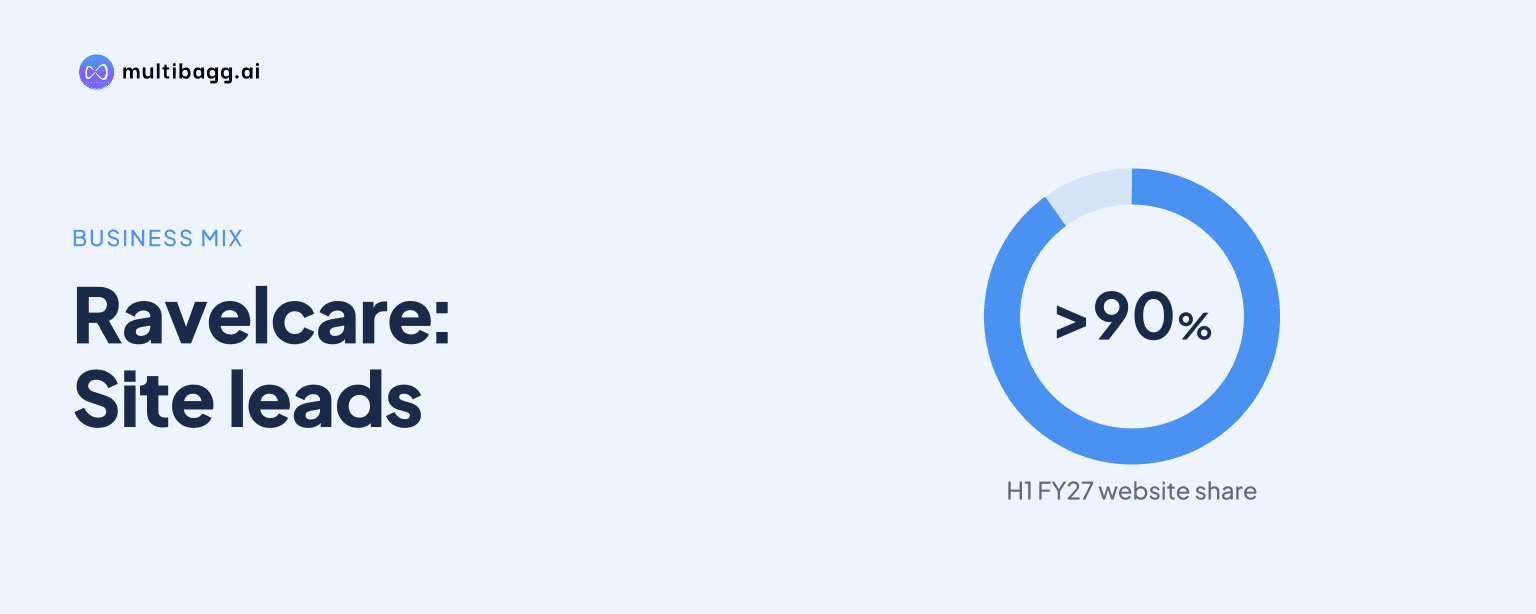
- More than 90% of Ravelcare’s business came from its own website in H1 FY27.
- Ravelcare launched PRO on Amazon, Flipkart, Nykaa, Blinkit and Myntra in H1 FY27.
- Ravelcare reported Rs 15.15 crore of revenue from operations in H1 FY27, up 20.7% from H2 FY26.
- Average order value increased 9% after the website and consultation-module revamp.
powered by IRIS
Ravelcare Limited launched its PRO range across marketplaces and quick-commerce platforms in H1 FY27, adding third-party reach while more than 90% of business still came from its own website. The company reported revenue from operations of Rs 15.15 crore in H1 FY27 and plans a personalised skincare launch by December 2026.
Know Ravelcare inside out
Results, valuation, peers and who's buying, in one view.
How dependent is Ravelcare on its own website?
Ravelcare remained highly dependent on its direct platform, with more than 90% of its business coming from its own website in H1 FY27. This concentration defines the distribution task: the company has controlled the customer journey through its site and consultation module, while marketplace, quick-commerce and distribution-channel revenue was not separately disclosed.
Management says repeat purchases in the long term usually occur on marketplaces and quick-commerce platforms, where customers expect immediate or one-day delivery for consumable haircare products. Ravelcare identifies faster fulfilment as the mechanism for reaching customers beyond its existing direct-sales base.
The shift is taking place while revenue expanded. Revenue from operations was Rs 15.15 crore in H1 FY27, up 20.7% from Rs 12.56 crore in H2 FY26 and 5.2% from Rs 14.40 crore in H1 FY26. The reported growth coincided with the initial channel expansion, although the presentation does not break out revenue by website, marketplace, quick commerce or distribution.
The profitability comparison provides context for the distribution effort. Gross margin rose 190 basis points from H2 FY26 and 350 basis points from H1 FY26 to 79.9% in H1 FY27. Earnings before interest, tax, depreciation and amortisation, or EBITDA, reached Rs 4.48 crore, compared with Rs 2.73 crore in H2 FY26 and Rs 4.33 crore in H1 FY26.
What did Ravelcare launch for new sales channels?
Ravelcare launched the PRO range in H1 FY27 specifically for marketplaces, quick commerce and distribution channels. The range went live on Amazon, Flipkart, Nykaa, Blinkit and Myntra, among other platforms, and is being sold through multiple warehouses on those platforms. This is the company’s disclosed route to make its products available outside the direct website.
The PRO launch is not described as replacing the direct model. Instead, it is intended to create a category suited to third-party channels while the direct website remains the source of more than 90% of business. The presentation does not disclose product-level pricing, marketplace sales, warehouse count or the share of H1 FY27 revenue contributed by PRO.
Management links PRO to a longer distribution plan. It says the range will help unlock distribution and create a path to offline retail in the future. That wording is a plan rather than confirmation of an existing offline launch: in H1 FY27, the disclosed live channels were marketplaces and quick commerce, while offline retail was presented as a future possibility.
The channel rollout occurred during a half year in which returns fell by around 60% compared with H2 FY26. That metric is a management estimate and unaudited, as are the operating metrics in the presentation. Ravelcare does not quantify whether the reduction came from the website revamp, product mix, fulfilment changes or the new channel mix.
Got a follow-up? Ask IRIS
How did Ravelcare improve its direct platform?
Ravelcare revamped its entire website and consultation module in H1 FY27, and management says the work improved conversion rate and lifted average order value by 9%. The direct platform remains commercially important because it accounted for more than 90% of business, so changes to consultation, checkout or ordering can influence the majority of current sales.
The company maintained repeat purchases at around 35% on its platform through the half year. This measure is also a management estimate, and the presentation does not provide a comparable repeat rate for H2 FY26 or H1 FY26. The disclosed evidence therefore establishes maintenance of the approximately 35% rate during H1 FY27 rather than a period-on-period improvement.
The comparison between direct-platform improvements and new-channel rollout shows two distribution mechanisms operating in H1 FY27. The website revamp produced a reported 9% increase in average order value, while the PRO range widened availability across five named third-party platforms. Ravelcare is pursuing higher value per direct order as well as wider external availability.
Ravelcare reported profit after tax of Rs 3.84 crore in H1 FY27, up 96.6% from Rs 1.95 crore in H2 FY26 and 19.8% from Rs 3.20 crore in H1 FY26. Other income was Rs 72.20 lakh in H1 FY27, against Rs 3.70 lakh in H2 FY26, so the increase in profit before tax to Rs 5.17 crore included a substantially higher contribution from other income as well as EBITDA growth.
What will Ravelcare use to widen its reach next?
Ravelcare plans to launch personalised skincare treatments by December 2026 and says the range will be available across all marketplaces and e-commerce channels from launch. The company presents skincare as its second category alongside haircare, with further products intended to follow after the initial launch. Management expects the category to add scale and reach a wider customer set.
The skincare timing matters because H1 FY27 established the marketplace and quick-commerce presence for PRO before the planned December 2026 launch. The presentation describes skincare as weeks away at the time of the results communication, but does not disclose product count, launch spending, sales targets, gross-margin expectations or named distribution partners beyond the commitment to marketplaces and e-commerce channels.
Ravelcare also says it plans to enter international markets soon and is investing in branding, new channels and influencer activations. These are forward-looking management plans without a disclosed launch country, date, budget or revenue target. They differ from the completed H1 FY27 PRO rollout, which was already live on Amazon, Flipkart, Nykaa, Blinkit and Myntra.
The company had Rs 26.60 crore in cash, deposits and investments at 30 September 2026, compared with Rs 26.07 crore at 31 March 2026, and reported nil debt on both dates. Trade receivables increased to Rs 8.65 crore from Rs 7.11 crore, while inventories declined to Rs 1.38 crore from Rs 1.52 crore. The 30 September 2026 balance-sheet figures and H1 FY27 results were unaudited.
Conclusion
Ravelcare’s distribution strategy combines a still-dominant direct website with a newly established third-party route. More than 90% of business remained website-led in H1 FY27, but PRO was live across named marketplaces and quick-commerce platforms, while the website revamp was associated with a 9% increase in average order value and approximately 35% platform repeat.
The next disclosed milestone is the personalised skincare launch by December 2026, with availability planned across marketplaces and e-commerce channels. The key unresolved measures are channel-level sales, the contribution from PRO and skincare, and progress toward management’s stated future path to offline retail and international-market entry.