










Raymond plans Rs 400 crore Andhra factory by December 2027
Key highlights
- Raymond expects roughly Rs 400 crore of investment in its Andhra Pradesh greenfield factory by December 2027.
- The Andhra Pradesh aerospace and automotive commitment totals Rs 1,000 crore over five years.
- Raymond said aerospace customer approval normally takes three to six months.
- The existing aerospace facility has a stated revenue capacity target of Rs 700 crore to Rs 750 crore.
powered by IRIS
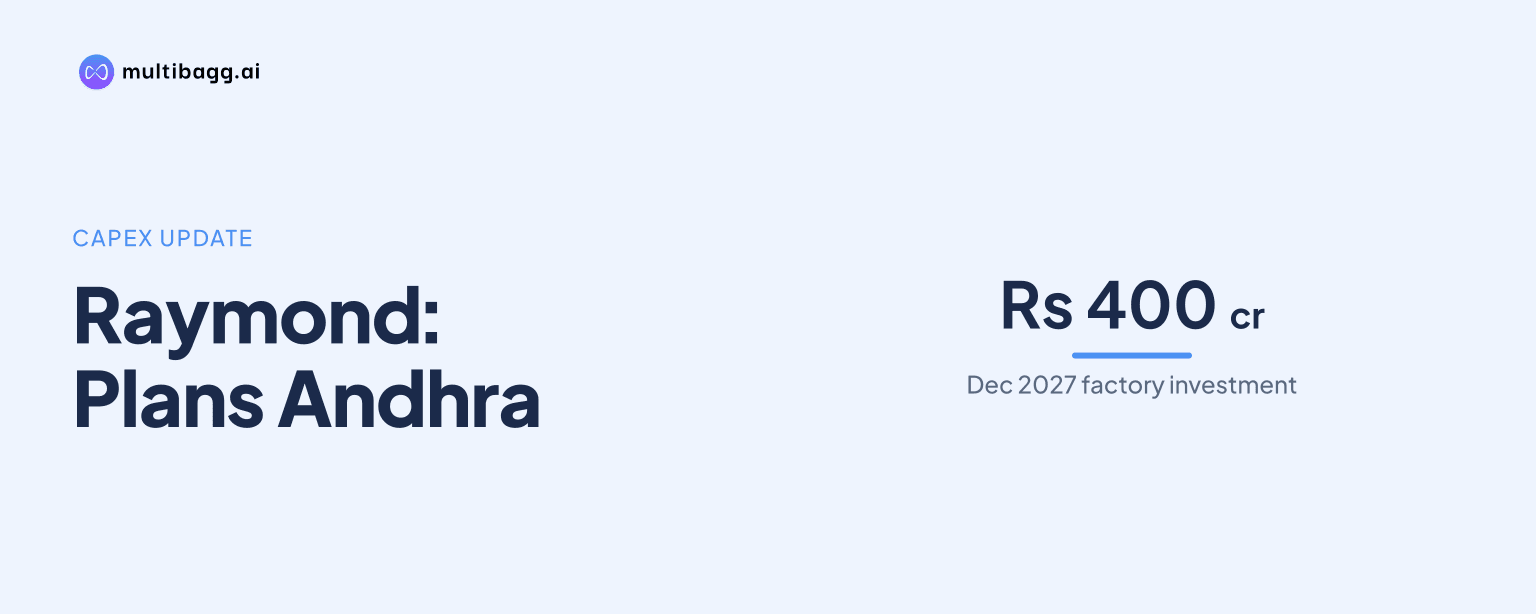
Raymond Limited plans to invest roughly Rs 400 crore in an Andhra Pradesh greenfield factory by December 2027, within a Rs 1,000 crore aerospace and automotive expansion commitment spread over five years. Management said the facility’s ramp-up will depend on customer approvals, but it is preparing transfers of existing parts to shorten that process.
Know Raymond inside out
Results, valuation, peers and who's buying, in one view.
How much will Raymond invest in the Andhra Pradesh factory?
Raymond expects to have spent close to Rs 400 crore when its Andhra Pradesh mega factory starts in December 2027. Sanjeev Sharma described this as the current ballpark estimate and said the eventual amount could increase or decrease depending on the flow of customer requests for quotation, or RFQs. The planned factory is therefore an expansion linked to demand rather than a fixed single-phase outlay.
The Rs 400 crore expected by start-up sits within Raymond’s total Rs 1,000 crore commitment across aerospace and automotive over five years. Management distinguished the greenfield mega factory from a brownfield Andhra facility: the brownfield site is primarily for precision technology, while aerospace production will remain at the current facility until it can move permanently to the new site. The brownfield site will also train people for both precision technology and aerospace work.
When will Raymond’s Andhra Pradesh greenfield factory begin production?
Raymond’s Andhra Pradesh greenfield mega factory is scheduled to start in December 2027. Management corrected an analyst’s suggestion that production would begin at the end of the current year, explaining that nearer-term activity is at the brownfield site while the greenfield facility starts next December. This separates the immediate precision-technology ramp-up from the later permanent aerospace expansion.
The existing aerospace facility is expected to provide capacity before the Andhra Pradesh site is needed. Management described aerospace revenue potential of Rs 700 crore to Rs 750 crore at the current facility, and Gautam Maini said growth at a mid-20s rate would still leave capacity there through the end of FY28. That differed from an analyst’s assumption that the current plant could be fully utilised by mid-FY28 on a faster growth path.
How will Raymond limit customer-approval delays at the new factory?
Raymond plans to move parts it already makes for customers into the new Andhra Pradesh factory so that approvals can focus on the plant rather than each individual part. Gautam Maini said aerospace customer approval normally takes between three and six months. By transferring proven parts, Raymond aims to shorten the transition period and avoid losing growth opportunities while production is shifted or expanded.
Management said it has a customer-by-customer transition team planning which ramps should receive priority in Andhra Pradesh. For automotive work, Sanjeev Sharma estimated approval time at about three months to eight or nine months, depending on validation required for a specific part. Raymond has already initiated this validation activity at the brownfield facility and intends to replicate it at the greenfield site, creating a staged route rather than waiting until December 2027 to begin all preparation.
Got a follow-up? Ask IRIS
What changes could the Andhra Pradesh factory bring to Raymond’s operations?
Raymond expects greater vertical integration at the Andhra Pradesh facility to lower working capital and allow it to bid for larger packages of work. Gautam Maini said these larger packages could move the company up the value chain, creating business opportunities beyond the operational savings of having more activities under one roof. Management did not quantify a prospective margin improvement or working-capital reduction.
The benefits will come with an initial settling period, according to management. Gautam Maini said a new factory needs customer approvals and time to stabilise, so Raymond is undertaking activities in parallel rather than making an immediate switch. The company is also assessing its business mix against a long-term return on capital employed, or ROCE, target of 20% to 25%; management noted that high-precision engine investment can produce higher earnings before interest, tax, depreciation and amortisation, or EBITDA, but lower ROCE.
How does Raymond intend to scale the factory without a large cash-burn period?
Raymond plans a modular rollout in which machines are brought in only a few months before expected dispatches, rather than installing the entire manufacturing base well before orders begin. Management said it could secure customer approval with an initial 10 machines, add another 10, and continue expanding in stages. It said there would be pre-operative expenses but did not expect a prolonged period of cash burn or a large utilisation threshold before break-even.
This approach reflects the company’s description of its work as discrete manufacturing with low volumes, high product mix and changing customer schedules. Management said capacity, vertical integration and machine mix make a simple revenue estimate unreliable because customers first approve samples, then begin with lower market shares before increasing allocations. The factory’s pace of investment and production will consequently depend on execution and RFQs, not solely on its Rs 1,000 crore five-year commitment.
Conclusion
Raymond’s Andhra Pradesh plan is a phased capacity expansion rather than an immediate wholesale relocation of aerospace production. The company expects about Rs 400 crore of spending by the greenfield factory’s December 2027 launch, while using the existing aerospace facility, brownfield training and staged equipment additions to manage the period before the new site contributes.
The next points to watch are whether the December 2027 start date holds, how much of the Rs 1,000 crore five-year commitment is deployed as RFQs develop, and how quickly customer approvals are completed. Management’s stated plan to transfer existing parts and pursue approvals in parallel is central to limiting the ramp-up risk it identified.