










REC says Rs 70,000 crore pipeline supports H2 disbursements
Key highlights
- REC said Rs 70,000 crore of documented projects are ready for disbursements to begin over the next two quarters.
- REC reported a committed order book of about Rs 2.5 lakh crore.
- REC disbursed Rs 90,000 crore in the first two quarters, while prepayments were Rs 19,000 crore.
- REC recorded Rs 2.11 lakh crore of disbursements in the preceding year, but prepayments close to Rs 1 lakh crore limited loan-book growth to 3%.
powered by IRIS
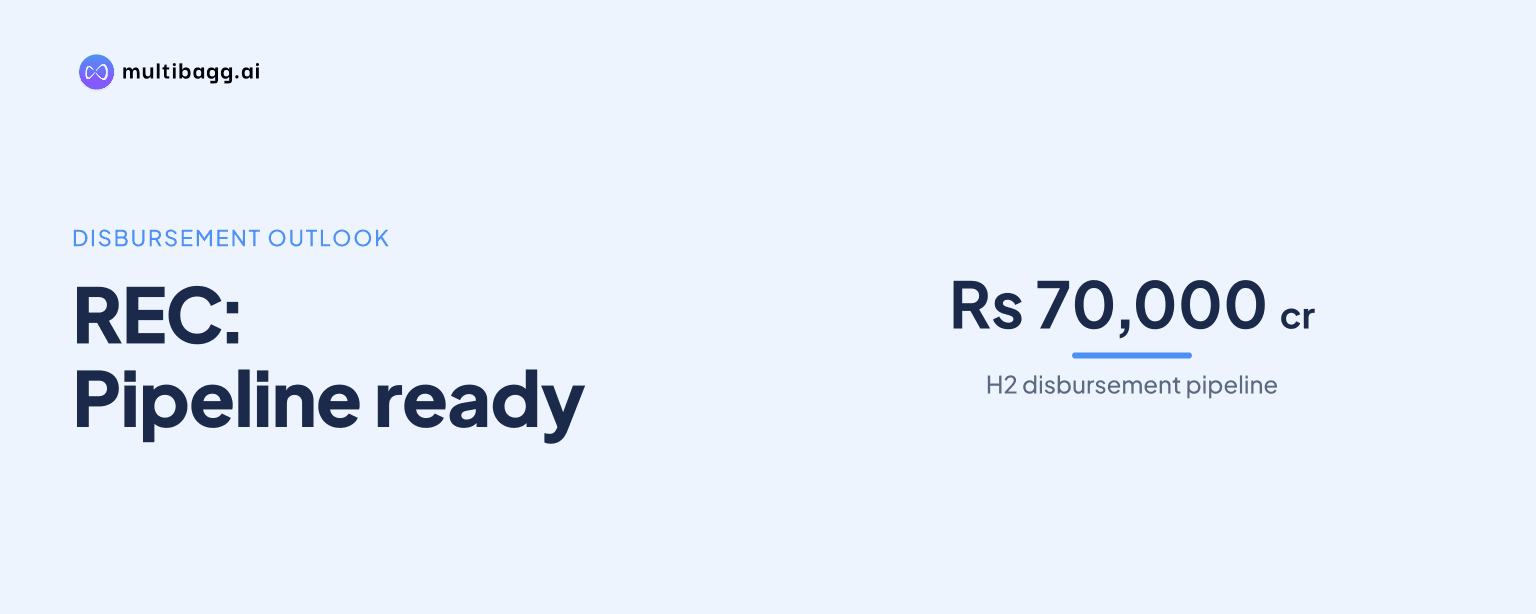
REC said Rs 70,000 crore of documented projects where disbursement is due to start, plus a committed order book of Rs 2.5 lakh crore, should support second-half (H2) disbursements after a weaker first quarter. Management identified the documented projects as an immediate source of drawdowns over the next two quarters.
Know REC inside out
Results, valuation, peers and who's buying, in one view.
Why does REC expect H2 disbursements to improve?
REC expects H2 disbursements to improve because projects with Rs 70,000 crore of documented financing are ready for drawdowns to begin. Chairman Jitendra Srivastava said this pool was the immediate indicator for the next two quarters, after an initial quarter in which major project documentation did not materialise as expected.
Director Projects T.S.C. Bosh said the first-quarter slowdown had no single specific cause. He cited delays in documentation of major loans, stiff competition from peers and challenges in capital-expenditure additions at state distribution companies. He also said improved distribution-company health reduced disbursements under the government-supported Revamped Distribution Sector Scheme, or RDSS.
REC described two layers to its disclosed pipeline. The Rs 70,000 crore consists of documented projects at the point where disbursement is to start, while the Rs 2.5 lakh crore committed order book is the broader set of committed business that management said would support activity in the third and fourth quarters.
How does REC's pipeline compare with recent disbursements?
REC reported Rs 90,000 crore of disbursements in the first two quarters, against record full-year disbursements of Rs 2.11 lakh crore in the preceding year. The Rs 70,000 crore pool of documented projects is therefore substantial relative to first-half disbursements, although REC did not provide individual project drawdown dates.
The prior year's Rs 2.11 lakh crore of disbursements was almost 10% above the previous record of Rs 1.9 lakh crore, according to management. Srivastava said REC would like to exceed Rs 2.11 lakh crore again, but presented that as a hope rather than a numerical full-year target or formal guidance.
Management said it did not expect the third quarter, or Q3, and fourth quarter, or Q4, to be lower than the first and second quarters, which it described as a conservative view. That expectation is based on the documented-project pool and order book, but conversion still depends on projects proceeding to drawdowns.
What has changed in REC's prepayment picture?
REC said prepayments, rather than a lack of fresh disbursement, limited loan-book growth in the preceding year. Record disbursements of Rs 2.11 lakh crore coincided with prepayments close to Rs 1 lakh crore, and the loan book grew only 3% as prepayments offset much of the impact of new lending.
In the first two quarters, prepayments fell to Rs 19,000 crore while disbursements reached Rs 90,000 crore. Srivastava said management believed prepayments had peaked, and that an increasing interest-rate environment should make them less significant. He distinguished prepayments from scheduled repayments, which he described as a normal outcome of lending.
Management linked lower prepayments to its confidence in 10% to 12% growth for REC in the current financial year. It also cited banks' sectoral lending limits and financing demand across power, renewable energy, transmission, distribution and infrastructure, without providing separate segment-level growth forecasts.
Got a follow-up? Ask IRIS
Which projects could add to REC's lending pipeline?
REC identified conventional thermal generation as a potential source of long-tenor lending. Bosh cited the Central Electricity Authority's National Electricity Plan, which includes a minimum addition of 80 gigawatts of thermal capacity from a baseline of about 215 to 217 gigawatts, with 22 to 24 gigawatts at various stages of construction.
At an estimated capital cost of Rs 8.34 crore per megawatt, management put the capital requirement for the planned thermal additions at Rs 6.67 lakh crore by 2031-32. REC said it was targeting Rs 1.8 lakh crore to Rs 2.2 lakh crore of financing opportunity, using an assumed funding structure of about 30% equity and 70% debt.
Generation represented 24.7% of REC's Rs 6.16 lakh crore loan book, or about Rs 1.52 lakh crore. Management said it planned to increase generation exposure to around Rs 2.5 lakh crore by 2032, while noting that thermal projects generally have five- to seven-year gestation periods and an economic life of about 25 years.
What could limit REC's H2 disbursement conversion?
REC's H2 expectation depends on documented projects translating into actual drawdowns, because delayed documentation was one of the factors management cited for the first-quarter slowdown. Competition from peers was another factor, meaning the Rs 70,000 crore documented-project figure indicates near-term available business rather than a guarantee that all of it will be disbursed in H2.
Margin conditions are separate from loan disbursement volumes. Srivastava said REC faced competition from banks with ample liquidity while borrowers sought lower rates and borrowing costs were rising. He said it would not be proper to say that net interest margins, or NIMs, would increase, and REC reported a NIM of 3.22% on a loan book of Rs 6 lakh crore.
The proposed merger also remained subject to approval. REC said its board resolution for absorption into Power Finance Corporation had received no-objection certificates from the Reserve Bank of India and stock exchanges, but the draft merger scheme awaited Cabinet approval. Management said the merged entity remaining a government company was a precondition of the transaction.
Conclusion
REC's disclosed pipeline gives management a specific basis for expecting H2 improvement: Rs 70,000 crore of documented projects are positioned for initial disbursement and the wider committed order book is Rs 2.5 lakh crore. Compared with Rs 90,000 crore disbursed in the first two quarters, the near-term project pool is material, while first-half prepayments of Rs 19,000 crore were below the close to Rs 1 lakh crore reported in the preceding year.
The next measure will be whether the Rs 70,000 crore of documented projects converts into drawdowns during Q3 and Q4, as management expects. Other disclosed developments to watch are REC's 10% to 12% growth expectation, management's aim to maintain its 3.22% NIM, and Cabinet approval of the proposed merger scheme.