










REC Stage 2 assets fall nearly fourfold to Rs 3,235 crore
Key highlights
- REC’s Stage 2 assets fell to Rs 3,235 crore at September 30, 2026, from Rs 12,350 crore at June 30.
- REC’s net credit-impaired-assets ratio declined to 0.11% from 0.24% a year earlier.
- REC reported no new NPAs for 19 quarters and said all existing NPAs were in the private sector.
- Stage 1 assets accounted for 99.26% of REC’s loan portfolio and carried a 0.85% provision.
powered by IRIS
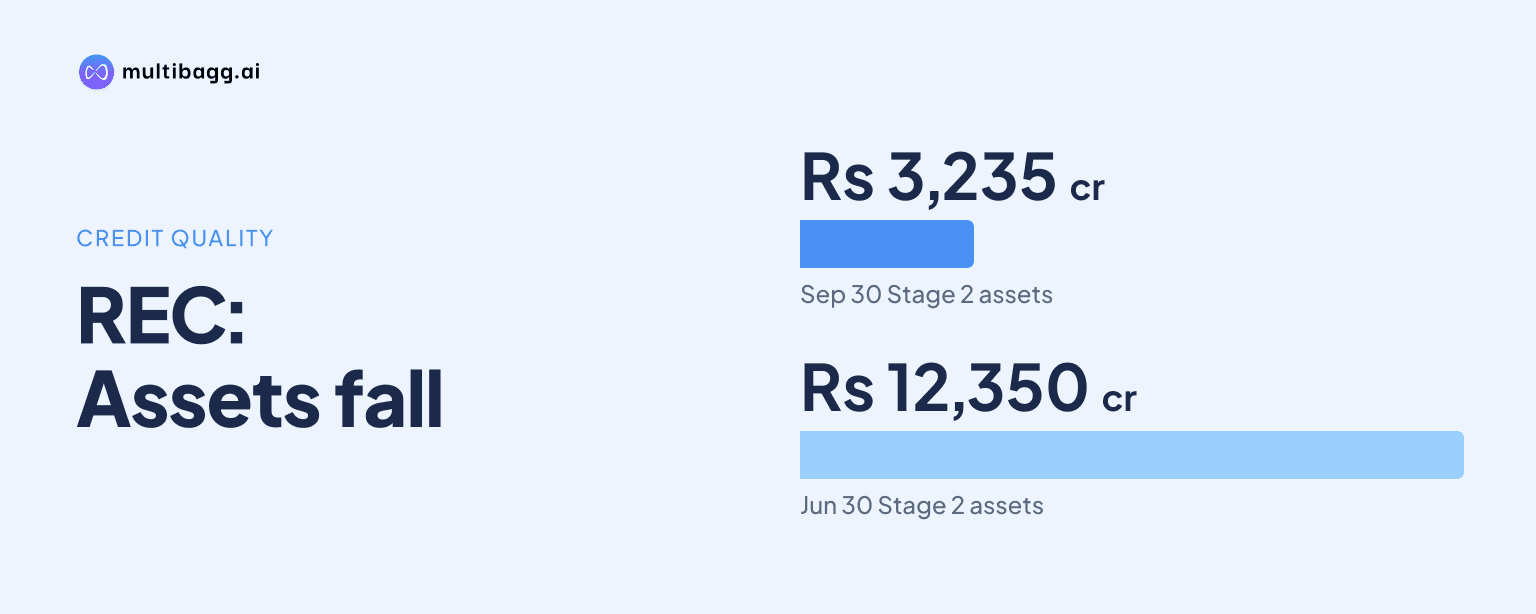
REC Limited’s Stage 2 assets fell nearly fourfold to Rs 3,235 crore at September 30, 2026, from Rs 12,350 crore at June 30, while net credit-impaired assets declined year on year to 0.11%. The quarterly reduction occurred as REC reported no new non-performing assets, or NPAs, for 19 quarters.
Know REC inside out
Results, valuation, peers and who's buying, in one view.
Why did REC’s Stage 2 assets decline in Q2 FY27?
REC’s Stage 2 assets declined from Rs 12,350 crore at June 30, 2026, to Rs 3,235 crore at September 30, 2026, a reduction of Rs 9,115 crore in one quarter. Management described the movement as an almost fourfold reduction, but did not identify individual borrowers, sectors or transactions responsible for the change.
REC separately said it resolved one project worth about Rs 4 crore during the quarter, contributing to a lower stock of gross credit-impaired assets. That project resolution was discussed in the context of NPAs, rather than as a stated explanation for the full reduction in Stage 2 assets, so the call does not establish a direct link between the two movements.
The Stage 2 reduction is set against REC’s statement that Stage 1 assets constituted 99.26% of its total loan portfolio at September 30. REC maintained a 0.85% provision on Stage 1 assets and a 4.5% provision on Stage 2 assets, meaning the Stage 2 category carried a higher stated provisioning rate.
How does REC’s current asset quality compare with last year?
REC’s net credit-impaired-assets ratio was 0.11% at September 30, 2026, compared with 0.24% at the same point a year earlier. Management described the decline as about 50%, while the gross credit-impaired-assets ratio was 0.22% at the end of Q2 FY27.
REC said all NPAs outstanding at September 30 were in the private sector and that it had not recorded a new NPA for 19 quarters. This record was reported alongside a loan book of Rs 6.17 lakh crore for H1 FY27, 6% higher than at the same time in the previous year.
REC reported a provision coverage ratio of about 51% on its NPA assets. That measure is separate from the 4.5% provision rate on Stage 2 assets and the 0.85% rate on Stage 1 assets, so the call disclosed different provisioning measures for different parts of the portfolio.
The reported lower impaired-asset ratios came as REC expanded its balance sheet. Net worth rose 14% year on year to Rs 94,325 crore, while borrowings reached Rs 5.27 lakh crore at September 30, 2026, up 4% from March 31, 2026. REC therefore reported improved asset-quality ratios despite higher lending and funding balances.
Got a follow-up? Ask IRIS
What provisions does REC hold against its loan portfolio?
REC provided 0.85% against Stage 1 assets, which accounted for 99.26% of the loan portfolio, and 4.5% against Stage 2 assets at September 30, 2026. It also reported about 51% provision coverage on NPA assets, with gross credit-impaired assets at 0.22% and net credit-impaired assets at 0.11%.
Beyond loan-loss provisions, REC maintained statutory reserves of Rs 18,736 crore under Section 45-IC of the Reserve Bank of India Act and Rs 1,200 crore under the Income Tax Act. Management said those reserves were additional to the provisions discussed for Stage 1, Stage 2 and NPA assets.
REC used distinct terminology across these disclosures. The call referred to gross and net credit-impaired assets for the 0.22% and 0.11% ratios, while management used NPAs when discussing provision coverage and the absence of fresh additions for 19 quarters. The transcript does not provide a reconciliation from Stage 2 assets to gross credit-impaired assets.
REC reported these asset-quality metrics during H1 FY27, when total income was Rs 29,068 crore, net interest income was about Rs 10,116 crore and profit after tax was Rs 7,541 crore. These are reported half-year operating results and do not establish that the lower Stage 2 balance alone caused the period’s profitability.
What does REC’s asset quality mean for its FY27 growth plan?
REC management said the lower Stage 2 balance and 0.11% net credit-impaired-assets ratio accompanied its plan to deliver 10% to 12% loan-book growth by the end of FY27. This is management’s target, based partly on its view that prepayments had peaked, rather than a forecast established by the reported asset-quality ratios.
REC had disbursed close to Rs 90,000 crore in the first half and set a full-year disbursement target of more than Rs 2 lakh crore. Its chairman said prepayments were about Rs 19,000 crore in the first two quarters, compared with close to Rs 1 lakh crore for the whole previous year, when record disbursements of Rs 2.11 lakh crore translated into only 3% loan-book growth.
Portfolio growth differed by segment between March 31 and September 30, 2026. REC said renewable-energy loan assets grew 15%, conventional-generation assets grew 4%, and infrastructure and logistics assets grew about 6%; infrastructure and logistics represented 10% of the portfolio. The renewable-energy portfolio reached Rs 86,660 crore at September 30.
Management said competition and power-sector derisking had slightly reduced net interest margins, or NIMs, but expected NIMs to remain above 3%. REC reported a 3.22% NIM for H1 FY27, a 2.38% spread between a 9.57% yield on loan assets and a 7.19% cost of funds, and capital adequacy of 24.04% against the Reserve Bank of India requirement of 15%.
Conclusion
REC’s Stage 2 asset reduction to Rs 3,235 crore adds a broader balance-sheet measure to the decline in its net credit-impaired-assets ratio to 0.11% at September 30, 2026. With Stage 1 assets accounting for 99.26% of the portfolio and no new NPAs reported for 19 quarters, REC presented asset quality as holding up while its loan book reached Rs 6.17 lakh crore.
The next point to watch is execution against management’s 10% to 12% FY27 loan-growth target and more than Rs 2 lakh crore disbursement target. Management linked that outlook to prepayments of Rs 19,000 crore in the first half, while the transcript leaves unresolved the specific drivers behind the Rs 9,115 crore quarterly reduction in Stage 2 assets.