










REC sees Rs 1.8-2.2 lakh crore thermal funding opportunity by 2032
Key highlights
- REC estimates a Rs 1.8 lakh crore to Rs 2.2 lakh crore thermal financing opportunity by 2032.
- REC's generation loan book was about Rs 1.52 lakh crore, or 24.7% of its Rs 6.16 lakh crore total book.
- Management plans to build REC's generation book to around Rs 2.5 lakh crore by 2032.
- REC targets Rs 2.1 lakh crore of FY27 disbursements after Rs 90,000 crore in H1.
powered by IRIS
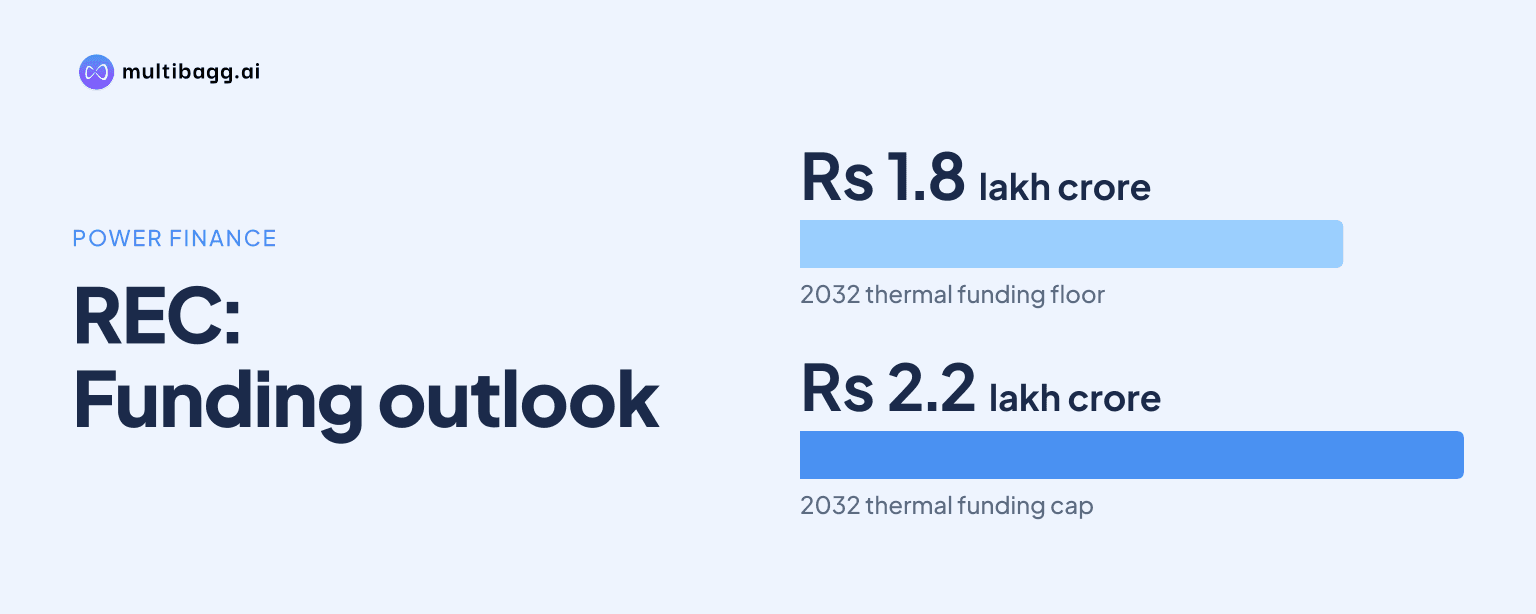
REC expects a Rs 1.8 lakh crore to Rs 2.2 lakh crore thermal-generation financing opportunity by 2032, based on a national plan for at least 80 gigawatts of additions and a stated Rs 8.34 crore per megawatt funding requirement. Management said the projects could expand its long-term generation lending book.
Know REC inside out
Results, valuation, peers and who's buying, in one view.
What thermal financing opportunity does REC see by 2032?
REC sees a Rs 1.8 lakh crore to Rs 2.2 lakh crore potential financing opportunity from thermal projects by 2032. T.S.C. Bosh said the National Electricity Plan envisages thermal-generation capacity of 274 gigawatts from a 215-gigawatt baseline, with a minimum 80 gigawatts of additions planned. He added that around 22 to 24 gigawatts were at different stages of construction at the time of the call.
The estimate uses a funding requirement of Rs 8.34 crore per megawatt, according to management. REC said it would consider projects from state-sector and private-sector borrowers that have committed fuel supply agreements, or FSAs. The Rs 1.8 lakh crore to Rs 2.2 lakh crore range is an opportunity estimate rather than a disclosed sanction target, with the final amount depending on which projects reach financing stages and are taken up by REC.
How long are REC's thermal-project loans likely to run?
REC expects thermal-project loans to be long-dated because management described a 5-to-7-year construction gestation period, a moratorium of more than five years and an economic project life of 25 years. Those characteristics differ from renewable-energy projects, which Rajesh Kumar said are generally delivered within one year and have returns that can be forecast more accurately.
REC did not provide a prepayment forecast or historical comparison for thermal projects. Management tied the loan structure to the underlying construction cycle, under which disbursements can extend through a multi-year build period before repayment begins. The Rs 1.8 lakh crore to Rs 2.2 lakh crore opportunity therefore depends on capacity plans as well as project execution and commissioning schedules.
Will thermal lending lift REC's lending yields?
Management said thermal-generation loans carry slightly higher yields than renewable-energy loans, but it did not disclose a numerical spread. Rajesh Kumar said pricing varies by promoter, the existence and terms of power purchase agreements, or PPAs, and engineering, procurement and construction, or EPC, arrangements. He also said thermal projects have longer gestation periods and other uncertainties.
REC placed infrastructure and logistics, or I&L, pricing between the two generation categories. Management said I&L rates are lower than thermal rates but higher than renewable-energy rates, while the average lending rate reflects the mix across thermal generation, renewable energy and I&L. Management said generation projects contribute to both top-line income and bottom-line results but did not quantify a direct margin effect.
The broader margin backdrop remains relevant. Jitendra Srivastava said REC's net interest margin, or NIM, was 3.22% on a Rs 6 lakh crore loan book and that competition from banks with ample liquidity was putting pressure on lending rates. He said REC would be happy to maintain the 3.22% NIM rather than forecast an increase because borrowing costs were also rising.
Got a follow-up? Ask IRIS
How large is REC's generation book and what is its 2032 plan?
REC's generation portfolio was about Rs 1.52 lakh crore, or 24.7% of its Rs 6.16 lakh crore loan book, and management plans to raise that book to around Rs 2.5 lakh crore by 2032. The stated objective implies an increase of about Rs 98,000 crore from the reported generation exposure, including emerging projects that management said it would evaluate.
Management cited the NTPC Meja project as a recent generation win, with total expected disbursement of about Rs 27,000 crore alongside Power Finance Corporation. T.S.C. Bosh said that if REC joins the project with Power Finance Corporation, half of the disbursement would come from REC's side. REC did not state a disbursement timetable or confirm its final allocation.
The generation objective sits within a wider lending franchise. Management said REC lent Rs 4.5 lakh crore to state power utilities over the previous three years, compared with close to Rs 10 lakh crore of debt financing received by those utilities in total. Management described this as a 45% share, based on regional-office inputs covering utilities representing about 90% to 95% of the market.
Can REC meet its FY27 disbursement and loan-growth plans?
Management said REC was positioned to target Rs 2.1 lakh crore of disbursements in FY27, the financial year referenced on the call, after reporting Rs 90,000 crore in the first half, or H1. It planned another Rs 1.2 lakh crore to Rs 1.3 lakh crore in the second half, supported by renewable energy, I&L, the Green Energy Corridor, distribution and transmission. This plan is broader than the 2032 thermal-financing opportunity.
The available pipeline included Rs 2.56 lakh crore of committed scope, with Rs 69,000 crore still to be documented with borrowers. REC had sanctioned Rs 1.12 lakh crore during the current financial year and said it planned a further Rs 1.7 lakh crore to Rs 2 lakh crore of sanctions. Management also cited Rs 4.09 lakh crore of sanctions in the prior year, providing a comparison for the current pace.
For the loan book, management guided to 10% to 12% growth in FY27 after reaching 6% in H1. Transmission represented a little over 7% of the Rs 6.16 lakh crore book, or about Rs 45,000 crore, and management said it was targeting a larger transmission component. Green Energy Corridor guidelines were still under development, leaving the programme's precise contribution unresolved.
Conclusion
REC's Rs 1.8 lakh crore to Rs 2.2 lakh crore thermal-financing estimate identifies a potential source of long-tenor lending, while its existing generation book of about Rs 1.52 lakh crore provides a base for the stated Rs 2.5 lakh crore 2032 objective. Management said thermal assets yield slightly more than renewable projects, but pricing, project structures and the overall lending mix will determine the effect on margins.
The next disclosed milestones are REC's Rs 2.1 lakh crore FY27 disbursement target and 10% to 12% loan-book growth plan after the 6% H1 increase. Progress in documenting Rs 69,000 crore of committed scope, the final REC allocation in NTPC Meja and Green Energy Corridor guidelines will also shape the pipeline management described.