










REC targets 10%-12% FY27 loan-book growth as prepayments fall
Key highlights
- REC’s first-half prepayments fell to Rs 19,000 crore from nearly Rs 1 lakh crore in the previous year.
- REC targets 10%-12% FY27 loan-book growth and disbursements above Rs 2 lakh crore.
- REC reported Rs 90,000 crore of first-half disbursements, including almost Rs 80,000 crore in power.
- REC has Rs 70,000 crore of documented projects awaiting disbursement and nearly Rs 2.5 lakh crore of committed order book.
powered by IRIS
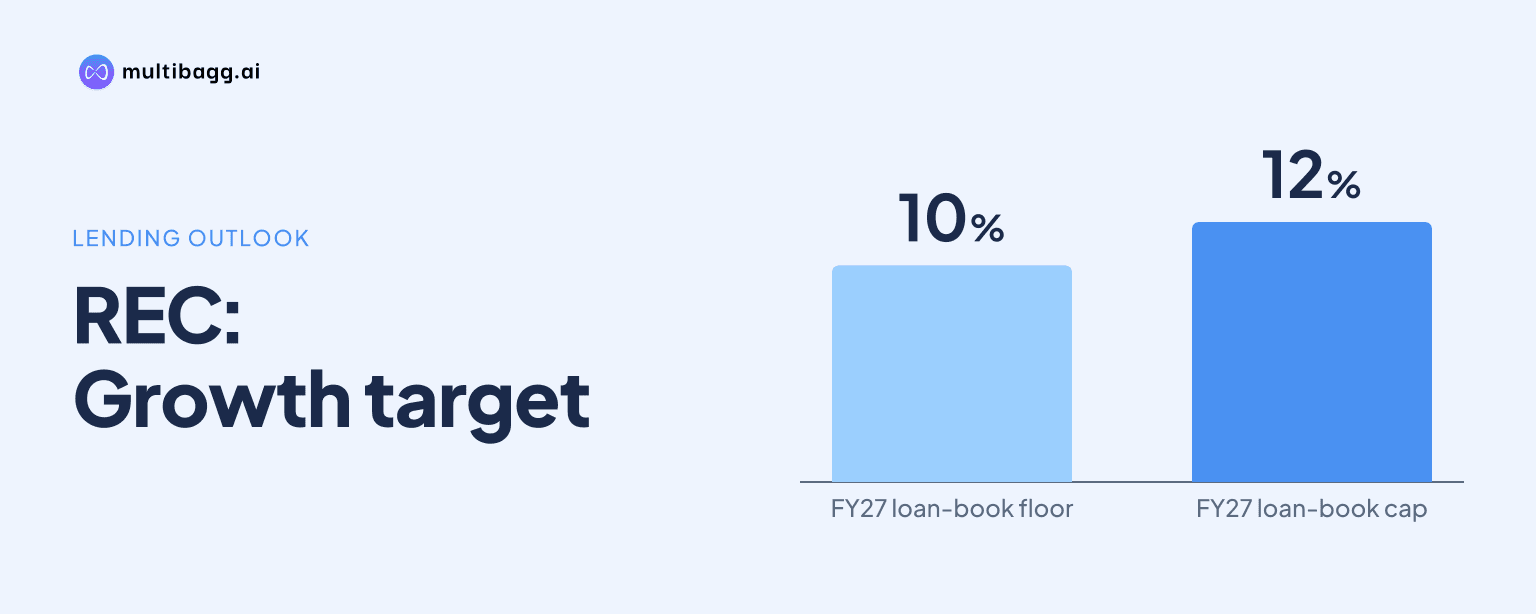
REC is targeting 10%-12% loan-book growth in FY27 after prepayments fell to Rs 19,000 crore in the first two quarters, from nearly Rs 1 lakh crore in the previous year. Management said lower prepayments should allow a greater share of Rs 90,000 crore of first-half disbursements to remain in REC’s loan book.
Know REC inside out
Results, valuation, peers and who's buying, in one view.
Why does REC expect 10%-12% loan-book growth in FY27?
REC expects 10%-12% growth because prepayments have declined sharply while disbursements remain high. Chairman Jitendra Srivastava said REC had disbursed about Rs 90,000 crore in the first half, including almost Rs 80,000 crore in power, and had set a full-year disbursement target above Rs 2 lakh crore.
The change is the difference between fresh lending and loans repaid before their scheduled maturity. REC recorded nearly Rs 19,000 crore of prepayments in the first two quarters against Rs 90,000 crore of disbursements. Srivastava distinguished prepayments from regular repayments, saying the former had been the main constraint on loan-book expansion in the prior year.
REC’s prior-year performance shows why high lending volumes did not automatically produce asset growth. It disbursed a record Rs 2.11 lakh crore, about 10% above the preceding record of Rs 1.9 lakh crore, but loan-book growth was about 3% because prepayments of nearly Rs 1 lakh crore offset much of the new lending.
How important are lower prepayments to REC’s FY27 target?
Lower prepayments are central to REC’s 10%-12% growth target, according to management. Srivastava said REC believes the prepayment cycle has peaked and that an increasing interest-rate cycle should make early refinancing or repayment less significant than it was in the previous year.
First-half prepayments of Rs 19,000 crore were less than one-fifth of the nearly Rs 1 lakh crore reported in the full previous year. Management’s case is that the Rs 90,000 crore disbursement total can translate more directly into loan-book growth when prepayments remain near the first-half level rather than absorbing most of the lending inflow.
Management also cited bank lending limits as a factor behind its outlook. Srivastava said banks may have excess liquidity but face sectoral exposure limits, while demand for financing is increasing in power, renewable energy, transmission, distribution, generation and infrastructure.
What pipeline could support REC’s second-half disbursements?
REC said Rs 70,000 crore of documented projects were awaiting the start of disbursement, creating an immediate pipeline for the next two quarters. Srivastava also cited a committed order book of nearly Rs 2.5 lakh crore and said he did not expect the third and fourth quarters to be below the first and second quarters.
Management attributed the weaker first quarter partly to large projects not completing documentation and to peer competition. T.S.C. Bosh said improving financial health at distribution companies, or DISCOMs, had also affected capital-expenditure additions in the state distribution segment under the Revamped Distribution Sector Scheme, or RDSS.
REC said 40% of its disbursement-related loan assets were under documentation. Bosh said sanctioned commitments should help the company make up during the second half, while Srivastava identified the Rs 70,000 crore of documented projects as lending where disbursement should begin over the next two quarters.
Got a follow-up? Ask IRIS
Which sectors could generate REC’s next lending opportunities?
REC identifies power as its mainstay and renewable energy, transmission, distribution, generation and infrastructure as additional lending opportunities. Management said the government-announced Rs 1.85 lakh crore transmission-strengthening project could create financing demand, although detailed guidelines were still being developed by the Ministry of New and Renewable Energy.
REC is also monitoring a Rs 23,000 crore biogas plan for potential infrastructure finance. Srivastava named transmission, biogas, distribution, conventional generation and shipping as areas of interest, but REC did not disclose an expected lending amount or allocation for any of these opportunities.
REC’s renewable-energy portfolio reached Rs 86,660 crore on September 30, 2026, more than three times its level five years earlier. Solar accounted for 35% of that portfolio, hybrid projects for 18%, pumped-storage projects for 14% and hydro projects for 13%.
REC also said its infrastructure loan book was almost Rs 62,000 crore, or about 10% of its overall loan book. The company cited a roughly 25% power-market share as an indication of its position in the sector, while management said power would remain the principal business.
Can REC deliver growth while holding its margin near current levels?
REC is pursuing loan-book growth while seeking to maintain net interest margin, or NIM, around 3.2%, but management acknowledged pressure from competition and borrowing costs. Srivastava said it would not be appropriate to predict an increase in NIM when borrowers seek lower rates and borrowing costs are rising.
REC reported NIM of 3.22% on a loan book of about Rs 6 lakh crore. Management said it would be satisfied to maintain that level and said rebates or concessions previously offered to state-sector borrowers had largely been settled, reducing one earlier source of pressure on lending yields.
Director Finance Rajesh Kumar said about 24% of borrowings, comprising rupee term loans and some external commercial borrowings, or ECBs, were floating-rate. He said about 25% of the loan book was also floating-rate, which management expects to offset higher costs on that portion of borrowings.
Kumar said REC’s other borrowings were fixed-rate at issue or had been converted to fixed rates through swaps. REC is seeking a withholding-tax exemption on ECBs and a green-bond basket mandate from the Ministry of Finance, measures Kumar said could lower borrowing costs if approved.
Conclusion
REC’s FY27 target depends on a specific balance-sheet shift: prepayments fell to Rs 19,000 crore in the first half while disbursements reached Rs 90,000 crore. That differs from the previous year, when nearly Rs 1 lakh crore of prepayments limited loan-book growth to about 3% despite record disbursements of Rs 2.11 lakh crore.
The next measure will be REC’s conversion of Rs 70,000 crore of documented but undisbursed projects and its nearly Rs 2.5 lakh crore committed order book during the second half. Management’s outlook also depends on prepayments remaining contained, while the detailed guidelines for the Rs 1.85 lakh crore transmission plan and the pending merger scheme Cabinet approval remain unresolved matters.