










Recode to use FOFO stores after dark-store demand tests
Key highlights
- Recode said all planned new stores will use the franchise-owned and franchise-operated, or FOFO, format.
- Management said dark stores will establish local demand before Recode opens FOFO outlets.
- Recode is targeting a ratio of stores closed to stores opened below 10%.
- Recode plans to add around 100 SKUs in H2, taking its range to around 500 SKUs.
powered by IRIS
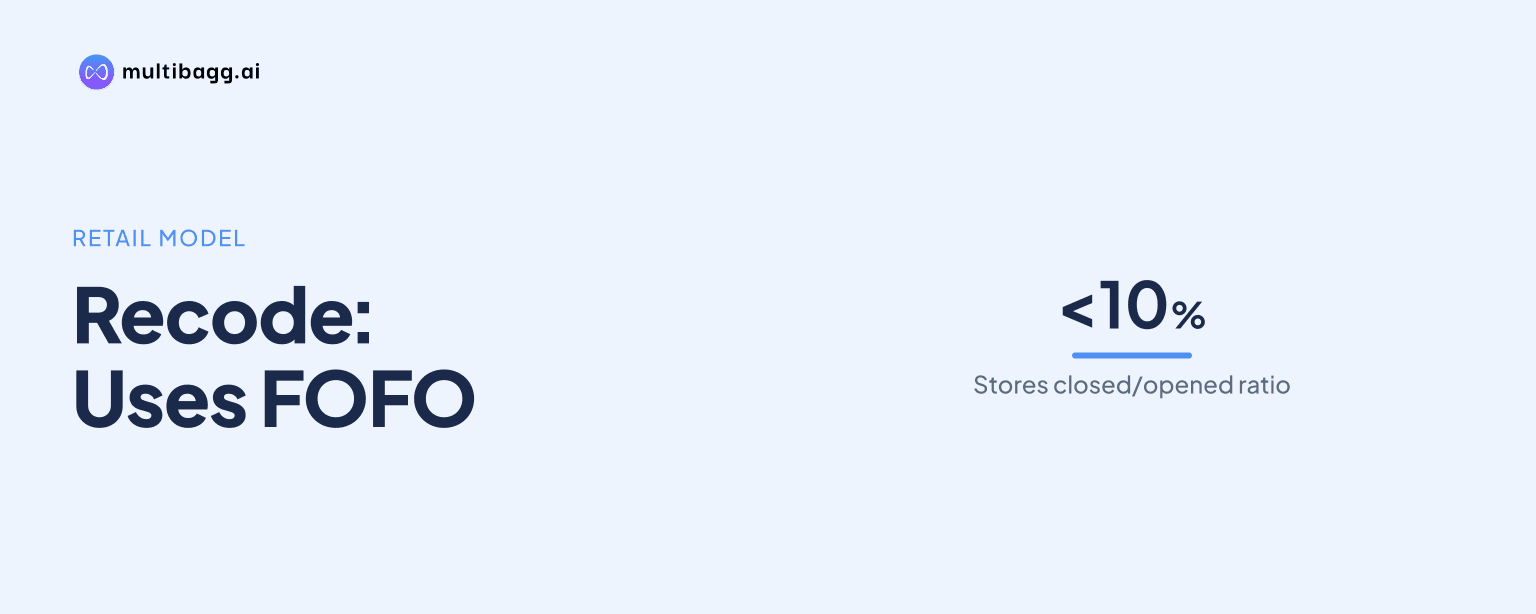
Recode said all planned new stores will be franchise-owned and franchise-operated after dark stores demonstrate local traction, while management targets a store-closure ratio below 10%. The model shifts outlet operations to franchisees and leaves Recode focused on new-product development and supply-chain management.
Know Recode Studios inside out
Results, valuation, peers and who's buying, in one view.
Why will Recode test demand through dark stores first?
Recode will build a local market through a dark store before opening a FOFO, or franchise-owned and franchise-operated, outlet in that location. Management said the dark store must gain traction before a physical franchise store opens because Recode, as a newer entrant, needs to create demand rather than open stores randomly.
The process is tied to Recode's focus on secondary sales, meaning sales to end consumers, rather than primary sales into a distribution channel. Management contrasted its approach with distributor-led models, where distributors retain 20% to 25% and brands may face product returns after two to three years. Recode said it could generate primary sales by billing inventory, but it is focused on products reaching consumers.
Management presented dark stores as a way to expand without committing immediately to a customer-facing outlet. The transcript does not disclose the number of dark stores, a sales threshold for traction, the average time between dark-store testing and a FOFO opening, or the cost of establishing a dark store.
Will every planned Recode store be FOFO?
Yes, Recode management said all planned new stores will be FOFO. When asked how future openings would be divided between FOFO and COCO, or company-owned and company-operated, formats, management said every new outlet would be operated through the franchise model.
Management said this structure allows Recode to concentrate on new-product development, supply-chain management and other central activities instead of running store operations. It said direct store operations would consume too much of the internal team's energy, making FOFO the planned format for expansion.
The exchange did not establish a numerical target for new-store openings. An analyst referred to 100 stores, but management clarified that there were not 100 planned stores; the disclosed figure was instead around 100 stock-keeping units, or SKUs, planned for addition in H2, taking Recode's range to around 500 SKUs.
What store-closure ratio is Recode targeting?
Recode is targeting a ratio of stores closed to stores opened of no more than 10%. Management described store closures as a normal part of retailing, saying it continues to open and shut locations, but the below-10% figure was presented as a target rather than a reported historical result.
Recode recently closed a COCO store in Mumbai because it was loss-making and had poor visibility, according to management. Management said a loss-making store can sometimes serve as advertising or brand recall, comparing that role with a billboard costing Rs 1.5 lakh to Rs 2 lakh, but it concluded that the Mumbai outlet did not provide sufficient visibility.
The dark-store process is intended to establish demand before Recode commits to a physical outlet, although management did not quantify its expected effect on closures. The transcript also does not disclose the current store count, the number of stores opened or closed in a particular period, or a historical closure ratio for FOFO and COCO formats.
Got a follow-up? Ask IRIS
Where is Recode creating demand for future outlets?
Recode said it is building demand across India, covering Tier 1, Tier 2, Tier 3 and Tier 4 cities rather than concentrating only on major metros. Management cited Chennai and nearby markets including Coimbatore, Ernakulam and Paramkudi, as well as Telangana and Hyderabad, as areas of expansion.
In Maharashtra, management said Recode operates beyond Mumbai and Pune in locations including Latur, Solapur, Kolhapur and Parbhani. It also named Mysuru and Belagavi in Karnataka, Rewa, Satna and Katni in Madhya Pradesh, and Gondia, Bilaspur, Raipur and Rajnandgaon around Nagpur.
Management rejected the description of Recode as only a Tier 2 and Tier 3 brand. Its stated view is that demand from Tier 1 markets makes products aspirational for consumers in smaller cities, while its distribution and market-building efforts extend across districts and subdistricts.
How does Recode adapt products for regional expansion?
Recode said regional product preferences are relevant to its expansion, citing nude lipstick demand in North India and higher demand for red and dark shades in South India. The planned addition of around 100 SKUs in H2, lifting the range to around 500 SKUs, is intended to provide a broader product pipeline for these markets.
Management said color cosmetics require frequent launches because fashion trends change rapidly. It described new launches every month or every 15 days as necessary, while older products can become dormant. It cited holographic eyeliner as a product that was prominent over the past two years but is no longer widely requested.
Recode said it can assess the potential of a new product within the first 10 to 15 days after launch, although inventory uncertainty may persist for the first 45 to 60 days. Management said product development uses trends in the United States and the United Kingdom alongside customer feedback, citing the Rose Grip Spray and a non-transfer, waterproof and smudgeproof bullet lipstick as recent examples.
How does the FOFO plan fit Recode's margin approach?
Recode said the FOFO structure is intended to keep its internal resources directed toward products and supply chain while franchisees manage outlet operations. Management also said marketing spending is around 20% of revenue, compared with its assertion that Renee and Sugar Cosmetics spend 50% of revenue, though it did not provide independently verified competitor data.
Management said it expects full-year profit after tax, or PAT, and earnings before interest, taxes, depreciation and amortisation, or EBITDA, to remain in line with the previous year, with a potential movement of one to two percentage points in either direction. This was management's stated expectation, not a formal margin target or reported result.
The approach combines consumer sell-through through dark stores, franchise-operated physical outlets and frequent product launches. Recode did not disclose franchise fees, franchisee investment requirements, outlet-level profitability, revenue per dark store or the number of FOFO stores expected to open in a future period.
Conclusion
Recode's stated expansion model is to create local demand through dark stores and then open FOFO outlets, rather than adding new company-operated stores. The plan is paired with a below-10% store-closure target, a focus on secondary sales and an H2 product plan to add around 100 SKUs to a range of around 500.
The next measures to watch are whether dark-store locations convert into FOFO outlets, whether the closure ratio stays below 10%, and whether full-year PAT and EBITDA remain near the previous year's levels within the one-to-two-percentage-point range management described. Management has not disclosed a store-opening count, a dark-store conversion timeline or franchise economics.