










Renaissance Global plans 12-18 month Jean Dousset in-house shift
Key highlights
- Renaissance Global currently manufactures about 25% of Jean Dousset sales in-house and targets full internal production within 12 to 18 months.
- Renaissance Global reported a 68% Jean Dousset gross margin and a 43% boutique contribution margin before advertising.
- Renaissance Global expects Jean Dousset revenue of about Rs 160 crore to Rs 175 crore in the current year.
- A Jean Dousset boutique requires about Rs 10 crore to Rs 12 crore of capital expenditure and inventory combined.
powered by IRIS
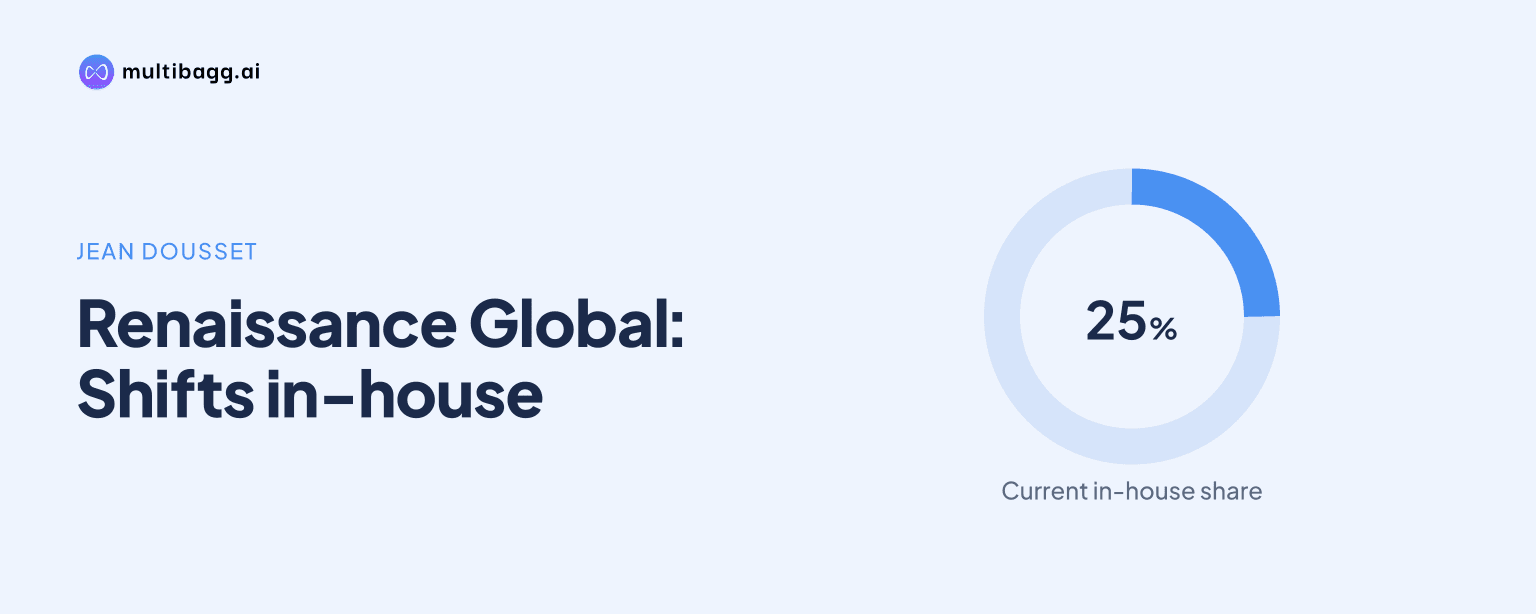
Renaissance Global expects to manufacture all Jean Dousset products in-house within 12 to 18 months, up from about 25% of sales currently made internally. Management said the transition requires staff training, specialist skill upgrades and automation for the luxury lab-diamond business, rather than a capital-intensive manufacturing expansion.
Know Renaissance Global inside out
Results, valuation, peers and who's buying, in one view.
Why is Renaissance Global changing Jean Dousset sourcing?
Renaissance Global is changing Jean Dousset sourcing because about 75% of the brand’s sales are still supplied outside its manufacturing system. Management said this has contributed to higher traded-goods purchases, alongside reduced capacity after the closure of its Bhavnagar facility. The company intends to manufacture all Jean Dousset products internally over time.
Management described Jean Dousset as operating at the extreme luxury end of the lab-diamond market, requiring a measured production transition. The company said the shift would take 12 to 18 months rather than occur immediately, reflecting the need to preserve the product and service standards associated with the brand’s bespoke jewellery model.
The Bhavnagar closure is a separate factor behind the changed manufacturing mix. Management said that both the gradual Jean Dousset integration and the reduction in manufacturing capacity have increased traded goods. It also said the lower employee-cost base followed a broader cost-reduction programme rather than a decision to outsource Jean Dousset permanently.
How will Renaissance Global bring Jean Dousset production in-house?
Renaissance Global said the Jean Dousset programme depends more on skills, training and automation than on major capital investment. Management did not specify a separate manufacturing budget, but said it was constantly investing in employee capability and the automation needed to meet Jean Dousset requirements over the 12-to-18-month transition.
The plan fits a made-to-order business model. Management said about 50% of Jean Dousset and With Clarity sales are made to order, with clients working with advisers to create engagement rings or other jewellery. Jean Dousset custom orders are delivered in three to four weeks, a cycle management linked to inventory turns.
Management said a Jean Dousset boutique can generate about Rs 25 crore of sales with inventory of about Rs 5 crore because a significant share of revenue is made to order. This means the production move is not solely about increasing finished-goods inventory; it also requires the ability to manufacture customised pieces within the stated three-to-four-week delivery period.
Customers can also buy without visiting a boutique. Management put Jean Dousset’s average order value at about Rs 5 lakh, compared with about Rs 7 lakh in stores and Rs 4 lakh online. Store customers tend to customise higher-value engagement rings, while online customers may buy lower-priced items such as earrings or bracelets.
What Jean Dousset margins has Renaissance Global disclosed?
Renaissance Global has not quantified the gross-margin change expected from bringing all Jean Dousset manufacturing in-house. It reported a 68% gross margin for Jean Dousset and a 43% boutique contribution margin before advertising. Management said approximately 25 percentage points of operating overhead bridge the gross margin and the store contribution measure.
The 43% contribution measure is four-wall profitability, meaning it covers operating costs at an individual location but excludes national advertising. Management said it does not allocate advertising by boutique because Jean Dousset uses a national campaign. As a result, the 43% metric is not a fully loaded measure of brand profitability.
Management expects marketing to decline to 17% to 18% of Jean Dousset sales in the current year from about 25% in FY26, as sales rise by 50% without a comparable increase in marketing spending. It said physical boutiques create more advertising leverage than digital-only brands because stores themselves add local visibility.
Got a follow-up? Ask IRIS
How does the manufacturing plan fit Jean Dousset store growth?
Renaissance Global expects Jean Dousset to generate about Rs 160 crore to Rs 175 crore of revenue in the current year, with the entire amount consolidated because Renaissance Global has a controlling stake. Management said Jean Dousset sales should be meaningfully higher next year, when it expects eight boutiques to be operational.
The store base began the financial year with two locations, New York and Los Angeles. Management said the New York store opened in November of the prior year and was performing well, while San Francisco had been open for about three months and recorded month-on-month growth. Boston had been open for only six or seven days when management discussed its early performance.
Management targets annual sales of Rs 25 crore to Rs 30 crore for each Jean Dousset boutique and said San Francisco was tracking within, or slightly above, that range. Each store requires about Rs 10 crore to Rs 12 crore of capital expenditure and inventory combined, with a targeted capital payback period of 12 to 15 months.
Renaissance Global expects direct-to-consumer revenue of Rs 375 crore, comprising roughly Rs 220 crore from With Clarity and about Rs 160 crore from Jean Dousset. Management said With Clarity remains the larger brand, but Jean Dousset is growing faster because new boutiques are being added. The manufacturing transition is therefore occurring alongside expansion in the Jean Dousset sales mix.
What other operating changes affect the transition?
Renaissance Global said its FY26 cost-reduction programme delivered total savings of about Rs 40 crore to Rs 50 crore across overheads. Management clarified that this was not solely a reduction in employee costs, although headcount declined meaningfully. Some employee-cost movements also reflect US dollar-denominated staff costs.
The company is also restructuring its Customer Brands segment by exiting customers representing about Rs 400 crore of revenue because of high working-capital intensity. Management expects Customer Brands revenue of about Rs 1,700 crore to Rs 1,800 crore this year, followed by a run rate of about Rs 1,400 crore to Rs 1,500 crore as inventory held with exited accounts is sold down.
Management said replacement customer business could require about Rs 100 crore of working capital compared with Rs 400 crore for the accounts being exited, with cycles of about 90 days rather than 360 days. It reported Rs 280 crore of cash flow from operations over the previous 12 months and said the shift to lower-intensity customers had helped reduce net debt.
Conclusion
Renaissance Global’s plan would shift Jean Dousset from about 25% internal manufacturing to full in-house production over 12 to 18 months while the brand expands its boutique network. The disclosed 68% gross margin and 43% pre-advertising boutique contribution margin describe existing brand and store economics, but management has not estimated the margin effect of the manufacturing transition itself.
The next measures to watch are progress in skills training and automation, maintenance of three-to-four-week bespoke delivery, and movement toward eight operational boutiques next year. Management also expects Jean Dousset marketing to decline from about 25% of sales in FY26 to 17% to 18% in the current year, while the Bhavnagar closure remains a manufacturing-capacity factor during the transition.