










Renaissance reports ₹103 crore H1 free cash flow after outflow
Key highlights
- Renaissance reported ₹143 crore of cash from operations in H1 FY27, versus an ₹83 crore outflow in H1 FY26.
- Renaissance generated ₹103 crore of H1 FY27 free cash flow after ₹24 crore of interest payments and ₹17 crore of capital expenditure.
- Renaissance's net debt fell ₹144 crore year on year to ₹199 crore, while net debt-to-equity declined to 0.12x from 0.23x.
- Renaissance said its working-capital cycle reduced by 54 days year on year in H1 FY27.
powered by IRIS
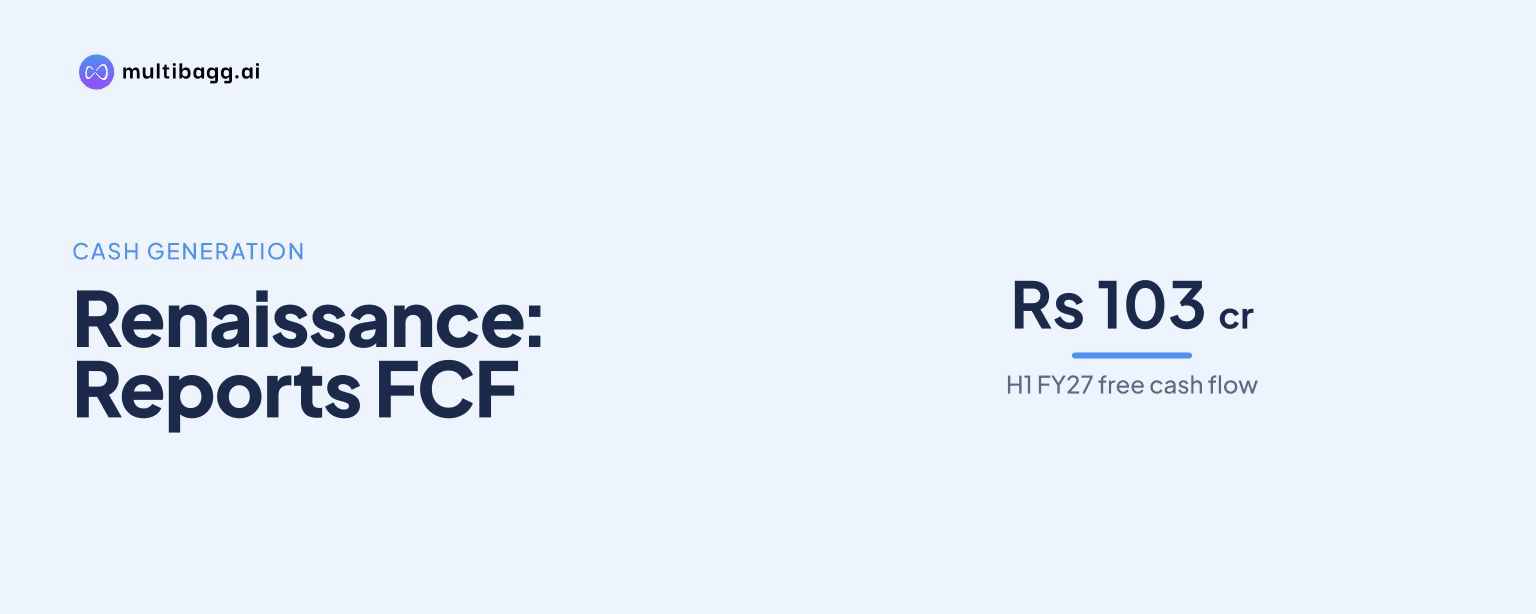
Renaissance Global Limited reported ₹103 crore of free cash flow in the first half of financial year 2027 (H1 FY27), after cash from operations reached ₹143 crore versus an ₹83 crore outflow in H1 FY26. The reversal coincided with a 54-day year-on-year reduction in its working-capital cycle and a ₹144 crore fall in net debt.
Know Renaissance Global inside out
Results, valuation, peers and who's buying, in one view.
What changed in Renaissance's H1 FY27 operating cash flow?
Renaissance moved to ₹143 crore of cash from operations in H1 FY27 from an ₹83 crore outflow in H1 FY26, a ₹226 crore turnaround stated in its November 6, 2026 release. Revenue from operations increased 37.0% year on year to ₹1,474.7 crore, while revenue excluding bullion rose 25.2% to ₹1,329.2 crore.
Renaissance reported ₹103 crore of H1 FY27 free cash flow after interest payments of ₹24 crore and capital expenditure of ₹17 crore. The release did not provide a corresponding H1 FY26 free-cash-flow amount, so the disclosed year-on-year comparison is for operating cash flow rather than free cash flow.
Renaissance also reported trailing 12-month (TTM) cash from operations of ₹280 crore, exceeding its previous peak of ₹229 crore recorded in FY23. TTM free cash flow stood at ₹204 crore, providing a 12-month measure alongside the ₹103 crore generated in the six-month H1 FY27 period.
How did Renaissance's working capital and debt change?
Renaissance said its working-capital cycle reduced by 54 days year on year in H1 FY27, which it presented as an improvement in capital efficiency. In the accompanying commentary, Chairman and Global Chief Executive Officer Sumit Shah referred to the cycle as 53 days shorter than a year earlier, creating a one-day difference from the 54-day figure in the highlights.
Renaissance's net debt declined by ₹144 crore year on year to ₹199 crore, while net debt-to-equity fell to 0.12x from 0.23x in the previous year. Shah said growth was being funded wholly from internal accruals and linked the lower debt to the company's cash-generation momentum.
The release provides the ₹143 crore operating-cash figure, ₹24 crore interest payment and ₹17 crore capital-expenditure figure, but not a full cash-flow reconciliation or a period-end cash balance. It therefore identifies the reported operating-cash turnaround and deleveraging, without disclosing each balance-sheet movement that connected the two measures.
Got a follow-up? Ask IRIS
Which operating trends accompanied Renaissance's cash generation?
Renaissance reported H1 FY27 earnings before interest, tax, depreciation and amortisation (EBITDA) of ₹101.2 crore, up 20.5% from ₹84.0 crore in H1 FY26. Profit after tax rose 91.9% to ₹51.5 crore from ₹26.8 crore, while profit before tax increased 86.9% to ₹61.7 crore.
The EBITDA margin excluding bullion declined to 7.6% in H1 FY27 from 7.9% a year earlier. In contrast, the profit-before-tax margin excluding bullion increased to 4.6% from 3.1%, and the profit-after-tax margin excluding bullion rose to 3.8% from 2.5%.
Bullion sales climbed to ₹145.5 crore in H1 FY27 from ₹14.8 crore a year earlier, contributing to the difference between ₹1,474.7 crore in total revenue from operations and ₹1,329.2 crore in revenue excluding bullion. In the second quarter of FY27 (Q2 FY27), revenue excluding bullion grew 20.3% to ₹639.3 crore and profit after tax rose 27.8% to ₹25.8 crore.
Renaissance said its owned business recorded 33% revenue growth and 57% EBITDA growth in H1 FY27. Shah said the direct-to-consumer brands With Clarity and Jean Dousset were the group's fastest-growing and most profitable businesses; in Q2 FY27, he said owned-brand revenue grew 39% and EBITDA grew 67%.
What is Renaissance planning for Jean Dousset?
Renaissance had four Jean Dousset stores operating when it announced results on November 6, 2026, and targets eight stores by FY27. Shah said four boutiques were trading and that the network would reach eight by the end of the financial year, indicating four further openings from the disclosed base.
Renaissance operates across owned brands, licensed brands and customer brands, and has launched six direct-to-consumer websites since 2020. Its owned-brand portfolio includes Jean Dousset, With Clarity, Irasva, Jewelili and Everyday Elegance, while disclosed licensing agreements include Disney, Hallmark and Star Wars.
Shah said the company was positioned for a strong holiday quarter, citing brands that were scaling, four boutique openings ahead and a lighter balance sheet. That is management's outlook rather than a financial forecast; the release says forward-looking statements are subject to risks including industry, political, economic, tax, import-duty, litigation and labour developments.
Conclusion
Renaissance's H1 FY27 figures show an operating-cash reversal from an ₹83 crore outflow to ₹143 crore of cash from operations, resulting in reported free cash flow of ₹103 crore after ₹24 crore of interest payments and ₹17 crore of capital expenditure. The 54-day working-capital-cycle reduction and ₹144 crore decline in net debt occurred alongside 37.0% growth in revenue from operations.
The next disclosed operational marker is the plan to take Jean Dousset from four stores to eight by FY27, with four openings pending at the announcement date. Results in the holiday quarter and subsequent disclosures will show whether TTM operating cash flow of ₹280 crore and TTM free cash flow of ₹204 crore are maintained while that expansion proceeds.