










Jean Dousset boutiques target 10-month payback as network doubles
Key highlights
- Jean Dousset’s base boutique model assumes about US$0.9 million of capital and a 10-month payback.
- Jean Dousset models US$2.6 million of revenue and US$1.1 million of annual contribution per boutique.
- Jean Dousset had 4 boutiques open and plans to reach 8 by the end of FY27.
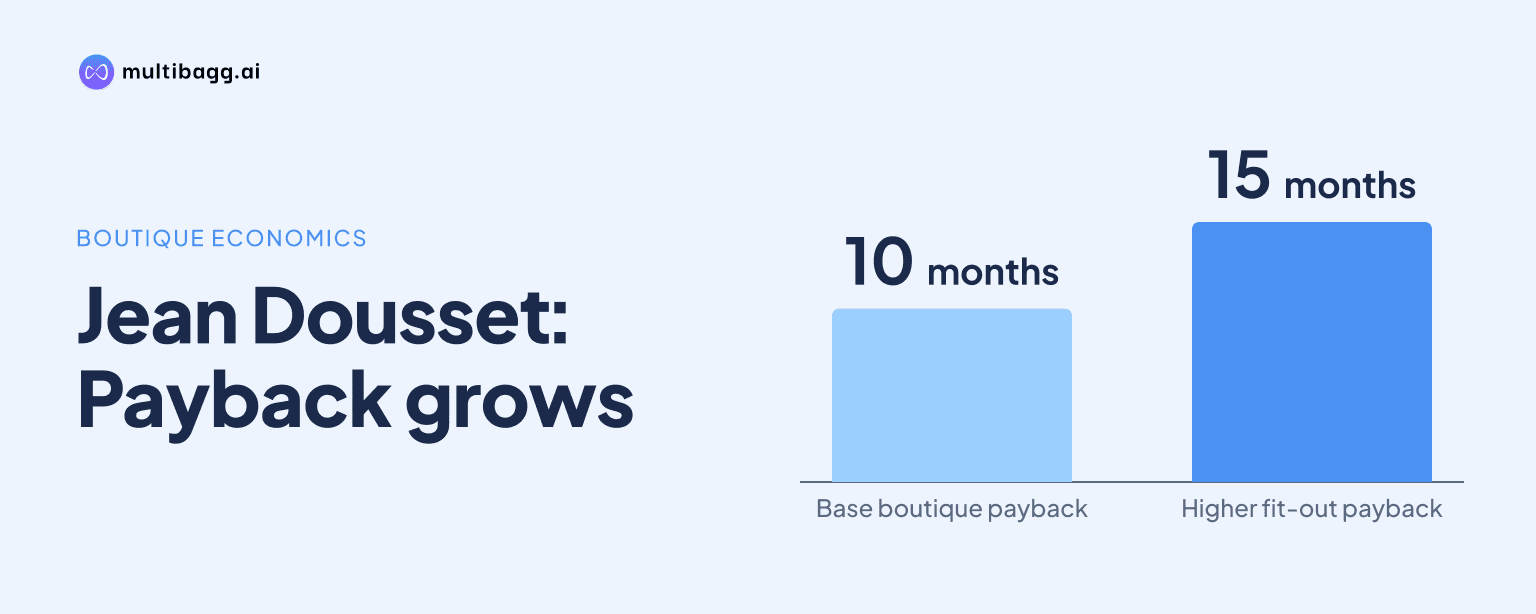
- Higher assumed fit-out capital extends illustrated payback from 10 months to 15 months.
powered by IRIS
Renaissance Global’s Jean Dousset projects a roughly 10-month boutique capital payback in the first full trading year, based on US$1.1 million annual contribution from US$2.6 million revenue against about US$0.9 million capital employed. Four boutiques were open, with four further openings planned to take the network to eight by the end of FY27.
Know Renaissance Global inside out
Results, valuation, peers and who's buying, in one view.
How quickly do Jean Dousset boutiques repay capital?
Jean Dousset estimates that a boutique can repay its capital in about 10 months during its first full year of trading. The model assumes US$0.9 million of capital employed and US$1.1 million of annual contribution, which the presentation says produces a pre-tax return on boutique capital above 100% at steady state, before brand-level costs.
The US$0.9 million requirement includes about US$0.5 million for fit-out and fixtures and about US$0.4 million for boutique inventory. Fit-out spending is implied by annual store depreciation of about US$50,000 over a 10-year life, while inventory is modelled at 55 days of sales because bespoke pieces are made to order and display stock is curated.
Jean Dousset’s US$1.1 million contribution is 43% of its US$2.6 million revenue assumption. The payback calculation therefore relies on boutique-level contribution rather than revenue alone, and the disclosed pre-tax return excludes brand-level costs.
What happens if Jean Dousset fit-out costs increase?
Jean Dousset’s sensitivity analysis shows that payback lengthens as fit-out capital rises while annual contribution remains US$1.1 million. At the base US$0.5 million fit-out assumption, total capital including inventory is US$0.9 million and payback is 10 months; at US$1.0 million of fit-out capital, total capital rises to US$1.4 million and payback reaches 15 months.
The indicated pre-tax return falls from 125% at US$0.5 million of fit-out capital to 80% at US$1.0 million. The intermediate case uses US$0.75 million of fit-out capital, US$1.15 million of total capital and a 13-month payback, showing the effect of capital spending without changing the contribution assumption.
Jean Dousset does not provide separate capital budgets, revenue assumptions or contribution targets for each of the four planned locations. The sensitivity also retains inventory within total capital in every case, but does not provide alternative inventory-days assumptions to accompany the fit-out range.
Got a follow-up? Ask IRIS
Where are Jean Dousset boutiques currently open?
Jean Dousset lists four operating boutiques: Los Angeles in West Hollywood, California; New York in SoHo on Mercer Street; the San Francisco Bay Area at Westfield Valley Fair in Santa Clara; and Boston on Newbury Street. The Boston boutique was the latest listed opening, opening on 4 November 2026.
Jean Dousset identifies premium sites in key markets, luxury-customer footfall, ticket size in luxury lab-grown diamond jewellery and digital-to-store sales as performance drivers. Its boutique-performance page gives a 12- to 15-month payback range, while the subsequent unit-economics page gives approximately 10 months under the US$0.9 million capital model.
The presentation does not reconcile the 12- to 15-month range with the 10-month base-case calculation. However, the sensitivity table produces 13- and 15-month outcomes when fit-out spending increases to US$0.75 million and US$1.0 million respectively, compared with the base US$0.5 million fit-out assumption.
When will Jean Dousset reach eight boutiques?
Jean Dousset plans four further boutiques over the next five months, taking the network from four open stores to eight by the end of FY27. Washington, D.C., on Wisconsin Avenue NW is scheduled to open by 20 November 2026, followed by Chicago on East Oak Street in January 2027.
Miami Beach is scheduled for February 2027 and Dallas on Henderson Avenue is planned for spring 2027. The four additions would double the network, but Jean Dousset does not state whether each planned store will use the base US$0.5 million fit-out assumption or generate the US$1.1 million annual contribution used in the illustrative model.
The schedule provides dates against which the rollout can be assessed: three openings have month-specific timing and Dallas has a spring 2027 target. The stated eight-boutique goal is dated to the end of FY27, rather than presented as an undated expansion objective.
What supports Jean Dousset’s boutique economics?
Jean Dousset links its boutique model to premium locations, targeted luxury footfall, high ticket sizes in luxury lab-grown diamond jewellery and omnichannel sales. Digital-to-store sales are the stated mechanism connecting its online activity with physical boutiques, while the model uses US$2.6 million of annual revenue per boutique.
The inventory assumption is also central to the US$0.9 million capital figure. Jean Dousset assumes 55 days of sales in inventory because bespoke pieces are made to order and display stock is curated, limiting the modelled boutique inventory requirement to about US$0.4 million.
The model represents store-level economics rather than a consolidated measure for Renaissance Global. The disclosed return is pre-tax, based on US$1.1 million of annual boutique contribution, and stated before brand-level costs, so the presentation does not establish an equivalent return for the wider business.
Conclusion
Jean Dousset’s presentation sets out a base boutique model of approximately US$0.9 million in capital, US$2.6 million in revenue and US$1.1 million in annual contribution, producing an indicated 10-month payback. Higher fit-out assumptions extend the illustrated payback to 13 or 15 months, making capital spending a key variable in the disclosed store economics.
The next milestones are the Washington, D.C. opening by 20 November 2026, Chicago in January 2027, Miami in February 2027 and Dallas in spring 2027. Management’s stated target is eight boutiques by the end of FY27, while the presentation leaves unresolved the capital and contribution profile of each new site.