










Rubicon Research Merger Returned After Missing 90% Thresholds
Key highlights
- Rubicon Research’s fast-track merger application was returned under an order dated November 6, 2026.
- Shareholder approval represented 88.65% of total shareholders, versus the stated 90% requirement.
- Unsecured creditors representing 71.83% of total value approved, versus the stated 90% requirement.
- Rubicon Research reported no expected financial implications because KIA Health Tech has no operations.
powered by IRIS
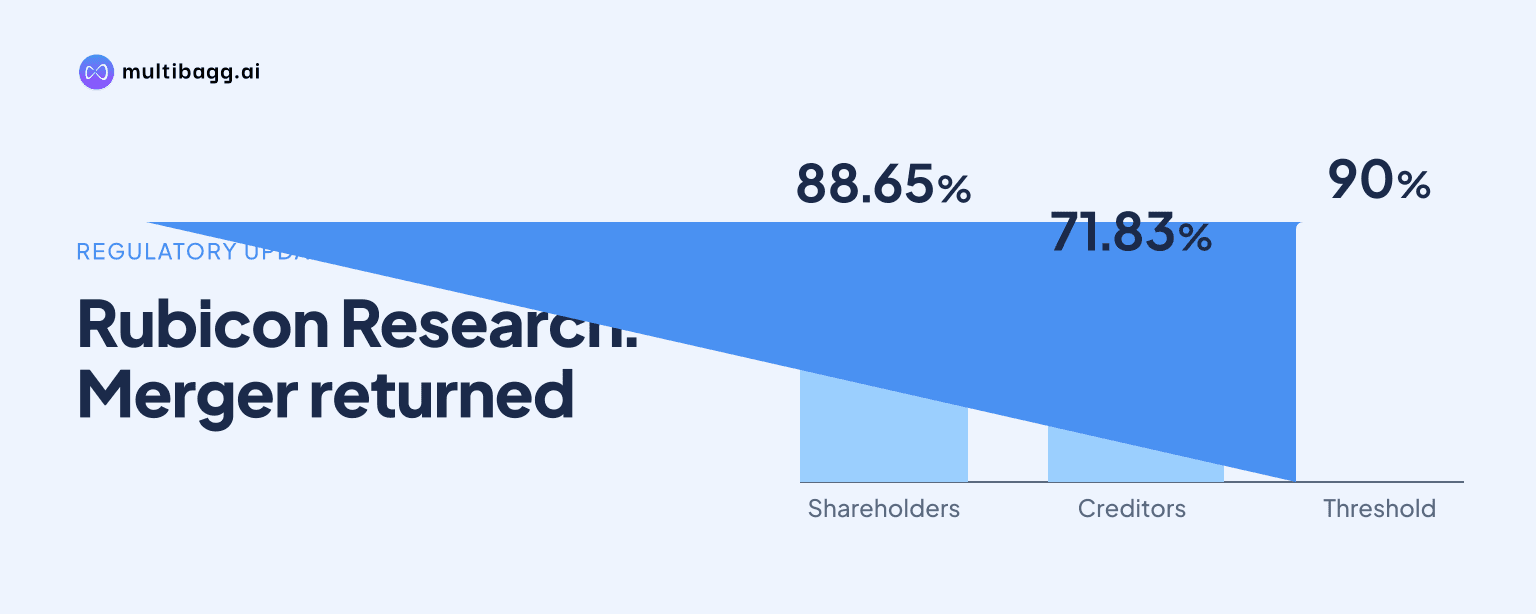
Rubicon Research Limited’s fast-track merger application for inactive wholly owned subsidiary KIA Health Tech Private Limited was returned after approvals covered 88.65% of total shareholders and 71.83% of unsecured-creditor value, below the stated 90% thresholds in the November 2026 disclosure.
Know Rubicon Research inside out
Results, valuation, peers and who's buying, in one view.
Why was Rubicon Research’s fast-track merger application returned?
Rubicon Research’s application was returned because two participation-based approval conditions were not met, despite near-unanimous support among shareholders and creditors who responded. The Office of the Regional Director, Western Region, Ministry of Corporate Affairs, issued its order on November 6, 2026, and Rubicon Research received it on November 13, 2026.
The proposed scheme concerned the merger of KIA Health Tech Private Limited into Rubicon Research through the fast-track route. Rubicon Research described KIA Health Tech as its wholly owned subsidiary and said the proposal was an internal restructuring initiative. The company disclosed the development to BSE Limited and the National Stock Exchange of India Limited on November 14, 2026 under Regulation 30 of the Securities and Exchange Board of India Listing Regulations.
The return was not attributed to an identified aberration, non-compliance, penalty, restriction or sanction. In its annexed disclosure, Rubicon Research reported “none” for each of those categories. The stated reason was narrower: aggregate approval levels did not reach the 90% shareholder and unsecured-creditor-value requirements cited for the fast-track filing.
Which approval thresholds did Rubicon Research miss?
Rubicon Research missed the stated 90% threshold for both total shareholders and the total value represented by unsecured creditors. Shareholder approval covered 88.65% of total shareholders, a 1.35-percentage-point shortfall, while consenting unsecured creditors represented 71.83% of total unsecured-creditor value, an 18.17-percentage-point shortfall.
The shareholder result differed depending on the denominator used. Of shareholders who voted, 99.44% approved the scheme. However, the condition cited by Rubicon Research required approval from 90% of total shareholders, rather than only a high proportion of votes cast, so total shareholder coverage of 88.65% was insufficient.
The creditor result also reflects participation rather than recorded opposition. Rubicon Research said all creditors that responded consented to the merger. Yet those responding creditors represented only 71.83% of total unsecured-creditor value, below the disclosed 90% requirement, because not enough creditors responded.
How do the shareholder and creditor results compare?
Rubicon Research’s shareholder approval was closer to the stated threshold than its unsecured-creditor approval. The shareholder measure was 1.35 percentage points below 90%, while the unsecured-creditor-value measure was 18.17 percentage points below 90%, creating a creditor gap that was 16.82 percentage points larger.
The filing shows a contrast between support and coverage. Among voting shareholders, support was 99.44%, but coverage of the total shareholder base was 88.65%. Rubicon Research did not disclose the number of shareholders, the number voting, or the date on which the approval process occurred in its November 14, 2026 announcement.
For unsecured creditors, Rubicon Research disclosed consent from every creditor that responded but did not provide the number of respondents, the total number of unsecured creditors, or the value of claims. The disclosed 71.83% relates to total unsecured-creditor value rather than headcount. The filing therefore identifies insufficient represented creditor value, rather than dissent from responding creditors, as the relevant shortfall.
Got a follow-up? Ask IRIS
What financial and operating impact did Rubicon Research report?
Rubicon Research reported no expected financial implications from the returned fast-track merger application. It also said the November 6, 2026 order does not have a material impact on business operations because KIA Health Tech presently has no operations.
That assessment places the filing in the context of internal restructuring rather than an operating acquisition or disposal. KIA Health Tech was identified as a wholly owned subsidiary, and Rubicon Research did not disclose revenue, assets, liabilities, consideration, synergies or cost effects for the proposed merger in the November 14, 2026 announcement.
The communication was an order from the Office of the Regional Director, Western Region, under the Ministry of Corporate Affairs, rather than a penalty notice. Rubicon Research’s November 14, 2026 disclosure records no sanction and no restriction arising from the order. The application was returned after the two stated approval thresholds were missed.
What will Rubicon Research do after the returned application?
Rubicon Research is evaluating options that include pursuing the merger through the regular process before the National Company Law Tribunal (NCLT). The company identified the NCLT process as an alternative to the fast-track route used for the proposed merger of KIA Health Tech.
The November 14, 2026 disclosure does not say that Rubicon Research has filed an NCLT application, selected a specific alternative, set a timetable, or started a new creditor or shareholder approval process. It says only that options are under evaluation, including the regular NCLT process. The next procedural step is therefore undecided in the information provided.
The disclosed sequence was that the Regional Director’s order was dated November 6, 2026, Rubicon Research received a copy on November 13, 2026, and the company informed the exchanges on November 14, 2026. Any further progress on the merger depends on the option Rubicon Research chooses after that evaluation rather than on the returned fast-track application.
Conclusion
The returned fast-track route reflects the difference between affirmative responses and the coverage tests disclosed for approval. Rubicon Research recorded 99.44% support among voting shareholders and consent from every responding creditor, but total shareholder coverage and represented unsecured-creditor value remained below 90%. The company also reported no expected financial implication and no material operational impact because KIA Health Tech has no operations.
The next disclosed matter to watch is whether Rubicon Research chooses the regular NCLT process, which management identified as an option under evaluation on November 14, 2026. The filing gives no NCLT submission date, decision date or revised approval timetable.