










Rubicon Reports Five FDA-Approved Nasal Products After 2020 Deal
Key highlights
- Rubicon acquired Toronto nasal and inhalation developer Impopharma in 2020.
- Rubicon filed its first nasal-spray product with the FDA in 2022.
- Rubicon reported five approved nasal products in 2024 and 2025.
- Rubicon’s Ambernath nasal facility received NAI outcomes in March and November 2024.
powered by IRIS
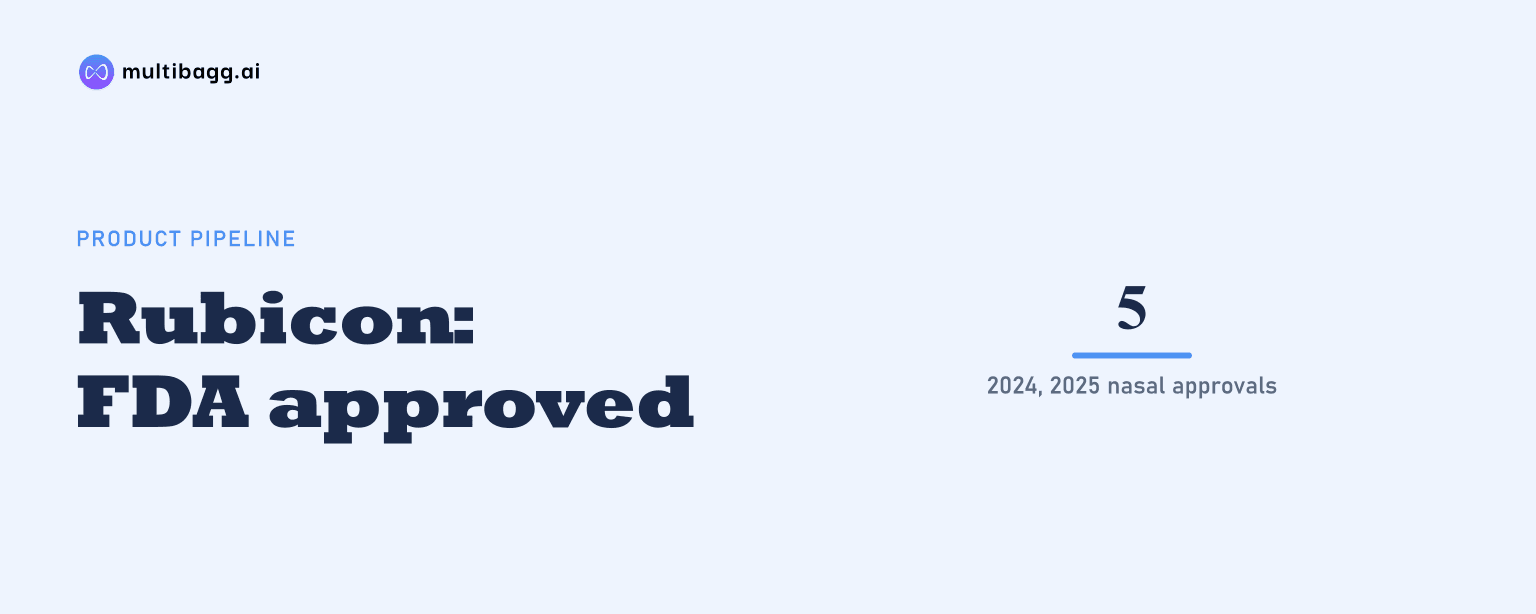
Rubicon Research reported five approved nasal-spray products in 2024 and 2025, after acquiring Toronto developer Impopharma in 2020 and commissioning automated filling capacity in 2023. Its first United States Food and Drug Administration (FDA) approval came in 2023 from a contract manufacturing organisation (CMO) site, before its captive unit-dose and multi-dose facilities received FDA inspection outcomes in 2024.
Know Rubicon Research inside out
Results, valuation, peers and who's buying, in one view.
How did Rubicon build its nasal-spray capability?
Rubicon identified intra-nasal drug delivery as a growth area in July 2019 and initially planned to develop products in-house while outsourcing manufacturing to CMOs. The company cited targeted drug delivery, rapid onset of action, possible central nervous system (CNS) applications and limited competition as the factors behind the strategy.
That initial model changed after Rubicon assessed talent and manufacturing economics in 2019. It found limited nasal and drug-device talent in India, a better specialist talent pool in the United States and Canada, and a need for product-characterisation capabilities. Engagement with CMOs indicated high costs that Rubicon said could affect long-term competitiveness.
Rubicon also expected CMO-sector buyouts, which it said were later borne out by transactions involving Summit, Renaissance and Catalent. The resulting model combined its own sites with CMO sites, rather than relying solely on outsourced production. The company then acquired Impopharma, a nasal and inhalation product-development company in Toronto, in 2020.
Why did Rubicon acquire Impopharma in Canada?
Rubicon acquired Impopharma in 2020 after its July 2019 review found that nasal and drug-device expertise was more available in the United States and Canada than in India. The acquisition preceded Rubicon’s first nasal-spray FDA filing in 2022 by two years, placing the Canadian development capability at the centre of the execution sequence disclosed in the presentation.
The presentation does not disclose Impopharma’s acquisition price, revenue, employee count or standalone contribution to product approvals. It does state that Impopharma was a Toronto nasal and inhalation development company, while Rubicon’s original plan had been to build development capability internally. The disclosed timeline therefore shows an acquisition replacing at least part of that original development plan.
The nasal platform also fits Rubicon’s broader move from services into products. Rubicon operated as a contract development organisation from 1999 to 2008, added small-volume manufacturing, development and out-licensing from 2009 to 2013, and recorded revenue from its own abbreviated new drug applications (ANDAs) from 2014 to 2021. It added drug-device combinations, including intra-nasal sprays, from 2023 onwards.
Rubicon defines specialty products as those with zero or at most one competitor for at least one year following product launch. That definition aligns with its stated interest in limited-competition products, but the presentation does not say that each of the five approved nasal products meets this specialty-product definition.
What manufacturing control has Rubicon added for nasal sprays?
Rubicon commissioned fully automated European filling lines for unit-dose and multi-dose nasal sprays in 2023 at its Ambernath site outside Mumbai. The company describes this facility as one of the largest single-site nasal-spray capacities in the world, although it does not disclose annual output, capacity utilisation or capital expenditure.
The filling investment followed the company’s view in 2019 that CMO manufacturing costs could affect its long-term competitiveness. Rubicon also signed supply partnerships with multiple device suppliers in 2022 to de-risk its pipeline. Its disclosed supply design therefore combines captive filling capacity, multiple device suppliers and continued use of CMO sites.
The Ambernath facility received FDA inspections for multi-dose nasal spray in March 2024 and unit-dose nasal spray in November 2024. Both outcomes were listed as no action indicated (NAI), and Rubicon said the successful inspections paved the way for commercial launch.
Got a follow-up? Ask IRIS
Which nasal approvals has Rubicon reported?
Rubicon’s first FDA nasal-spray approval came from a CMO site in 2023, and the company said it was one of only seven nasal-spray approvals granted that year. This approval occurred after the first nasal filing in 2022 and in the same year as the commissioning of Rubicon’s own automated unit-dose and multi-dose filling lines.
By 2024 and 2025, Rubicon reported five approved products, with further products in the pipeline. The presentation does not name all five products, provide launch dates for each product, or disclose their sales. It identifies Fluticasone Propionate nasal spray in both prescription (Rx) and over-the-counter (OTC) forms as the most recent approvals.
Rubicon said it received the first Rx approval for Fluticasone Propionate nasal spray in more than 15 years in June 2025. It also said another competitor received an approval in August 2026. Rubicon’s approval therefore preceded the disclosed competing approval, though the presentation provides no product-level price, volume, market-share or revenue data.
Management expects the nasal portfolio to benefit from an early-mover position and a captive supply chain. That is management’s expectation rather than a reported financial result. The disclosed execution evidence is the 2020 acquisition, the 2022 filing, the 2023 first approval and capacity commissioning, the two 2024 NAI inspection outcomes, and five approved products in 2024 and 2025.
How does the nasal strategy fit Rubicon’s wider financial and regulatory record?
Rubicon’s revenue from operations increased to Rs 1,754 crore in FY26 from Rs 1,284.3 crore in FY25. Research and development expense rose to Rs 193.5 crore from Rs 132.5 crore, while operating earnings before interest, tax, depreciation and amortisation (EBITDA) increased to Rs 400.2 crore from Rs 264.3 crore.
Research and development expense represented 11% of operating revenue in FY26, compared with 10% in FY25. The change coincided with Rubicon’s move into drug-device combinations from 2023 onwards, but the presentation does not allocate any portion of FY26 research and development expense to the nasal platform.
Rubicon also reported zero observations from FDA inspections of its Canada research and development facility in April 2026 and its Thane research and development headquarters in March 2025. These outcomes are separate from the March and November 2024 inspections of nasal filling at Ambernath, covering both the Canadian development operation and the Indian manufacturing location cited in the platform strategy.
Conclusion
Rubicon’s five reported approved nasal products followed a shift from planned outsourced manufacturing to a mixed model of acquired Canadian development capability, captive Indian filling lines, device-supply partnerships and selected CMO production. The sequence from the 2020 Impopharma acquisition to the first 2023 approval and the two 2024 NAI inspection outcomes documents how the company moved the strategy into its operating model.
What to watch next is progress for the remaining nasal pipeline and commercial launches enabled by the inspected unit-dose and multi-dose facilities. Management expects early entry and captive supply-chain control to benefit the portfolio, while the presentation records a competing Fluticasone Propionate approval in August 2026 after Rubicon’s June 2025 Rx approval. Rubicon does not disclose sales, utilisation or launch timing for the five approved products.