










Rubicon says R&D plan gives revenue visibility to FY2030
Key highlights
- Rubicon spent Rs 313 crore across six quarters toward its Rs 500 crore R&D cycle covering FY2026, FY2027 and Q1 FY2028.
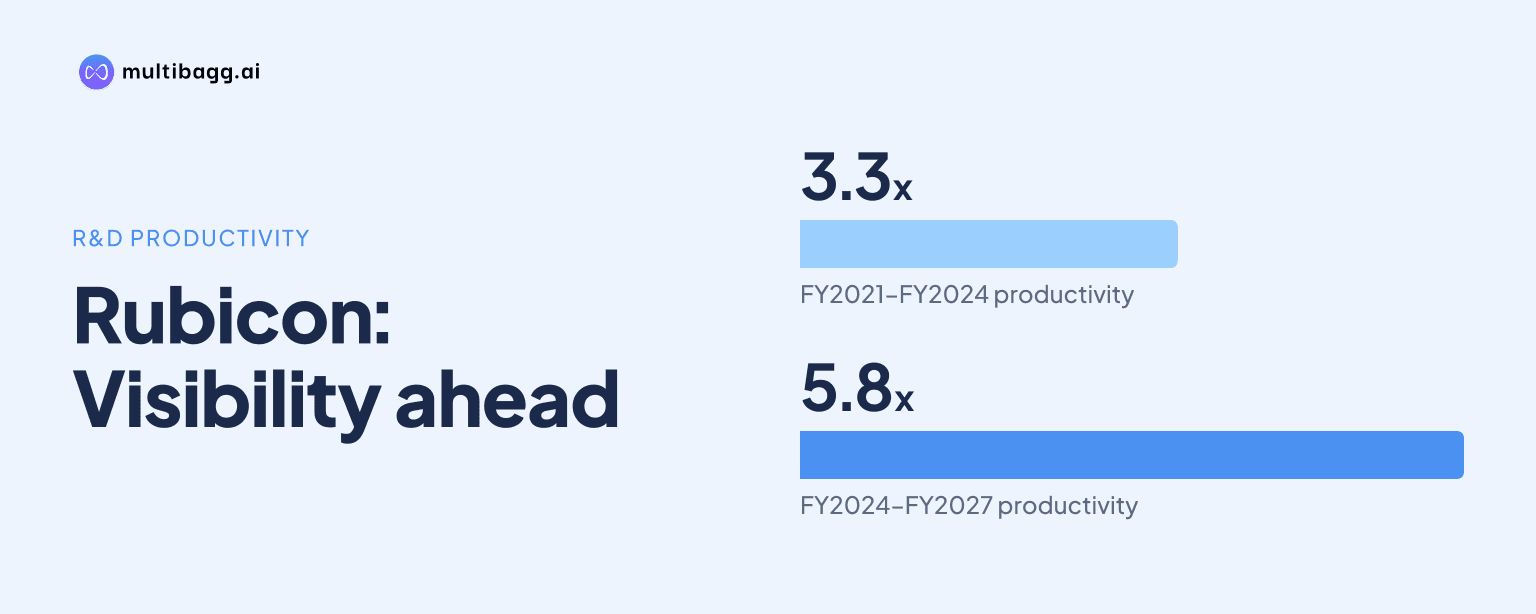
- Rubicon reported R&D productivity of 5.8 times in its FY2024-to-FY2027 product-sales analysis, versus 3.3 times for FY2021 to FY2024.
- Rubicon spent Rs 120 crore on R&D in the first half ended September 2026, equal to 10.8% of consolidated operating revenue.
- Q2 FY27 revenue rose 40% year on year to Rs 577 crore, while operating EBITDA increased 53% to Rs 144 crore.
powered by IRIS
Rubicon Research Limited said on its Q2 FY27 earnings call that Rs 313 crore of research and development (R&D) spending completed over six quarters of a Rs 500 crore cycle gives management visibility on revenue growth through FY2030. Management based that view on R&D productivity reaching 5.8 times in its FY2024-to-FY2027 analysis.
Know Rubicon Research inside out
Results, valuation, peers and who's buying, in one view.
How does Rubicon link R&D spending to FY2030 revenue?
Rubicon links R&D spending to revenue by comparing product-sales growth over three years with spending in the two preceding financial years plus the first quarter of the next year. Management said this reflects the time taken for completed development programmes to affect sales while allowing new products to ramp steadily rather than disrupting margins.
For FY2030, Rubicon is using a current R&D cycle covering FY2026, FY2027 and Q1 FY2028. The company guided for Rs 500 crore of spending in that period, with Rs 313 crore already incurred across six quarters. Management said it had visibility to complete the programme over the remaining three quarters and expects this incremental R&D to support revenue growth to FY2030 relative to the FY2027 base.
The company did not disclose an FY2030 revenue target or a productivity multiple for the Rs 500 crore cycle. Its argument instead rests on completed R&D pools in earlier cycles: Rs 275 crore for the FY2025-to-FY2028 comparison and Rs 384 crore for the FY2026-to-FY2029 comparison. Management said both spending pools were materially higher than the Rs 218.7 crore reference spend in the current FY2024-to-FY2027 analysis.
What does Rubicon’s R&D productivity analysis show?
Rubicon reported that its R&D productivity increased from 3.3 times in the FY2021-to-FY2024 comparison to 5.8 times in the FY2024-to-FY2027 calculation. The metric divides incremental product sales by reference-period R&D spending, rather than measuring the profitability or success rate of individual development projects.
The FY2027 product-sales figure of Rs 2,105 crore is not management guidance. It is an arithmetic annualisation of first-half FY2027 product sales excluding Arinna Lifesciences, and management said the multiple would rise if revenue increased in the second half. The analysis also excludes service revenue and Arinna, which explains why its product-sales figures differ from reported consolidated revenue.
Management said the changing portfolio mix and improved R&D efficiency both contribute to the rising metric. It cited a shift from relatively simpler immediate-release tablets in earlier years toward drug-device combinations and products with larger individual opportunities, while saying the top five and top 10 products remained within narrow ranges across four sequential quarters.
How much is Rubicon spending on R&D?
Rubicon spent Rs 120 crore on R&D in the first half ended September 2026, equal to 10.8% of consolidated operating revenue. In Q2 FY27 alone, R&D expense was Rs 62 crore, also 10.8% of revenue from operations, while all R&D costs were charged to the profit and loss account rather than capitalised.
The company’s spending has changed in both absolute scale and proportion of sales. R&D was about Rs 95 crore in FY2021 and nearly Rs 124 crore in FY2022, when it represented almost 40% of revenue. Rubicon said R&D has since normalised to 10%-11% of operating revenue, although annual expenditure nearly doubled from about Rs 107 crore in FY2024 to nearly Rs 194 crore in FY2026.
The Rs 313 crore already spent against the Rs 500 crore current-cycle plan implies Rs 187 crore remains to be incurred. That is an arithmetic difference, not separate company guidance. Management said the Rs 500 crore programme was on track, providing the disclosed spending base for its FY2030 visibility statement.
Got a follow-up? Ask IRIS
What could affect conversion of R&D into sales?
Rubicon’s R&D-led revenue plan depends on approvals being commercialised, and management reported an 84% commercialisation rate in Q2 FY27. Three approvals were received during the quarter, but management said some launches would move into the following quarter because revised Indian rules allow export-licence applications only after United States Food and Drug Administration approval.
The rule change alters launch timing rather than the reported number of approvals. Rubicon said that, under the previous process, it could prepare licences and manufactured stock while awaiting an approval. In Q2 FY27, revenue rose 40% year on year to Rs 577 crore and operating earnings before interest, tax, depreciation and amortisation (EBITDA) increased 53% to Rs 144 crore.
Management did not quantify what share of R&D is unsuccessful or stopped. It said a stage-gated process subjects projects to de-risking and stress testing before significant spending is committed, while acknowledging that some programmes can still be paused or discontinued later in their life cycle. The company presented the productivity trend as evidence of improving product selection and execution.
What operational capacity and regulatory issues matter?
Rubicon said slightly more than 25% of its capital employed, or almost Rs 400 crore, was in assets that were pre-revenue or had yet to contribute materially to revenue and returns as of September 30, 2026. These included Pithampur, the upcoming Chhatrapati Sambhajinagar facility, the New Jersey facility and Arinna.
Management said Pithampur, Chhatrapati Sambhajinagar and the New Jersey facility were not contributing revenue at the time of the call. The New Jersey acquisition added Rs 85 crore to fixed assets, including Rs 29 crore of cash payout and Rs 55 crore of non-cash right-of-use assets. Arinna added Rs 19.4 crore of revenue to the FY2027 comparisons, but management said its EBITDA contribution was not material in either quarter.
Regulatory outcomes will also affect the expansion plan. New Jersey was inspected in May 2026, Pithampur in July, and Ambernath and Satara in October, meaning all four manufacturing sites had inspections within six months. Management said Ambernath received five observations, Satara one and Pithampur two; it characterised the Ambernath observations as procedural or systems-related and said none concerned data integrity.
Conclusion
Rubicon’s FY2030 revenue-visibility case combines a rise in its reported R&D productivity from 3.3 times to 5.8 times, completed spending pools of Rs 275 crore and Rs 384 crore for the FY2028 and FY2029 comparison cycles, and a Rs 500 crore current programme. The conclusion remains management’s assessment because Rubicon gave no FY2030 revenue target or forecast productivity multiple.
The next disclosed milestones are completion of the remaining Rs 187 crore implied by the current R&D plan over three quarters, launches deferred by the export-licensing process and revenue contribution from the three pre-revenue manufacturing facilities. For FY2027, management raised operating EBITDA guidance to more than 24%, from its prior indication of more than 23%.