










Rubicon Research specialty share reached 36% in H1 FY27
Key highlights
- Rubicon specialty products contributed 36% of gross profit in H1 FY27, after a 32% share in FY2026.
- Specialty gross profit rose from Rs 34.2 crore in FY2023 to Rs 376.7 crore in FY2026.
- Validus was licensed in 43 US states and marketed four brands as of 31 March 2026.
- FY2026 specialty contribution was Rs 310.8 crore after Rs 65.9 crore of Validus operating expenditure.
powered by IRIS
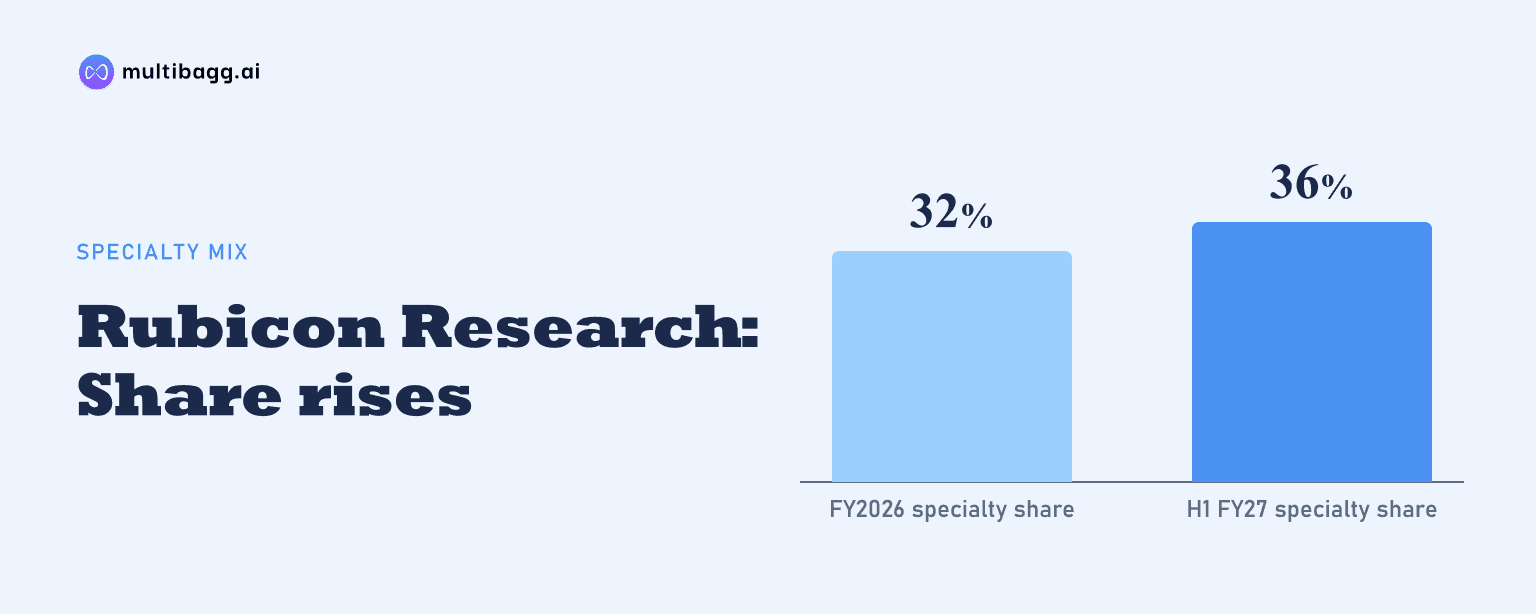
Rubicon Research’s specialty products contributed 36% of gross profit in H1 FY27, following a 32% specialty share in FY2026, while its wholly owned Validus Pharmaceuticals subsidiary was licensed in 43 US states to support branded central nervous system, or CNS, product launches.
Know Rubicon Research inside out
Results, valuation, peers and who's buying, in one view.
What makes Rubicon's products specialty products?
Rubicon defines specialty products as products with zero or one competitor for at least one year after launch. The classification is based solely on competitive intensity and its effect on pricing, rather than on product complexity or the regulatory pathway.
Rubicon combines development capabilities with economic research when selecting specialty products. Management says it validates unmet needs through physician and payer research, including expected reimbursement and coverage levels, while its therapy-discipline approach can create multiple opportunities with the same prescriber audience.
How much did Rubicon's specialty gross profit grow?
Rubicon's specialty gross profit rose from Rs 34.2 crore in FY2023 to Rs 376.7 crore in FY2026, while the number of specialty products increased from 3 to 21. The specialty share of gross profit rose to 32% in FY2026 from 13% in FY2023, before reaching 36% in H1 FY27.
Gx, or generic products, also expanded in absolute gross-profit terms, from Rs 228.9 crore in FY2023 to Rs 789.4 crore in FY2026. Specialty gross profit grew alongside a larger product count, lifting its share by 19 percentage points between those fiscal years.
Rubicon states that specialty status depends on the number of competitors in the first year after launch. Its broader portfolio recorded an average unit-price increase of 8.0% between FY2022 and FY2025, compared with industry-average price erosion of 5.2%, although this measure does not isolate the specialty segment.
What does Validus add to Rubicon's US specialty strategy?
Validus gives Rubicon a US commercial platform for branded prescription products, with licences to market products in 43 states. Rubicon describes Validus as a 100% subsidiary with CNS prescriber coverage in the eastern and southern US that can generate prescriptions and insights into patient needs for pipeline decisions.
Validus products are distributed through specialty channels and all major US wholesalers, according to Rubicon. Management says the 43-state licensing footprint can provide broad reach for new branded launches from day one, supported by commercial and operations teams, support systems and selected-territory healthcare-professional coverage through a contract field force.
As of 31 March 2026, Validus marketed four brands with no US Food and Drug Administration-approved substitutable generics. That branded focus is separate from Advagen, Rubicon's wholly owned US platform for non-branded prescription products sold to wholesalers, group purchasing organizations and pharmacy chains.
Got a follow-up? Ask IRIS
Is Rubicon's specialty business already profitable at group level?
Rubicon reported that the specialty business was profit positive at group level in FY2026, with Rs 376.7 crore of specialty gross profit and Rs 65.9 crore of Validus operating expenditure. That produced specialty contribution of Rs 310.8 crore for FY2026 under the presentation's group-level measure.
This measure shows gross profit generated by the specialty portfolio after Validus operating expenditure, rather than Validus's standalone profitability. Rubicon says Validus standalone financials are not representative of the specialty segment because transfer-pricing rules apply between Validus and Rubicon's India operations.
Management describes the use of specialty cash flows to build a branded platform as an operating plan, not as a separately reported segment result. The FY2026 contribution figure is Rubicon's disclosed basis for saying the specialty business was profit positive at group level while Validus is developed as the branded commercial platform.
How is Validus preparing for branded-product growth?
Validus is preparing for growth through wider patient access, deeper payer and pharmacy benefit manager, or PBM, relationships, and expanded healthcare-professional coverage. Rubicon says this coverage will combine its own field force with digital marketing initiatives, while logistics and distribution capabilities are also being augmented.
The stated plan builds on Validus's existing 43-state licences, specialty-channel distribution and major-wholesaler access. The presentation provides no launch timetable, revenue target or number of additional Validus brands, so the disclosed evidence concerns capability-building rather than a quantified branded-sales forecast.
Rubicon had 90 active approved products as of 30 September 2026 and had commercialized 76, equal to a US commercialization rate of 84%. Those figures cover the broader approved-product portfolio, but they provide context for Rubicon's US commercial base as Validus develops branded specialty capabilities.
Conclusion
Rubicon's disclosed figures show that specialty products have become a larger part of its economics: specialty gross profit increased from Rs 34.2 crore in FY2023 to Rs 376.7 crore in FY2026, and the specialty share reached 36% in H1 FY27. Validus complements that product strategy with branded-product commercial capabilities, four marketed brands as of 31 March 2026 and licences covering 43 US states.
The next point to watch is execution of Validus's stated plan to widen patient access, deepen payer and PBM relationships, expand field-force coverage, use digital marketing and augment distribution. Rubicon has not disclosed a branded-product revenue target or timetable for new launches, so future progress will depend on evidence that these capabilities translate into branded commercial activity.