










S. P. Retail posts Rs 50 lakh H1 EBITDA after losses
Key highlights
- S. P. Retail reported Rs 50 lakh EBITDA in H1FY27 versus a Rs 1.54 crore EBITDA loss in H1FY26.
- S. P. Retail said EBITDA was positive for five consecutive quarters.
- Like-for-like sales rose 16.8% across 45 exclusive stores during April to August.
- S. P. Retail said D2C and online business grew threefold.
powered by IRIS
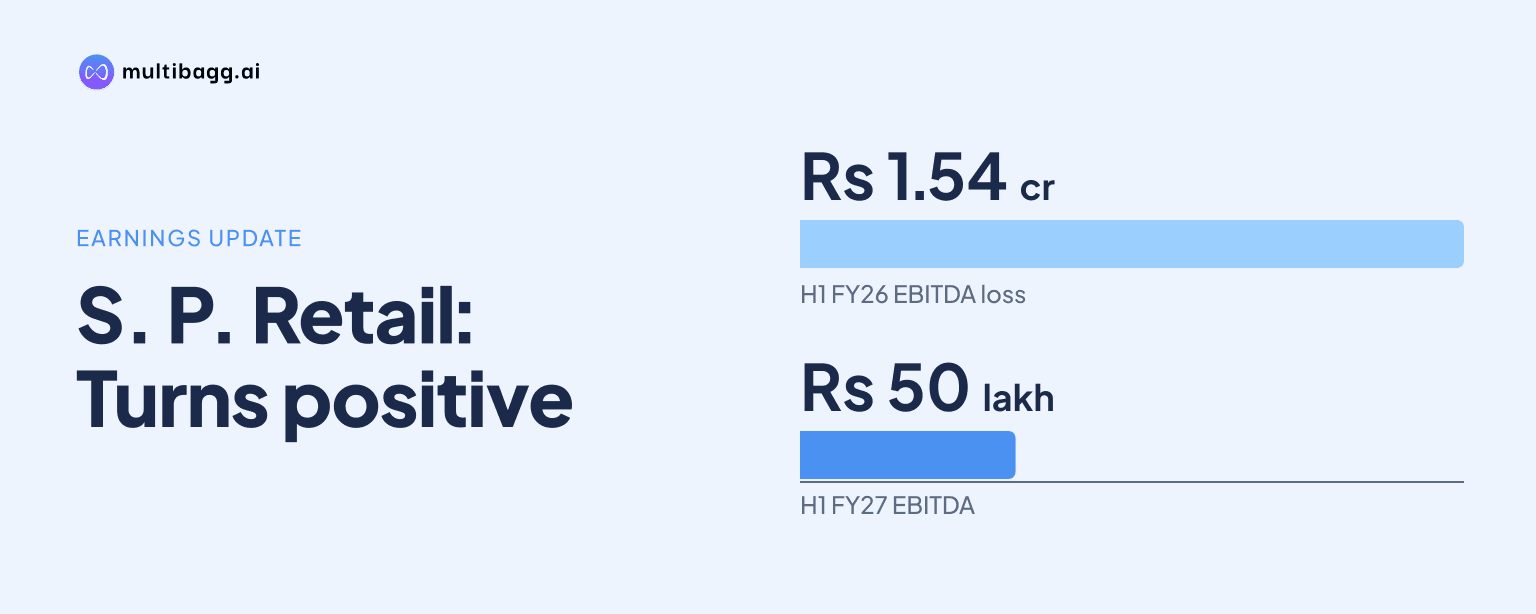
S. P. Retail reported Rs 50 lakh of EBITDA in H1FY27, compared with a Rs 1.54 crore loss in H1FY26, ending the half year positive after five consecutive profitable quarters. The division attributed the shift to 16.8% like-for-like sales growth at 45 exclusive stores and threefold direct-to-consumer and online growth.
Know S P Apparels inside out
Results, valuation, peers and who's buying, in one view.
What drove S. P. Retail's return to EBITDA profit?
S. P. Retail's return to EBITDA profit was driven by higher productivity at existing stores and faster growth in digital channels. EBITDA, or earnings before interest, tax, depreciation and amortisation, was positive for five consecutive quarters, according to the presentation, and store-level EBITDA improved alongside the 16.8% like-for-like sales gain.
The H1FY27 outcome followed annual EBITDA losses from FY22 through FY26. The annual loss narrowed sharply to Rs 61 lakh in FY26 from Rs 6.84 crore in FY25, before the division reported Rs 50 lakh of EBITDA in H1FY27. This shows that the improvement in the latest half year followed a substantial reduction in the prior year's losses.
S. P. Retail also connected the result with inventory and working-capital management. Management said inventory was under control to support sales and store operations, while working capital remained healthy and provided operational flexibility. The presentation does not provide a retail inventory value, retail cash flow or retail EBITDA margin, so the financial effect of these measures is not quantified.
How much did S. P. Retail's existing-store sales grow?
S. P. Retail's like-for-like sales increased 16.8% across 45 exclusive stores during April to August in both comparison years. Like-for-like sales compare sales from the same operating stores, rather than growth resulting from newly opened locations. The company said store-level EBITDA improved as productivity increased across the existing retail network.
The division's distribution extends beyond those 45 comparable exclusive stores. S. P. Retail reported 94 large-format outlets, 36 company-owned stores and 19 franchisee stores, as well as 117 distributor, shop-in-shop and department-store channels. It also disclosed retail space of 59,030 square feet and about 121,000 loyal customers across stores and online channels.
Crocodile had 51 standalone stores in the disclosed portfolio. Angel & Rocket had five standalone stores and placements in 46 large-format stores, serving children aged zero to 14 years. The portfolio also includes Natalia, a women's western-wear brand with ethnic styling targeted at consumers aged 20 to 35 years, although the presentation gives no brand-level revenue or EBITDA figures.
Got a follow-up? Ask IRIS
How significant is digital growth for S. P. Retail?
S. P. Retail said its direct-to-consumer, or D2C, and online business grew threefold and contributed significantly to revenue growth. Management described the channels as meaningful growth engines that are broadening the division's revenue mix. The presentation does not disclose the base-period digital revenue, current digital revenue or online share of total retail revenue.
Digital sales operate alongside a physical distribution model in the information provided. Crocodile is distributed through physical stores, a wider sales network and several e-commerce platforms, while Angel & Rocket combines five standalone stores with 46 large-format placements. The threefold digital expansion and 16.8% comparable-store sales growth therefore represent two separately identified contributors to the turnaround.
S. P. Retail said its retail model combines a distribution network, in-house design capability and a growth strategy across Crocodile, Angel & Rocket and Natalia. Management specifically cited digital acceleration and store performance as drivers of profitable growth. It did not disclose targets for digital sales, store openings, online profitability or division-level EBITDA margin.
How did S. P. Retail's revenue trend compare with profitability?
S. P. Retail generated Rs 71.54 crore of revenue in FY26, down from Rs 79.41 crore in FY25, while its EBITDA loss narrowed to Rs 61 lakh from Rs 6.84 crore. The comparison means the FY26 reduction in losses occurred despite lower annual revenue. The company separately showed H1FY27 revenue of Rs 39 crore in a rounded retail revenue chart, without an H1FY26 comparison.
Revenue increased from Rs 48.02 crore in FY22 to Rs 71.54 crore in FY26, but it reached Rs 82.91 crore in FY24 before falling in FY25 and FY26. The presentation characterises the FY22-to-FY26 change as 49% growth and a 10% compound annual growth rate. The annual figures also show that revenue growth over the five-year period did not prevent EBITDA losses until the H1FY27 result.
The garment division, including Young Brand Apparel in FY25 and FY26, reported FY26 revenue of Rs 1,421.98 crore and EBITDA of Rs 230.57 crore. By comparison, S. P. Retail's FY26 revenue was Rs 71.54 crore and its EBITDA was a Rs 61 lakh loss. The presentation reports these divisional numbers but does not provide a retail margin, preventing a like-for-like margin comparison.
Conclusion
S. P. Retail's Rs 50 lakh H1FY27 EBITDA marks a shift from the losses reported for FY22 through FY26. The evidence presented identifies two operational contributors: 16.8% like-for-like sales growth across 45 exclusive stores and threefold growth in D2C and online business. The FY26 result had already narrowed the EBITDA loss to Rs 61 lakh, despite a decline in annual retail revenue.
The next development to watch is the division's proposed funding activity. S. P. Retail said it is actively seeking a strategic investor to support growth initiatives and plans to raise capital from the market shortly, without giving an amount or timetable. Future disclosures on digital revenue, store additions, retail margins and working capital would provide further evidence on whether the H1FY27 EBITDA result is sustained.