










SPAL utilisation drops to 74% after machine base expansion
Key highlights
- SPAL garment capacity utilisation fell to 74% in Q2FY27 from 83% in Q2FY26.
- SPAL’s garment machine base increased to 5,700 in Q2FY27 from 4,950 a year earlier.
- Export volume declined to 14.1 million pieces, while net sales realisation rose to Rs 162.9 per piece.
- Garmenting adjusted operational revenue increased to Rs 399.26 crore in Q2FY27, while adjusted EBITDA margin was 16.1%.
powered by IRIS
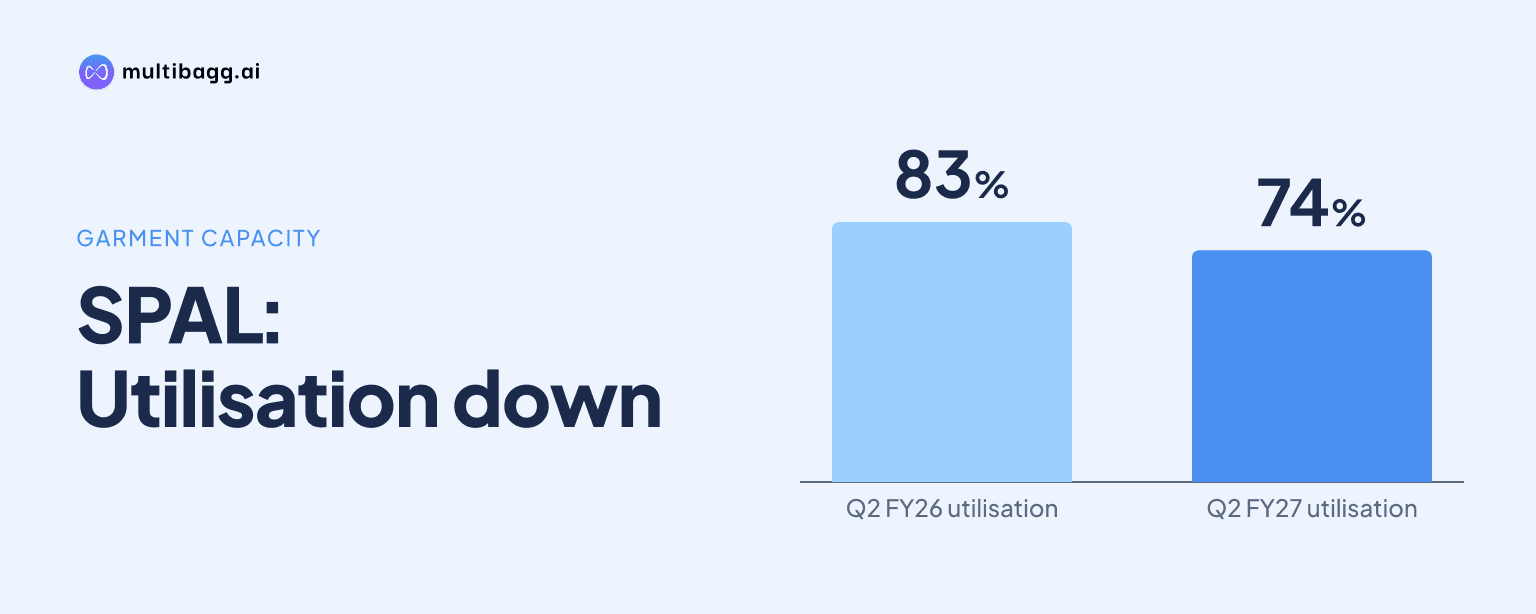
S. P. Apparels Limited reported garment-division capacity utilisation of 74% in Q2FY27, versus 83% in Q2FY26, as the machine base increased to 5,700 from 4,950 and export volume fell to 14.1 million pieces. SPAL’s net sales realisation nevertheless rose to Rs 162.9 per piece from Rs 142.3.
Know S P Apparels inside out
Results, valuation, peers and who's buying, in one view.
Why did SPAL’s garment utilisation fall in Q2FY27?
SPAL’s utilisation fell to 74% because it measured production against a larger base of 5,700 machines in Q2FY27, while export volume declined to 14.1 million pieces from 18.9 million pieces in Q2FY26. The comparable machine base was 4,950 in Q2FY26, when utilisation was 83%.
The Q2FY27 reading was also below the 75% utilisation reported for FY26, which SPAL calculated on 4,950 machines. Its annual utilisation had risen from 72% in FY23 to 76% in FY24 and 85% in FY25, before declining to 75% in FY26, showing that the current quarter followed both lower volume and an expanded installed base.
Utilisation is a measure of capacity used rather than a direct measure of revenue. Despite the lower rate, SPAL’s garmenting adjusted operational revenue rose to Rs 399.26 crore in Q2FY27 from Rs 389.21 crore in Q2FY26, indicating that revenue growth occurred alongside lower factory loading.
How did SPAL’s export volumes and realisation change?
SPAL exported 14.1 million pieces in Q2FY27, down 4.8 million pieces from 18.9 million in Q2FY26, while net sales realisation increased by Rs 20.6 per piece to Rs 162.9 from Rs 142.3. The disclosed figures therefore show lower export volume alongside higher price realisation.
The Q2FY27 realisation of Rs 162.9 per piece was the highest in the five-quarter series presented by SPAL. Realisation rose from Rs 126.2 in Q3FY26 and Rs 141.5 in Q4FY26 to Rs 150.1 in Q1FY27, while export volume moved from 18.2 million pieces to 14.8 million, 15.7 million and then 14.1 million pieces over the same sequence.
Young Brand Apparel, which SPAL says will be included in the Garment Export Division going forward, recorded a different volume trend. Its sales volume increased to 7.6 million pieces in Q2FY27 from 6.0 million pieces in Q2FY26 and 5.0 million pieces in Q1FY27, while adjusted operational revenue rose 29.4% year on year to Rs 109.13 crore.
What was the effect on SPAL’s garment division earnings?
SPAL’s garmenting adjusted operational revenue increased to Rs 399.26 crore in Q2FY27 from Rs 389.21 crore, but adjusted EBITDA, or earnings before interest, tax, depreciation and amortisation, declined to Rs 64.39 crore from Rs 66.55 crore. The adjusted EBITDA margin consequently decreased to 16.1% from 17.1%.
The H1FY27 comparison differed from the quarterly outcome. Adjusted garmenting revenue declined to Rs 736.59 crore from Rs 762.14 crore in H1FY26, while adjusted EBITDA increased to Rs 123.62 crore from Rs 120.82 crore and the margin rose to 16.8% from 15.9%.
At the consolidated level, SPAL’s revenue from operations rose 5.8% to Rs 452.22 crore in Q2FY27, EBITDA increased 4.7% to Rs 66.65 crore, and profit after tax rose 6.8% to Rs 37.06 crore. Consolidated EBITDA margin was 14.7%, compared with 14.9% a year earlier, while profit after tax margin increased to 8.2% from 8.1%.
Other segments produced mixed Q2FY27 results. SPUK, or S.P. Apparels UK, increased operational revenue to Rs 38.09 crore from Rs 17.99 crore but reported an EBITDA loss of Rs 0.99 crore against EBITDA of Rs 1.13 crore a year earlier; retail revenue declined to Rs 19.72 crore from Rs 21.68 crore and retail EBITDA fell to Rs 0.22 crore from Rs 0.53 crore.
Got a follow-up? Ask IRIS
What utilisation and margin headroom has SPAL outlined?
SPAL has said its traditional garment division can raise utilisation from the FY26 level of 75% toward peak utilisation of about 90% or more within the current operational setup. This is management’s stated operating-capacity potential, not a disclosed FY27 utilisation target, and the reported Q2FY27 rate was 74%.
Management has also guided that adjusted EBITDA margin should remain sustainable at about 17%. SPAL reported adjusted garment-division EBITDA margins of 18% in FY23 and FY24, followed by 17% in FY25 and FY26; its Q2FY27 margin was 16.1%, while its H1FY27 margin was 16.8%.
SPAL plans to diversify the traditional garment mix by reducing dependency on kidswear and increasing adultwear. Its established garment business focuses on knitted infant and children’s apparel, while Young Brand Apparel adds intimate-wear exports and reported a Q2FY27 adjusted EBITDA margin of 16.6%, compared with 14.5% in Q2FY26.
Which expansion plans could affect future utilisation?
SPAL entered Sri Lanka in January 2025 through a subsidiary and is targeting customer-approved factories for acquisition. The company says its India and Sri Lanka manufacturing platform can offer sourcing flexibility, while its presentation identifies duty-free trade to Europe and UK markets as a Sri Lanka advantage.
Young Brand Apparel has commenced commercial production at an additional Palladum factory, which SPAL says has started contributing to revenue, and is adding machines at Salem. Once Salem is operational, management plans to add capacity in nearby Indian areas and is evaluating Sri Lanka capacity linked to the country’s lingerie-production capabilities.
SPUK’s customer-addition plan is another potential driver of order flow. Management expects its top five to six customers to generate GBP 2 million to GBP 3 million annually and anticipates at least 10% annual growth per customer, but the presentation does not disclose a timetable for achieving that contribution.
Conclusion
SPAL’s Q2FY27 results show the trade-off between capacity expansion and current factory loading: utilisation fell to 74% on 5,700 machines and export volume declined to 14.1 million pieces, but realisation reached Rs 162.9 per piece and garmenting adjusted operational revenue increased to Rs 399.26 crore. Quarterly adjusted EBITDA margin fell to 16.1%, although the H1FY27 margin improved to 16.8%.
The next disclosed factors to watch are whether utilisation moves toward management’s stated peak level of about 90% or more and whether adjusted EBITDA margin stays near the guided 17%. Salem machine additions, the Palladum production ramp-up, potential Sri Lanka factory acquisitions and SPUK’s planned customer additions could change both available capacity and the orders needed to use it.