










Sai CDMO revenue reaches ₹1,417 crore, pharma share 94%
Key highlights
- Sai’s CMC Services revenue rose to ₹1,417 crore in FY26 from ₹1,068 crore in FY25.
- Pharma customers supplied 94% of Sai’s FY26 CMC Services revenue, up from 91% in FY25.
- Sai reported a 155-program CMC Services pipeline across multiple therapy areas.
- CNS contributed 25% of Sai’s FY26 CMC Services revenue, the largest disclosed therapy-area share.
powered by IRIS
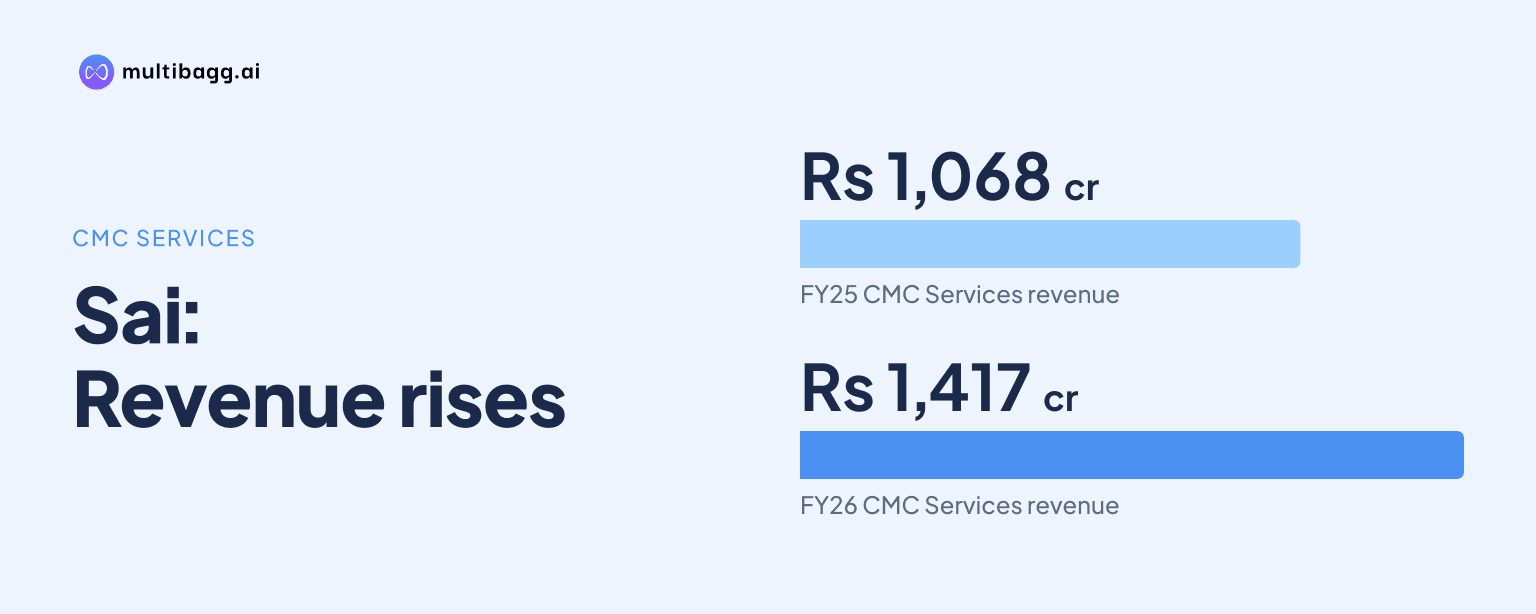
Sai Life Sciences Limited’s CMC Services, its contract development and manufacturing organization (CDMO) business, generated ₹1,417 crore of revenue in FY26, compared with ₹1,068 crore in FY25, while pharma customers contributed 94% of the FY26 total, up from 91% a year earlier.
Know Sai Life Sciences inside out
Results, valuation, peers and who's buying, in one view.
How fast did Sai’s CDMO revenue grow?
Sai’s CMC Services revenue rose by ₹349 crore from FY25 to FY26, reaching ₹1,417 crore after reporting ₹1,068 crore in the preceding year. The business increased revenue in each of the five financial years shown by Sai, from ₹596 crore in FY22 to ₹760 crore in FY23, ₹968 crore in FY24, ₹1,068 crore in FY25 and ₹1,417 crore in FY26. Sai states a 25% compound annual growth rate, or CAGR, for FY22 to FY26.
The FY26 increase of ₹349 crore was larger than the ₹100 crore addition between FY24 and FY25. Across FY22 to FY26, CMC Services added ₹821 crore of revenue. Sai presents the business as serving customers from hit-to-lead, or H2L, development through commercial supply, linking development work, manufacturing and lifecycle activities.
Why does Sai’s pharma customer mix matter?
Sai’s FY26 CMC Services revenue was 94% from pharma customers and 6% from biotech customers, compared with 91% and 9%, respectively, in FY25. The three-percentage-point increase in pharma’s contribution means the segment’s revenue expansion coincided with a higher share from pharma clients. The presentation does not disclose client names, customer counts, contract values or individual-customer revenue contributions.
Sai describes its CMC Services offering as end-to-end, from an investigational new drug, or IND, through to commercialization. Its listed work includes discovery process chemistry, active pharmaceutical ingredient, or API, developability, supply-route optimisation, commercial-route selection, process optimisation, control-strategy definition, continuous verification and continuous improvement. These activities span pre-clinical work, Phase 1, Phase 2 and Phase 3 development, process validation and commercial supply.
Got a follow-up? Ask IRIS
What capabilities support Sai’s CMC Services pipeline?
Sai reports 155 programs in its CMC Services pipeline across multiple therapy areas. The company says it focuses on complex chemistry as well as antibody-drug conjugate, or ADC, payloads and linkers, and can support both small-scale clinical supplies and large-scale commercial production. Its CMC Services facilities are in the United Kingdom and India and are described as modern and compliant with good manufacturing practice, or GMP.
Sai also cites a record of commercialising new chemical entities, or NCEs, and identifies regulatory records with the US Food and Drug Administration, or USFDA, and the Pharmaceuticals and Medical Devices Agency, or PMDA. The presentation does not specify how the 155 programs are divided between clinical stages, commercial products, customer types or sites. It also does not state when individual pipeline programs could move into commercial supply.
Sai presents its operating model as phase-appropriate integration of scientific and manufacturing work. The sequence includes API developability and supply-route optimisation early in development, followed by process design, control strategy and continuous verification nearer to process validation and commercial operations. This approach connects CDMO revenue with work that can start before commercialisation, although Sai provides no program-level revenue forecasts or conversion targets.
Which therapy areas contributed most to Sai’s FY26 CDMO revenue?
Sai’s largest disclosed FY26 therapy contribution was central nervous system, or CNS, at 25% of CMC Services revenue. Infectious diseases accounted for 16%, while oncology and the category labelled others each contributed 15%. The next-largest named categories were metabolic disorders at 8%, followed by anti-histamine and cardiovascular at 7% each.
Sai states that therapy-area contribution varies year to year according to client portfolio mix and project timelines. It specifically says the percentages are not indicative of broader market trends. The FY26 mix therefore shows the composition of Sai’s CMC Services revenue for that year, rather than an assessment of demand across CNS, oncology, infectious diseases or the other listed fields.
Conclusion
Sai’s FY26 CMC Services result combines five years of rising revenue with a customer base that became more pharma-led in the latest year. Revenue reached ₹1,417 crore, up ₹349 crore from FY25, while pharma represented 94% of the business. The 155-program pipeline, end-to-end service scope and therapy-area mix provide the operating context for the segment’s FY26 outcome.
The next point to watch is how Sai’s 155 CMC Services programs progress through the stated development stages, from pre-clinical work and clinical phases to process validation and commercial supply. Sai also says therapy contributions can vary with client portfolio mix and project timelines, making future changes in the 25% CNS share and other FY26 therapy allocations relevant to monitor.