










Sai Discovery revenue hits Rs 775 crore as pharma mix rises
Key highlights
- Sai Discovery Services revenue increased from Rs 274 crore in FY22 to Rs 775 crore in FY26, a reported 30% CAGR.
- Pharma represented 48% of Sai Discovery Services customer mix in FY26, up from 38% in FY25.
- More than 65% of Sai Discovery programmes are integrated.
- Sai’s development and manufacturing services reported Rs 1,417 crore of FY26 revenue and a 25% CAGR from FY22 to FY26.
powered by IRIS
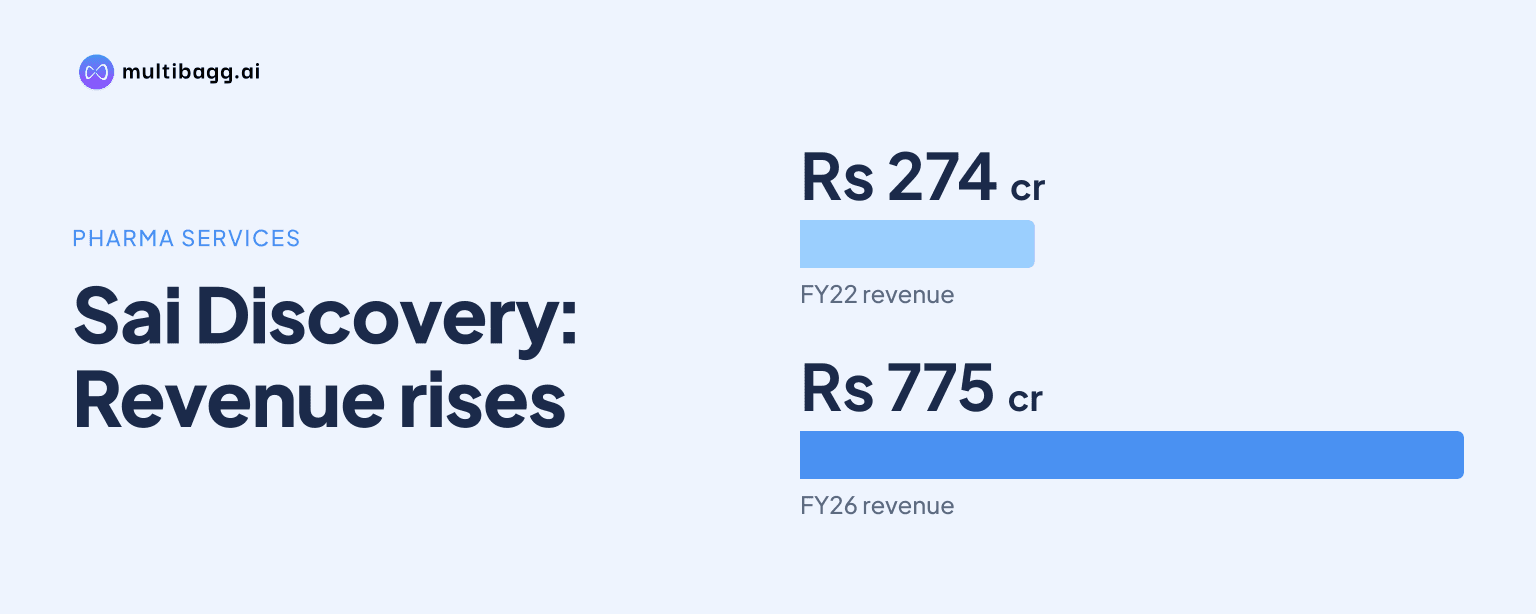
Sai Life Sciences Limited reported Rs 775 crore of Discovery Services revenue in FY26, following a reported 30% compound annual growth rate from FY22, while pharma represented 48% of its customer mix, up from 38% in FY25. The disclosure shows revenue expansion alongside a narrower gap between pharma and biotech clients.
Know Sai Life Sciences inside out
Results, valuation, peers and who's buying, in one view.
How fast is Sai’s Discovery Services business growing?
Sai’s Discovery Services revenue increased from Rs 274 crore in FY22 to Rs 775 crore in FY26, and Sai reports a 30% compound annual growth rate, or CAGR, across the period. The business is presented as Sai’s contract research organisation, or CRO, segment, covering synthetic and medicinal chemistry, biology, computational chemistry, drug metabolism and pharmacokinetics, or DMPK, and toxicology.
Revenue rose to Rs 467 crore in FY23, Rs 497 crore in FY24, Rs 626 crore in FY25 and Rs 775 crore in FY26. The increase was Rs 501 crore between FY22 and FY26, while the annual increase moved from Rs 30 crore between FY23 and FY24 to Rs 129 crore in FY25 and Rs 149 crore in FY26.
Sai positions Discovery Services within an integrated research, development and manufacturing model spanning target identification and validation through investigational new drug, or IND, stage. Its stated discovery activities include integrated drug discovery, complex chemical synthesis, in-vitro and in-vivo pharmacology, absorption, distribution, metabolism and excretion, or ADME, profiling, and toxicology evaluation.
How has Sai’s Discovery customer mix changed?
Sai’s pharma share of the Discovery Services customer mix rose by 10 percentage points to 48% in FY26 from 38% in FY25, while biotech’s share declined to 52% from 62%. Biotech remained the larger group in FY26, but the difference between the two client categories narrowed to 4 percentage points from 24 percentage points a year earlier.
The mix changed while Discovery Services revenue increased by Rs 149 crore, from Rs 626 crore in FY25 to Rs 775 crore in FY26. Sai does not disclose revenue generated separately from pharma and biotech, so the percentages show customer-mix composition rather than each category’s rupee contribution. The presentation also does not identify whether the movement reflected new customers, larger programmes or project timing.
Sai’s development and manufacturing business has a different split: pharma accounted for 94% and biotech for 6% of that segment’s FY26 customer mix. Compared with Discovery Services at 48% pharma and 52% biotech, this shows that Sai’s discovery operation had a more evenly divided client base in FY26.
Are Sai’s Discovery programmes becoming more integrated?
Sai says more than 65% of Discovery Services revenue in FY23 to FY26 came from customers that used more than one discovery service. The company defines those services as chemistry, biology and/or DMPK, making the measure an indicator of multi-service customer use rather than revenue from a single standalone activity.
Sai separately states that more than 65% of Discovery programmes are now integrated, using next-generation biology, automation and artificial intelligence, or AI. The two measures are not identical: the first covers revenue from multi-service customers across FY23 to FY26, while the second covers the share of programmes described as integrated. Sai gives neither an exact percentage above 65% nor an earlier integration rate for comparison.
Sai’s stated operating focus is automation and scale in DMPK and biology to handle large integrated programmes. The company also cites scaled chemistry, biology, DMPK and in-vivo laboratories, alongside its Hyderabad campus and Boston Biology Lab, as supporting parallelised research, collaboration and rapid technology transfer.
Got a follow-up? Ask IRIS
What technologies and modalities support Sai’s Discovery strategy?
Sai lists AI-enabled retrosynthesis tools, high-throughput experimentation, DMPK automation and computer-aided drug design, or CADD, in-silico tools as Discovery technologies. These tools are used alongside the more than 65% integrated-programme model that Sai says is intended to accelerate development and improve outcomes.
Sai is expanding Discovery capabilities in peptides, antibody-drug conjugate, or ADC, payloads, oligonucleotides, targeted protein degraders, or TPDs, and other modalities. The presentation describes these specialised areas as supporting high-value Discovery growth, but provides no separate revenue, customer count or programme total for any of them.
The Discovery platform also includes organoids and spheroids, which Sai says enable predictive, United States Food and Drug Administration-aligned efficacy and toxicity testing. Its wider manufacturing network has 700 kilolitres of capacity, 80 production trains and reactor sizes from 0.25 to 12 kilolitres, linking Discovery Services to a broader small-molecule value chain.
How does Discovery growth compare with Sai’s development and manufacturing business?
Sai reports a 30% CAGR for Discovery Services between FY22 and FY26, compared with 25% for its contract development and manufacturing organisation business over the same period. Despite the higher reported Discovery growth rate, the development and manufacturing business remained larger, reporting FY26 revenue of Rs 1,417 crore against Rs 775 crore for Discovery Services.
Sai reported 155 programmes in the pipeline for its development and manufacturing services. That segment’s FY26 therapy-area contribution included central nervous system at 25%, infectious diseases at 16%, oncology at 15% and metabolic disorders at 8%; Sai notes that these contributions vary with client portfolios and project timelines.
Conclusion
Sai’s FY26 disclosure combines Rs 775 crore of Discovery Services revenue, a reported 30% CAGR since FY22 and a 10-percentage-point increase in pharma’s customer-mix share to 48%. More than 65% of programmes being integrated, alongside more than 65% of revenue coming from multi-service customers in FY23 to FY26, indicates that growth is being presented with a broader service model rather than as chemistry work alone.
The next disclosures to watch are those on Sai’s plans to automate DMPK and biology and expand peptides, ADC payloads, oligonucleotides and TPD capabilities. Sai has identified these mechanisms as part of its Discovery strategy, but has not provided revenue targets, programme totals or a timetable for their individual contribution.