










Sai spends Rs 621 crore in H1 as expansion advances
Key highlights
- Sai spent Rs 621 crore on capex in 6M FY27, including Rs 358 crore in Q2 FY27.
- Sai management retained its FY27 capex projection of Rs 1,100 crore to Rs 1,300 crore.
- Sai said the new Unit 2 Process R&D Block will double R&D capacity.
- H1 FY27 revenue rose 17% to Rs 1,213 crore and EBITDA rose 19% to Rs 335 crore.
powered by IRIS
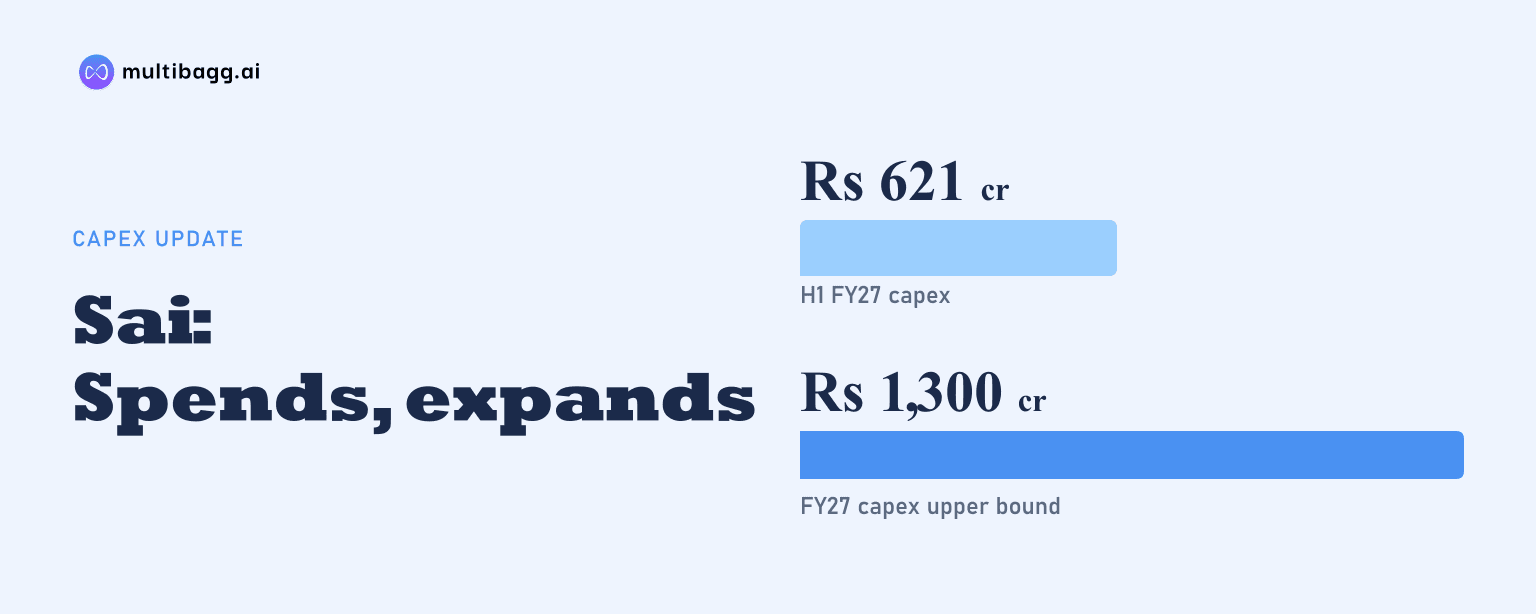
Sai Life Sciences Limited spent Rs 621 crore on capital expenditure in 6M FY27, including Rs 358 crore in Q2 FY27, and said it remained on track for Rs 1,100 crore to Rs 1,300 crore for the full year. The programme covers R&D expansion, additional manufacturing capacity and a new greenfield site.
Know Sai Life Sciences inside out
Results, valuation, peers and who's buying, in one view.
How much did Sai spend on capex in 6M FY27?
Sai spent Rs 621 crore on capital expenditure in 6M FY27, with Rs 358 crore incurred in Q2 FY27. Q2 represented about 58% of the disclosed six-month spend, showing that investment activity was more concentrated in the second quarter than the balance of the first half.
The presentation identifies the Rs 621 crore as capex spend but does not provide a site-by-site allocation, equipment breakdown or project-specific spending amount. It also does not disclose a capital work-in-progress balance, debt position or cash-flow funding mix for the 6M FY27 expenditure.
Sai's reported first-half outlay compares with H1 FY27 revenue of Rs 1,213 crore. Revenue increased 17% from Rs 1,034 crore in H1 FY26, while earnings before interest, tax, depreciation and amortisation, or EBITDA, including foreign exchange, increased 19% to Rs 335 crore from Rs 281 crore.
What is Sai's FY27 capex plan?
Sai said it is on track for a FY27 capex projection of Rs 1,100 crore to Rs 1,300 crore. After spending Rs 621 crore in 6M FY27, the stated range implies further expenditure of Rs 479 crore to Rs 679 crore during the rest of the financial year, if management maintains its projection.
The six-month spend equals about 56% of the lower end and 48% of the upper end of Sai's annual range. The remaining Rs 479 crore to Rs 679 crore would be more than the Rs 358 crore spent in Q2 FY27, but less than two quarters of spending at the Q2 pace.
Management's range is a projection rather than a project-level commitment. Sai did not disclose a quarterly capex schedule for the second half of FY27, nor did it state how much of the remaining spend is assigned to Unit 2, Unit 4, Unit 8 or Choutuppal.
Which projects is Sai expanding?
Sai is expanding Unit 2 in Hyderabad, adding production capacity at Unit 4 in Bidar and developing a greenfield site at Choutuppal. The company has broken ground for a new Process R&D Block at Unit 2 that it says will double R&D capacity and add early-phase peptide development and clinical formulation capabilities.
At Unit 4, Sai said it is building additional production capacity without disclosing the incremental capacity, cost or commissioning date. The existing Bidar facility has 700 kilolitres of current good manufacturing practice capacity, 80 production trains and reactor sizes ranging from 0.25 kilolitres to 12 kilolitres.
Sai also said it acquired land for its new Choutuppal greenfield site. The presentation provides no land area, construction schedule, planned manufacturing capacity or allocated capex for Choutuppal, leaving the scale and timing of that project unresolved.
Got a follow-up? Ask IRIS
How does capex support Sai's CRDMO model?
Sai's investment programme supports its integrated contract research, development and manufacturing organisation, or CRDMO, model, spanning drug discovery through commercial manufacturing. The company reported more than 300 active customers and said 19 of the 25 largest pharmaceutical companies, measured by calendar-year 2025 market capitalisation, were customers.
The Unit 2 project is directed towards R&D capacity and early-phase peptide work, while Sai also identifies antibody-drug conjugates and oligonucleotides as next-generation modalities. As of 30 September 2026, Sai had more than 2,500 employees in R&D, compared with more than 700 in manufacturing and more than 350 in quality.
The programme also coincides with new integrated client engagements. Sai said it had commenced operations on its first end-to-end integrated collaboration, onboarded in the preceding quarter, and expected it to be fully functional in Q3. It also converted another large pharmaceutical relationship into a similar strategic engagement and said discussions were under way with a few additional companies.
What operating performance accompanied Sai's expansion spending?
Sai reported H1 FY27 material margin of Rs 893 crore, up 19% from Rs 753 crore in H1 FY26, and the margin increased to 74% from 73%. EBITDA margin increased by 1 percentage point to 28% as EBITDA rose to Rs 335 crore from Rs 281 crore.
Q2 FY27 revenue growth was faster than the H1 rate, rising 23% to Rs 659 crore from Rs 537 crore in Q2 FY26. However, Q2 material margin declined to 73% from 74%, while EBITDA margin declined to 28% from 29%, even as EBITDA increased 20% to Rs 187 crore.
Sai also reported one molecule entering its late-phase pipeline and another moving from late phase to commercial status. As of 30 September 2026, it listed 34 active new chemical entity commercial molecules and 14 Phase III or pre-registration molecules, illustrating the development and manufacturing scope of the platform being expanded.
Conclusion
Sai's Rs 621 crore capex spend in 6M FY27 places more than half of the lower end of its Rs 1,100 crore to Rs 1,300 crore full-year projection in the first half. The disclosed work combines an R&D expansion intended to double Unit 2 capacity, added production capacity at Unit 4 and land acquisition for the Choutuppal greenfield project.
The next disclosed milestone is Sai's expectation that its first end-to-end integrated collaboration will be fully functional in Q3. Investors can watch whether Sai maintains the FY27 capex range after the Rs 358 crore Q2 outlay and whether it later discloses commissioning dates, capacity additions or spending allocations for its expansion projects.