










Saksoft accepts near-term revenue cannibalisation in AI push
Key highlights
- Saksoft reported Q2-FY27 operating income of Rs 248.612 crore, flat sequentially and down 3.8% year on year.
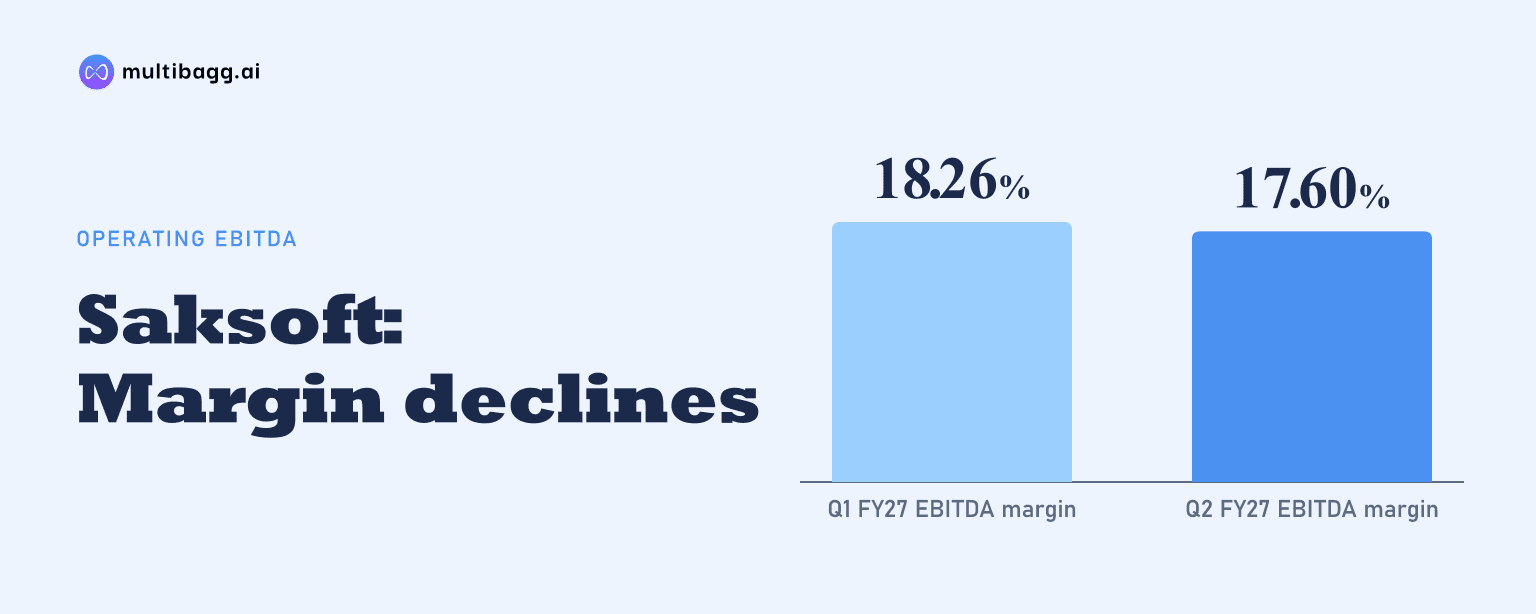
- Q2-FY27 operating EBITDA was Rs 43.760 crore, and its margin declined to 17.60% from 18.26% in Q1-FY27.
- H1-FY27 operating income was Rs 497.231 crore, down 2.0% year on year, while PAT fell 10.1% to Rs 61.410 crore.
- Emerging verticals accounted for 45% of H1-FY27 revenue and the USA contributed 51% of geographic revenue.
powered by IRIS
Saksoft said its AI-first sales approach will accept near-term revenue cannibalisation through free proof-of-concept offers and reduced team sizes, after Q2-FY27 operating income was flat sequentially at Rs 248.612 crore and 3.8% below Q2-FY26. Management said it expects H2-FY27 performance to be better than H1-FY27.
Know Saksoft inside out
Results, valuation, peers and who's buying, in one view.
Why is Saksoft accepting AI-related revenue cannibalisation?
Saksoft is accepting the near-term revenue effect because management wants customers to see it as a co-innovator and business partner. Chairman and Managing Director Aditya Krishna said Saksoft is proactively offering free proof-of-concepts, or POCs, and reduced team sizes to use artificial intelligence, or AI, to improve customer workflows. The mechanism is that free POCs and smaller delivery teams can reduce billable revenue in the short term.
Saksoft said its AI investments and accelerators are intended to deepen customer engagement, increase wallet share and drive sustainable growth. The presentation does not disclose the number of free POCs, their cost, the revenue associated with reduced teams, or a conversion timetable. It therefore provides management's rationale for the AI-first approach but no quantified financial target for the programme.
The strategy sits alongside Saksoft's focus on customers with revenue of USD 100 million to USD 3 billion and its stated multiyear contracts with well-known brands. Its growth plan also identifies cross-selling, upselling, domain-specific solutions and group-company specialists as delivery mechanisms. These measures provide the commercial setting for introducing AI-led efficiency offers to existing customers.
What did Saksoft report in Q2-FY27?
Saksoft reported Q2-FY27 operating income of Rs 248.612 crore, effectively unchanged from Rs 248.619 crore in Q1-FY27, while operating earnings before interest, tax, depreciation and amortisation, or EBITDA, declined 3.6% sequentially to Rs 43.760 crore. Operating EBITDA margin fell 66 basis points, or 0.66 percentage points, to 17.60% from 18.26% in Q1-FY27.
Quarterly operating income was stable from Q1-FY27 to Q2-FY27, but operating EBITDA decreased by Rs 1.636 crore as expenses rose 0.8% to Rs 204.852 crore. Against Q2-FY26, operating income declined 3.8% and operating EBITDA declined 13.6%. The operating EBITDA margin was 17.60%, compared with 19.58% a year earlier, a fall of 1.98 percentage points.
Profit after tax, or PAT, rose 9.6% sequentially to Rs 32.118 crore from Rs 29.292 crore in Q1-FY27. Profit before tax declined 0.6% to Rs 42.314 crore, while tax expense fell 23.2% to Rs 10.196 crore. Year on year, Q2-FY27 PAT was 10.7% below Rs 35.967 crore and the PAT margin declined to 12.92% from 13.91%.
How did Saksoft perform in H1-FY27?
Saksoft reported H1-FY27 operating income of Rs 497.231 crore, down 2.0% from Rs 507.568 crore in H1-FY26, while operating EBITDA fell 7.6% to Rs 89.156 crore. Operating EBITDA margin declined to 17.93% from 19.00% in the prior-year half, a reduction of 1.07 percentage points.
H1-FY27 PAT was Rs 61.410 crore, down 10.1% from Rs 68.315 crore in H1-FY26, and PAT margin reduced to 12.35% from 13.46%. The percentage declines in operating EBITDA and PAT exceeded the operating-income decline. This is the H1-FY27 base from which management said H2-FY27 should perform better.
Saksoft has not issued a revenue, margin or PAT target for H2-FY27. It also has not separated the financial effect of free POCs or smaller delivery teams in the H1-FY27 results. The disclosed 2.0% decline in H1-FY27 operating income therefore cannot be assigned between the AI-first programme and other factors using the presentation.
Got a follow-up? Ask IRIS
Which business areas could shape Saksoft's AI transition?
Saksoft's H1-FY27 revenue mix was led by emerging verticals at 45%, followed by banking and financial services, or BFS, at 30%, logistics at 16% and commerce at 9%. From FY26, logistics increased by 2 percentage points from 14% and commerce rose by 1 point from 8%. BFS declined by 1 point from 31%, while emerging verticals declined by 2 points from 47%.
The USA accounted for 51% of H1-FY27 revenue, Europe 28%, and Asia-Pacific and other regions 21%. Offshore delivery represented 57% of revenue, up from 56% in FY26, while onsite work fell to 43% from 44%. Saksoft said European businesses are using smaller nearshore teams to support offshore operations because of overlapping time zones, and it has developed local talent to support European client time zones.
Client concentration increased at the top-20 level, with those clients contributing 72% of H1-FY27 revenue versus 70% in FY26. The top five clients represented 40%, down from 42%, while the top 10 represented 58%, unchanged from FY26. Saksoft had 16 clients generating more than USD 1 million each and 10 generating USD 0.5 million to USD 1 million, both unchanged from FY26.
What should readers watch in Saksoft's second half?
The principal disclosed marker is management's expectation that H2-FY27 will be better than H1-FY27. The relevant H1-FY27 base is Rs 497.231 crore of operating income, Rs 89.156 crore of operating EBITDA and a 17.93% operating EBITDA margin. Management did not specify whether the expected improvement would come from revenue growth, paid POC conversions, margin recovery or another measure.
Saksoft's workforce was 2,203 employees in H1-FY27, down from 2,277 in FY26, with technical staff comprising 84% of employees versus 83% in FY26. Support staff declined to 190 from 217. The company also appointed Gurmeet Chahal as chief executive officer of Saksoft Inc., saying he will steer its next phase of global growth in an AI-driven era.
Conclusion
Saksoft is explicitly accepting some near-term revenue cannibalisation to pursue an AI-led customer proposition based on free POCs and smaller delivery teams. The immediate results showed Q2-FY27 operating income of Rs 248.612 crore, operating EBITDA of Rs 43.760 crore and H1-FY27 PAT of Rs 61.410 crore, with each half-year measure below the prior-year comparison except for sequential quarterly PAT.
The next disclosed test is management's expectation for a better H2-FY27 than H1-FY27. Readers can watch whether operating income improves from the Rs 497.231 crore H1-FY27 base, whether the 17.93% operating EBITDA margin changes, and whether Saksoft provides evidence that free POCs and reduced teams are converting into broader paid customer work.