










SAMHI Q2 EBITDA margin fell 300 bps on GST credit impact
Key highlights
- SAMHI’s Q2 FY27 reported EBITDA margin was 36.1% after a Rs 10.3 crore GST ITC impact reduced it by 300 basis points.
- SAMHI’s Q2 FY27 total income rose 15.6% year on year to Rs 342.7 crore.
- SAMHI’s Q2 FY27 PBT before exceptional items increased 39.9% to Rs 53.4 crore.
- SAMHI’s Q2 FY27 reported PAT fell 58.8% to Rs 41.1 crore as exceptional items declined to Rs 3.9 crore from Rs 84.1 crore.
powered by IRIS
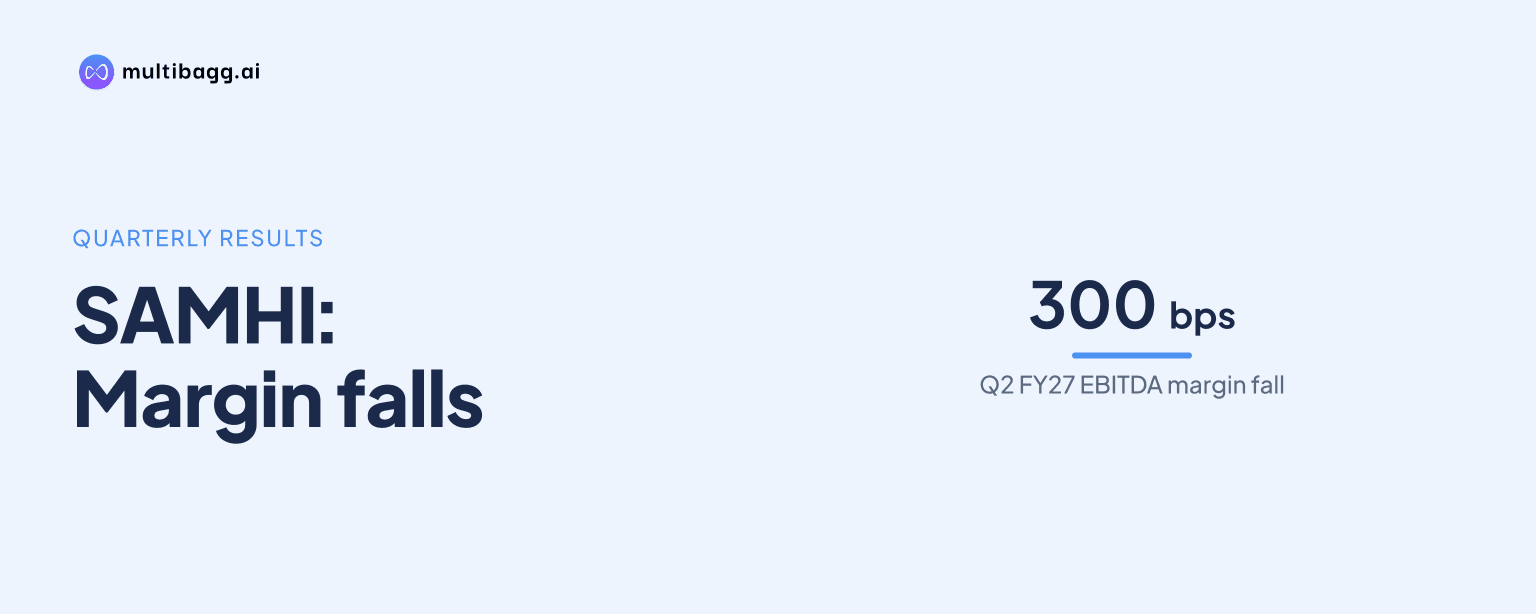
SAMHI Hotels Limited reported a 36.1% consolidated Q2 FY27 EBITDA margin after a Rs 10.3 crore goods and services tax input-tax-credit impact cut it by 300 basis points, even as profit before tax excluding exceptional items rose 39.9% year on year to Rs 53.4 crore. Total income grew 15.6%.
Know Samhi Hotels inside out
Results, valuation, peers and who's buying, in one view.
How did GST input tax credit affect SAMHI’s Q2 margin?
SAMHI said the goods and services tax, or GST, input tax credit, or ITC, effect reduced its reported Q2 FY27 consolidated earnings before interest, tax, depreciation and amortisation, or EBITDA, margin to 36.1% from 39.1% excluding the effect. Consolidated EBITDA rose 12.0% to Rs 123.8 crore for the quarter ended September 30, 2026, from Rs 110.5 crore in Q2 FY26.
The Rs 10.3 crore ITC impact was not in the Q2 FY26 base period. Management therefore cited comparable EBITDA growth of 21.3% excluding the GST regulation change, compared with reported EBITDA growth of 12.0%, while total income increased 15.6% to Rs 342.7 crore.
Management said there was scope for margin improvement in later periods and that growth in upscale inventory not affected by the GST changes could lift operating margins to about 40%. This is management’s outlook, rather than a reported result: the 36.1% Q2 FY27 margin was below Q2 FY26’s 37.3% and the 39.1% margin excluding the ITC impact.
What changed in SAMHI’s Q2 earnings year on year?
SAMHI’s total income and profit before tax, or PBT, before exceptional items rose, but reported profit declined because Q2 FY26 included much larger exceptional gains. Total income increased by Rs 46.4 crore to Rs 342.7 crore, while PBT before exceptional items rose by Rs 15.2 crore to Rs 53.4 crore from Rs 38.2 crore.
Exceptional items were Rs 3.9 crore in Q2 FY27, comprising a gain on sale of Hosur land, compared with Rs 84.1 crore in Q2 FY26. The prior-year amount included a Rs 69.6 crore reversal of impairment on Navi Mumbai land and a Rs 14.5 crore gain on sale of Caspia, Delhi.
Reported PBT consequently declined 52.1% to Rs 57.3 crore, while profit after tax, or PAT, fell 58.8% to Rs 41.1 crore from Rs 99.8 crore. The difference between reported and pre-exceptional PBT reflects the comparison with the prior-year non-recurring items.
What supported SAMHI’s Q2 operating income growth?
SAMHI reported same-store revenue growth of 12.6%, occupancy of 78.6% and revenue per available room, or RevPAR, growth of 14.3% in Q2 FY27. Occupancy rose from 75.0% in Q2 FY26, while average room rate, or ARR, increased 9.2%.
Domestic travellers accounted for about 80% of room nights sold in the quarter ended September 30, 2026. Management described this group as more resilient amid geopolitical instability and reported incremental EBITDA flow-through of about 57% of incremental revenue.
The same-store measures differ from the consolidated income figures. RevPAR grew 14.3% and total income rose 15.6% to Rs 342.7 crore, while management said recent reported growth had largely been driven by same-store performance because no new inventory had come online.
Got a follow-up? Ask IRIS
How did SAMHI perform in the first half of FY27?
SAMHI’s H1 FY27 total income increased 11.5% to Rs 651 crore, while EBITDA rose 4.2% to Rs 225.1 crore and the EBITDA margin declined to 34.6% from 37.0%. The six-month EBITDA included a Rs 19.4 crore GST ITC impact, compared with Rs 10.3 crore in Q2 alone.
PBT before exceptional items rose 34.5% to Rs 86.2 crore from Rs 64.1 crore in H1 FY26, but reported PBT fell 37.0% to Rs 90 crore and PAT declined 44.6% to Rs 66 crore. Exceptional items were Rs 3.9 crore in H1 FY27 against Rs 84.1 crore a year earlier.
H1 FY26 total income also included about Rs 9.1 crore of one-time other income linked to a subsidiary capital restructuring related to the GIC transaction. SAMHI separately disclosed about Rs 2.1 crore of one-time GIC transaction expenses in H1 FY26 EBITDA, limiting a simple comparison of reported half-year figures.
What does SAMHI’s debt profile show after Q2 FY27?
SAMHI reported net debt of Rs 1,457.9 crore at September 30, 2026, compared with Rs 1,450.7 crore at March 31, 2026 and Rs 1,966.9 crore at March 31, 2025. Trailing 12-month EBITDA was Rs 477.7 crore, excluding employee stock option plan and one-time expenses and excluding Caspia Delhi EBITDA on that basis.
Net debt to EBITDA was unchanged at 3.1 times from March 2026, versus 4.4 times at March 2025 and 5.3 times at September 2023. Net debt to EBITDA adjusted for growth capital was 2.2 times at September 2026, compared with 2.4 times at March 2026.
The effective interest rate was 7.8% at September 2026, versus 7.9% at March 2026 and 9.2% at March 2025. Net annualised interest was Rs 125 crore, down from Rs 127 crore and Rs 190 crore in those respective periods; the measure excludes non-cash finance costs, including lease interest and effective interest rate charges.
Conclusion
SAMHI’s Q2 FY27 figures show improving hotel income and pre-exceptional profitability alongside a GST-related margin effect and a distorted comparison with prior-year asset gains. Total income rose 15.6% to Rs 342.7 crore and PBT before exceptional items increased 39.9% to Rs 53.4 crore, but the Rs 10.3 crore ITC impact reduced reported EBITDA margin to 36.1% and reported PAT fell 58.8% to Rs 41.1 crore.
The next disclosed marker is H2 FY27, which management expects to be operationally stronger, with incremental EBITDA expected to translate into free cash flow while interest outflows remain stable. Management plans to open the W Hotel in Hyderabad in the next fiscal year and has identified a pipeline of about 1,700 rooms through FY2031; delivery timing and the stated scope for operating margins of about 40% are the items to watch.