










SAMHI investment accesses RARE India's 70-hotel leisure platform
Key highlights
- RARE India has approximately 70 hotels and approximately 900 rooms across 19 states and three countries.
- SAMHI says RARE India can receive business-generation fees, selected incentive fees and returns from selective investments.
- SAMHI’s FY2027-FY2032 plan lists approximately 900 leisure rooms alongside 2,655 upper upscale and upscale rooms.
- The presentation discloses a planned Marriott distribution partnership but no Marriott Bonvoy or December 2026 integration date.
powered by IRIS
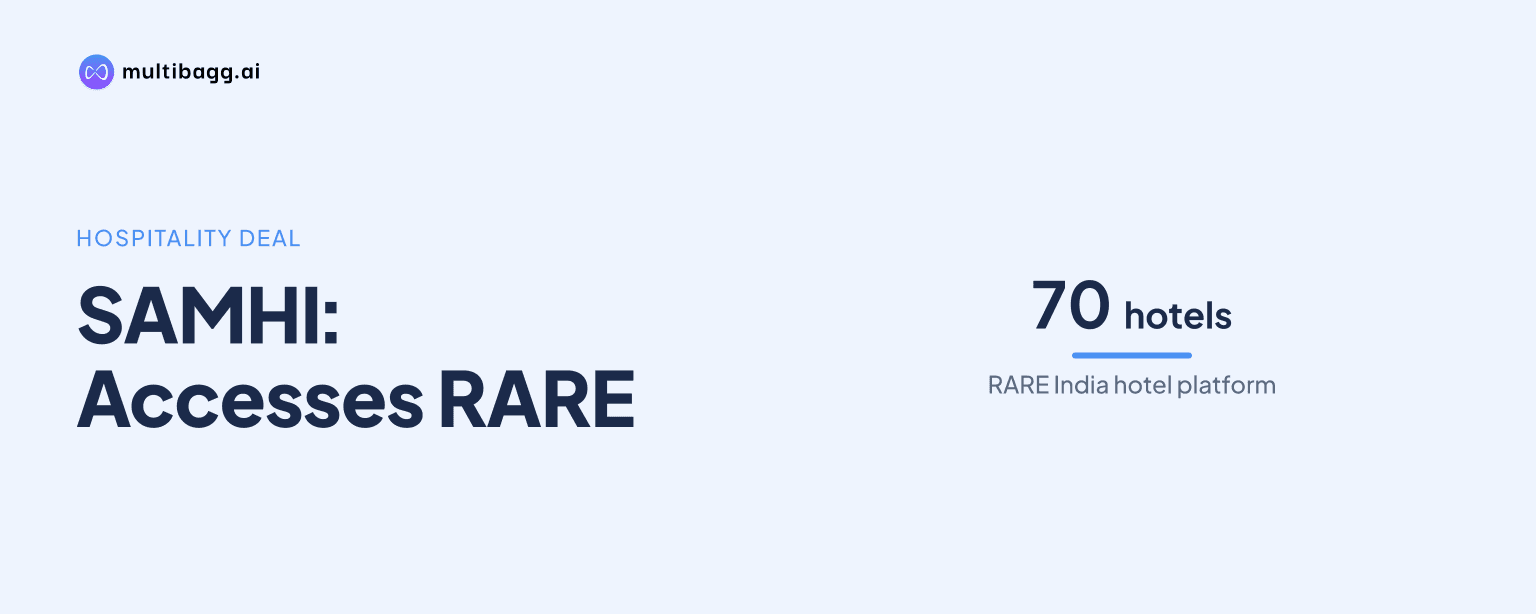
SAMHI’s small investment in RARE India gives it access to an asset-light leisure platform of about 70 hotels and 900 rooms across 19 states and India, Nepal and Bhutan. SAMHI says RARE India can earn business-generation fees, selected incentive fees and returns from selective investments, while a Marriott distribution partnership remains planned.
Know Samhi Hotels inside out
Results, valuation, peers and who's buying, in one view.
What has SAMHI invested in through RARE India?
SAMHI says it has made a small investment in RARE India, providing access to an experience-led leisure hotel platform of about 70 hotels. The presentation does not disclose the investment amount, ownership percentage, closing date, transaction valuation or the value of SAMHI’s stake.
The stated rationale is to extend SAMHI’s capabilities beyond its urban hotel portfolio into leisure assets. SAMHI describes RARE India as asset-light, scalable and differentiated, while its separate core growth pipeline comprises seven new big-box hotels with 1,669 rooms in commercial districts, including 22 apartments at Hyatt Regency, Pune that were under pre-opening.
How large is the RARE India leisure network?
RARE India has approximately 70 hotels and approximately 900 rooms across 19 states and three countries: India, Nepal and Bhutan. This network is shown separately from SAMHI’s FY2026 owned-hotel segments of upper upscale and upscale, upper mid-scale, and mid-scale properties.
RARE India’s approximately 900 rooms are fewer than SAMHI’s 2,047 upper mid-scale rooms, 1,729 mid-scale rooms and 1,123 upper upscale and upscale rooms in FY2026. However, the presentation gives no FY2026 leisure revenue, revenue per key or occupancy figure, preventing a like-for-like operating comparison with the owned portfolio.
SAMHI places RARE India’s room base in its FY2027-FY2032 leisure portfolio rather than in an owned-hotel category. The company says its percentage-change commentary on new rooms applies only to owned new hotels and excludes RARE India inventory because the leisure platform follows an asset-light model.
How will RARE India generate income?
RARE India is intended to receive fee income from business it generates for hotel partners, additional incentive fees at select hotels, and returns from selective opportunistic investments. SAMHI does not quantify current fee income, incentive-fee rates, investment commitments, margins or the share of those economics attributable to SAMHI.
This model differs from the disclosed revenue structure for SAMHI’s owned hotel categories in FY2026. Upper upscale and upscale hotels generated Rs 527 crore from 1,123 rooms, or Rs 47 lakh revenue per key, while upper mid-scale hotels generated Rs 523.5 crore from 2,047 rooms, or Rs 26 lakh per key; no corresponding leisure metric is disclosed.
The platform therefore introduces income mechanisms linked to hotel-partner business generation rather than a disclosed owned-room revenue line. SAMHI has not stated how many of RARE India’s approximately 70 hotels are eligible for incentive fees, how many may receive selective investments, or whether all approximately 900 rooms could participate in Marriott distribution.
Got a follow-up? Ask IRIS
How does RARE India change SAMHI’s growth mix?
RARE India gives SAMHI a leisure platform alongside a secured FY2027-FY2032 pipeline that raises upper upscale and upscale rooms by 1,532 to 2,655. That increase consists of 1,059 rooms from new openings and 473 rooms converted from upper mid-scale through renovation and rebranding.
The planned mix change is not solely an expansion in room numbers. Upper mid-scale rooms are projected to decline by 123, or 6%, to 1,924 after the 473-room conversion, while mid-scale rooms are planned to increase by 260, or 15%, to 1,989; RARE India contributes approximately 900 leisure rooms without a comparable percentage change.
SAMHI says most new owned rooms are being added in segments with relatively higher revenue per key. In FY2026, upper upscale and upscale revenue per key of Rs 47 lakh exceeded Rs 26 lakh in upper mid-scale and Rs 12 lakh in mid-scale, but SAMHI does not provide an equivalent revenue-per-key measure for RARE India.
What does SAMHI disclose about Marriott integration?
SAMHI discloses a planned partnership with Marriott for distribution, saying it is intended to unlock value for RARE India’s hotel partners and for SAMHI as a shareholder. The supplied presentation does not mention Marriott Bonvoy, a December 2026 integration date, commercial terms, participating hotel count or expected financial contribution.
Management presents the Marriott arrangement as planned rather than completed. The source therefore supports a proposed distribution partnership for RARE India’s approximately 70 hotels and approximately 900 rooms, but not a timetable for implementation or confirmation of the hotels that would be included.
SAMHI’s wider operating data shows the importance of demand and distribution to its hotel business. In the quarter ending 30 September FY2027, same-store occupancy was 78.6%, compared with 75.0% in Q2 FY2026, while same-store revenue per available room, or RevPAR, rose 14.3% year on year to Rs 5,746.
Conclusion
SAMHI’s RARE India investment adds access to an approximately 70-hotel, 900-room leisure platform across 19 states and three countries, beside its secured owned-hotel expansion through FY2032. The disclosed economics are business-generation fees, incentive fees at selected hotels and selective investments, while the presentation does not quantify the investment, current income, margins or leisure revenue per key.
The disclosed items to watch are progress in the FY2027-FY2032 room pipeline, which includes 2,655 upper upscale and upscale rooms and approximately 900 leisure rooms, and developments in the planned Marriott distribution partnership. Further SAMHI disclosure would be needed to establish any integration timing, participating hotels, fee generation and whether selective investments change the platform’s asset-light profile.