










SAMIL Q2 revenue reaches Rs 38,280 crore despite output fall
Key highlights
- SAMIL reported record Q2 FY27 revenue of Rs 38,280 crore, up 27% year on year and 9% sequentially.
- Global light-vehicle production declined 2.3% year on year, while SAMIL’s H1 FY27 revenue exceeded Rs 73,500 crore.
- Q2 FY27 normalized PAT rose 37% year on year to Rs 1,175 crore, while EBITDA increased 23% to Rs 3,353 crore.
- SAMIL spent Rs 3,585 crore on H1 FY27 capital expenditure and reported Rs 11,292 crore of effective net debt at September-end.
powered by IRIS
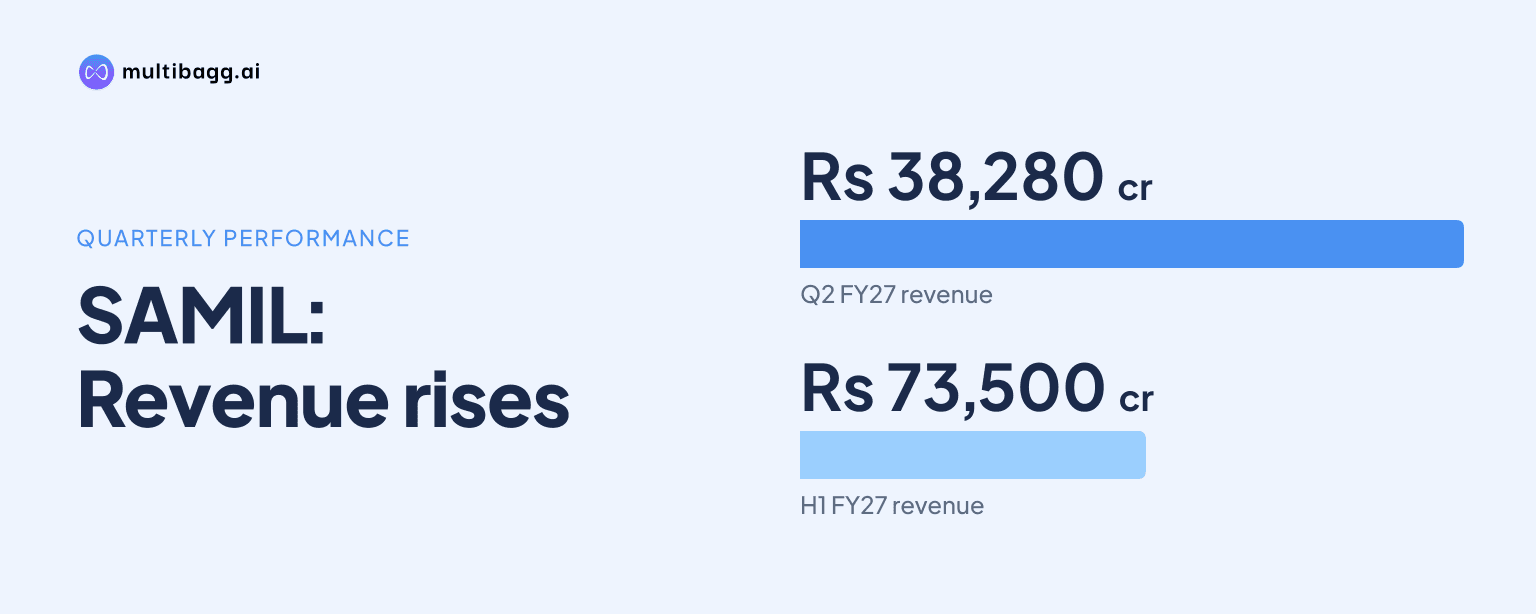
Samvardhana Motherson International Limited reported record Q2 FY27 revenue of Rs 38,280 crore, up 27% year on year and 9% sequentially, despite a 2.3% decline in global light-vehicle production. SAMIL attributed the growth to the integration of Autoelectric and Yutaka Giken and robust demand in its wiring-harness business.
Know Samvardhana Motherson International inside out
Results, valuation, peers and who's buying, in one view.
How did SAMIL reach record Q2 FY27 revenue?
SAMIL reached record Q2 FY27 revenue of Rs 38,280 crore through acquired-business integration and wiring-harness demand. Revenue grew 27% from Q2 FY26 and 9% from the preceding quarter, making the September-quarter result the group’s highest quarterly revenue disclosed on the November 5, 2026 earnings call.
For H1 FY27, revenue exceeded Rs 73,500 crore, up 22% year on year. The 27% Q2 growth rate was higher than the 22% first-half rate, indicating faster growth in the second quarter than across H1 as a whole. Management specifically identified Autoelectric and Yutaka Giken integration, alongside wiring harnesses, rather than an improvement in global light-vehicle production.
Autoelectric was integrated into SAMIL’s wiring-harness business, where management said it would deepen the group’s presence outside India. Yutaka Giken was included as a sub-vertical within emerging businesses and adds a new capability, according to management. SAMIL did not disclose separate Q2 revenue, margin or profit contributions from either acquired business.
Why did SAMIL grow while global light-vehicle production fell?
SAMIL grew revenue by 27% while global light-vehicle production fell 2.3% year on year because acquisitions and wiring-harness demand added to reported sales. China’s light-vehicle production declined 5.5%, North America’s declined 3.8% and Europe’s declined 0.6%, according to management’s Q2 FY27 market assessment.
India differed from those regions, with light-vehicle production rising 15% year on year. Management said its modules and polymer products business was finding opportunities in India across interiors, exteriors and plastics, including with new customers. In Europe, it described a mixed market as customers assessed electric-vehicle platforms and future product lines.
Commercial-vehicle production was more supportive than light-vehicle production, rising 7.6% globally. North American commercial-vehicle production increased 43.6% and India’s rose 18.9%; management expects that momentum to continue in H2 FY27. SAMIL did not provide a revenue split between commercial-vehicle and passenger-vehicle customers, so the direct contribution of this market growth was not quantified.
Management said legacy original equipment manufacturer, or OEM, customers were facing a difficult environment, including changes to production and business outlooks. In response, SAMIL said it was adjusting manufacturing capacity where customer demand rises or falls. It also said reorganisation actions in modules and polymer products were improving financial performance in those locations, without providing a separate segment profit figure.
Got a follow-up? Ask IRIS
What happened to SAMIL’s profit and margins in Q2 FY27?
SAMIL’s Q2 FY27 EBITDA increased 23% year on year to Rs 3,353 crore, but its EBITDA margin declined to 8.8% from 9.0% in Q2 FY26. Management attributed the approximately 20-basis-point contraction primarily to the integration of newly acquired businesses. One basis point equals one-hundredth of a percentage point.
Normalized PAT increased 37% year on year to Rs 1,175 crore in Q2 FY27, outpacing both revenue and EBITDA growth. For H1 FY27, normalized PAT rose 45% to Rs 2,207 crore and EBITDA increased 25% to Rs 6,457 crore. H1 EBITDA margin improved by about 20 basis points to 8.8%, despite commodity-cost inflation.
Management said margins improved both year on year and sequentially after excluding acquisition effects. It cited customer discussions on input-cost pass-throughs, operating leverage, cost optimisation and automation as the mechanisms. Copper, aluminium and polymers remained input-cost pressures, and SAMIL did not quantify either customer recoveries or the remaining cost exposure.
SAMIL had started more than 1,000 automation initiatives under its Vision 2030 strategy and had a pipeline of approximately 940 projects as of the November 5 call. These include robots, collaborative robots and automated guided vehicles, or AGVs, for assembly, intra-logistics and end-of-line testing. Management aims to implement more than 1,000 automation projects by next year.
How is SAMIL financing expansion beyond automotive?
SAMIL spent Rs 1,971 crore on capital expenditure in Q2 FY27, taking H1 FY27 capital expenditure to Rs 3,585 crore. That was about 56% of H1 EBITDA and was within management’s full-year capital-expenditure guidance of Rs 6,000 crore, plus or minus 10%. The company said spending supports booked-business execution, emerging markets and non-automotive operations.
About 60% of SAMIL’s FY27 guided capital expenditure is earmarked for non-automotive businesses. A greenfield printed circuit board, or PCB, facility began operating during Q2 FY27 and is intended to provide backward integration to lighting and vision-systems businesses. SAMIL also announced five facility expansions, bringing the total at various development stages to 17, with 10 expected to become operational in FY27.
Effective net debt was Rs 11,292 crore at the end of September 2026, compared with Rs 9,757 crore at the end of June 2026. Management attributed the increase to copper-related working capital, capital expenditure and lease liabilities from the consolidation of Autoelectric and Yutaka Giken. The leverage ratio remained 0.8 times, against SAMIL’s 2.5-times financial-policy ceiling and internal aspiration to stay below 1.5 times.
SAMIL said booked business had reached Rs 10 lakh crore, up from Rs 9 lakh crore in FY26 and Rs 5.9 lakh crore in FY23. Management described this as about 13% compound annual growth from FY23 to H1 of the current financial year. Aerospace revenue grew more than 20% year on year in Q2 FY27, and SAMIL announced the Rotary Connectors acquisition to broaden aerospace and defence capabilities.
Conclusion
SAMIL’s Q2 FY27 performance showed revenue expansion despite lower global light-vehicle production: revenue rose 27% to Rs 38,280 crore while worldwide output fell 2.3%. Acquisitions and wiring-harness demand were the stated drivers, while normalized PAT rose 37% to Rs 1,175 crore. The quarter also included a 20-basis-point EBITDA-margin decline to 8.8% as acquired businesses were integrated.
Next, investors can watch whether commercial-vehicle production sustains the H2 FY27 momentum management expects, whether 10 of the 17 facilities under development begin operations in FY27, and whether capital expenditure remains within the Rs 6,000 crore guidance range. Management’s progress on approximately 940 automation projects and customer pass-throughs for copper, aluminium and polymer costs will also be relevant to margins.