










Sarthak cored-wire revenue reaches Rs 151.3 crore on volume
Key highlights
- Sarthak’s cored-wire revenue reached Rs 151.3 crore in the trailing 12 months to September 2026.
- Cored-wire volume rose 35% from 4,505 tonnes in FY24 to 6,063 tonnes in TTM Sep-26.
- Cored-wire realisation was Rs 250 per kg in TTM Sep-26, versus Rs 248 per kg in FY24.
- Q2 FY27 cored-wire revenue rose 53% year on year to Rs 38.6 crore on 1,463 tonnes sold.
powered by IRIS
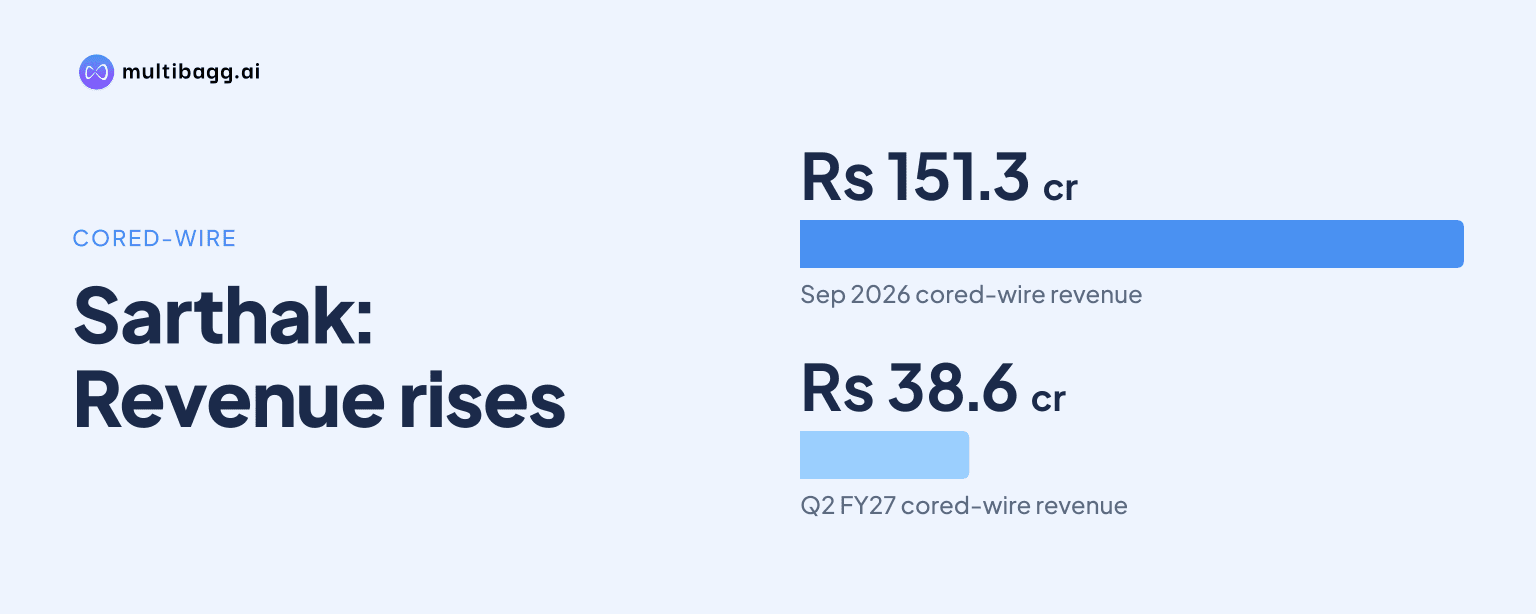
Sarthak Metals Limited’s cored-wire revenue reached Rs 151.3 crore in the twelve months to 30 September 2026, up 36% from Rs 111.6 crore in FY24, as volume rose 35% to 6,063 tonnes while realisation was Rs 250 per kg.
Know Sarthak Metals inside out
Results, valuation, peers and who's buying, in one view.
How did Sarthak’s cored-wire business recover after FY24?
Sarthak’s cored-wire business recovered through higher sales volumes after both revenue and tonnes sold fell in FY24. Revenue declined from Rs 188.6 crore in FY23 to Rs 111.6 crore in FY24, then rose in each subsequent reported period to Rs 127.1 crore in FY25, Rs 135.5 crore in FY26 and Rs 151.3 crore in the trailing 12 months ended September 2026.
The recovery from FY24 to the trailing 12-month period was 36% in revenue, compared with a 35% increase in volume from 4,505 tonnes to 6,063 tonnes. That relationship indicates that added tonnage, rather than a material change in unit selling prices, accounted for nearly all of the increase in cored-wire sales over the period.
The FY24 decline had two components. Volume fell 20% from 5,627 tonnes in FY23 to 4,505 tonnes in FY24, while realisation dropped from Rs 335 per kg to Rs 248 per kg. Sarthak said the FY23 realisation included a larger share of niche, higher-value products, making FY23 an unusually elevated price comparison.
Was Sarthak’s cored-wire growth driven by pricing or volumes?
Sarthak’s cored-wire growth since FY24 was principally volume-led, with realisation broadly stable between Rs 243 per kg and Rs 260 per kg from FY25 through the trailing 12 months to September 2026. Volume rose from 4,881 tonnes in FY25 to 5,566 tonnes in FY26 and then to 6,063 tonnes in the trailing period, while realisation moved from Rs 260 per kg to Rs 243 per kg and Rs 250 per kg respectively.
The Rs 250 per kg trailing-12-month realisation was Rs 2 per kg above FY24’s Rs 248 per kg, but Rs 10 per kg below FY25’s Rs 260 per kg. In contrast, the 1,558-tonne increase between FY24 and the trailing period was substantial, supporting the company’s assessment that revenue growth was almost entirely explained by higher material sold.
Quarterly data show a modest improvement in price compared with the immediately preceding quarter. Sarthak sold 1,463 tonnes of cored wire in Q2 FY27, 37% more than a year earlier, and stated that realisation was about 7% higher than in Q1 FY27. The annual series nevertheless places that quarter-on-quarter gain within a narrower Rs 243 per kg to Rs 260 per kg range after FY24.
The revenue trend therefore differs from FY23, when Rs 335 per kg realisation helped produce Rs 188.6 crore of revenue on 5,627 tonnes. By September 2026, Sarthak had exceeded that FY23 volume by 436 tonnes but remained below its FY23 revenue, because Rs 250 per kg realisation was Rs 85 per kg lower than the earlier level.
Got a follow-up? Ask IRIS
What did cored wire contribute in Q2 FY27?
Cored wire generated Rs 38.6 crore in Q2 FY27, up 53% year on year, and represented about three-quarters of Sarthak’s Rs 52.4 crore quarterly revenue. The segment’s 1,463 tonnes of sales were 37% higher than Q2 FY26 volume, while first-half cored-wire volume rose 20% from the comparable prior-year period.
The segment’s revenue growth outpaced the company’s 44% year-on-year increase in total Q2 revenue. Sarthak reported that both its established cored-wire operation and newer welding business contributed to the quarterly increase, but the Rs 38.6 crore cored-wire contribution made it the larger business by revenue during the July-to-September quarter.
Group operating profit, or earnings before interest, tax, depreciation and amortisation, was Rs 2.2 crore in Q2 FY27 versus Rs 1.6 crore a year earlier. Compared with Q1 FY27, operating profit increased by about Rs 0.7 crore, although net profit was broadly unchanged at Rs 1.28 crore versus Rs 1.33 crore because other income was about Rs 0.9 crore lower.
That distinction separates operating performance from income on deposits and other non-operating sources. Sarthak said the Q1 other-income figure had been unusually high, so the Q2 movement in operating profit is the relevant measure alongside the 53% cored-wire revenue increase and 37% volume increase.
What demand outlook did management give for cored wire?
Management said it expects good cored-wire growth over the next year as several new steel capacities are expected to start operations in the January-to-March quarter. The stated demand link is steel production, especially higher-value and alloy steels where alloy additions must be made precisely using cored wire.
The industry indicators cited in the presentation showed finished steel consumption rising 7.5% to 84.9 million tonnes in H1 FY27, while crude steel output increased 2.9% to 85.1 million tonnes. Alloy-steel production, which management identified as particularly relevant to cored-wire demand, grew 32% during the April-to-September 2026 period.
India’s installed crude-steel capacity was stated at around 220 million tonnes, compared with the National Steel Policy target of 300 million tonnes by 2030-31. Those industry figures provide the backdrop to management’s growth view, but the presentation does not quantify how much incremental cored-wire volume Sarthak expects from individual capacity additions.
Management’s listed priorities are to sustain both cored-wire volume and realisation momentum, scale welding, improve working capital and remain disciplined on newer initiatives. Existing plants have spare capacity, according to the presentation, while short-term working-capital borrowings fell from Rs 6.6 crore in March 2026 to Rs 2.6 crore in September 2026.
Conclusion
Sarthak’s cored-wire recovery is measurable in tonnes sold: volume rose 35% from FY24 to 6,063 tonnes in the trailing 12 months to September 2026, lifting revenue 36% to Rs 151.3 crore. Realisation at Rs 250 per kg was close to FY24’s Rs 248 per kg and below FY25’s Rs 260 per kg, so the revenue increase was not primarily a pricing event.
The next indicator is whether steel capacities expected to begin in the January-to-March quarter translate into additional cored-wire orders and whether realisation remains near the Rs 243 per kg to Rs 260 per kg post-FY24 band. Management also plans to sustain volume and realisation momentum while reducing working-capital needs after generating Rs 4.1 crore of operating cash flow in H1 FY27.