










Shankesh Jewellers equity reaches Rs 531 crore, borrowings fall
Key highlights
- Shankesh Jewellers reported shareholder equity of Rs 531.1 crore at Sep-26, versus Rs 209.4 crore at Mar-26.
- Shankesh Jewellers’ short-term borrowings fell by Rs 101.4 crore to Rs 65.9 crore between Mar-26 and Sep-26.
- Trade receivables increased to Rs 260.4 crore and inventories rose to Rs 319.4 crore at Sep-26.
- Shankesh Jewellers’ H1FY27 revenue from operations increased 52% year on year to Rs 980.0 crore.
powered by IRIS
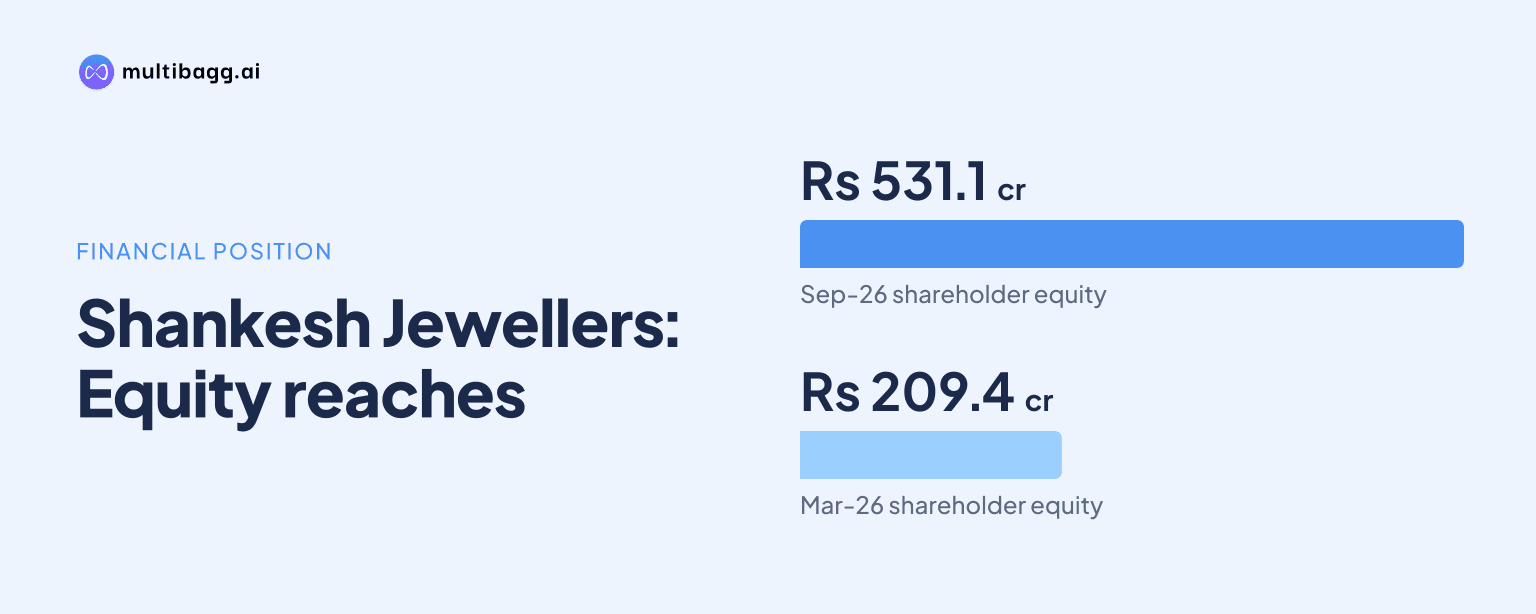
Shankesh Jewellers Ltd. reported shareholder equity of Rs 531.1 crore at Sep-26, up from Rs 209.4 crore at Mar-26, while short-term borrowings fell to Rs 65.9 crore from Rs 167.3 crore. The balance-sheet shift came as trade receivables rose to Rs 260.4 crore and inventories reached Rs 319.4 crore.
Know Shankesh Jewellers inside out
Results, valuation, peers and who's buying, in one view.
How did Shankesh Jewellers’ funding mix change by Sep-26?
Shankesh Jewellers’ funding mix moved towards shareholders’ funds by Sep-26, with shareholder equity increasing by Rs 321.7 crore from Mar-26 to Rs 531.1 crore, while total current liabilities declined by Rs 101.6 crore to Rs 92.1 crore. Total equity and liabilities nevertheless rose to Rs 623.5 crore from Rs 403.8 crore because the equity increase exceeded the reduction in current obligations.
The increase in equity comprised a rise in equity share capital to Rs 73.5 crore from Rs 58.8 crore and an increase in other equity to Rs 457.6 crore from Rs 150.7 crore. The presentation notes that Shankesh Jewellers launched its initial public offering, or IPO, in August 2026 and was listed on NSE and BSE on 25 August 2026.
Long-term borrowings were Rs 0.3 crore at Mar-26 and nil at Sep-26, while total non-current liabilities declined to Rs 0.4 crore from Rs 0.6 crore. The reported reduction in liabilities was therefore concentrated in short-term funding rather than long-term debt.
What happened to Shankesh Jewellers’ short-term borrowings and liabilities?
Shankesh Jewellers reduced short-term borrowings by Rs 101.4 crore, or about 61%, between Mar-26 and Sep-26, bringing the balance to Rs 65.9 crore from Rs 167.3 crore. This was also below the Rs 145.1 crore reported at Mar-25 after borrowings had increased during FY26.
Not every current-liability category declined at Sep-26. Trade payables increased to Rs 10.1 crore from Rs 3.0 crore, while other current liabilities fell to Rs 11.3 crore from Rs 15.7 crore, current tax liabilities declined to Rs 4.2 crore from Rs 6.4 crore, and other financial liabilities decreased to Rs 0.3 crore from Rs 1.2 crore.
The historical balance sheet shows short-term borrowings rising from Rs 98.4 crore at Mar-23 to Rs 109.0 crore at Mar-24, Rs 145.1 crore at Mar-25 and Rs 167.3 crore at Mar-26. Sep-26 therefore reversed that four-year pattern, although the presentation does not provide a separate explanation for the deployment of each source of funds or the borrowing reduction.
Why did Shankesh Jewellers’ receivables and inventory rise?
Shankesh Jewellers’ current assets increased by Rs 211.3 crore to Rs 598.0 crore at Sep-26, led by trade receivables rising by Rs 134.0 crore to Rs 260.4 crore and inventories increasing by Rs 79.4 crore to Rs 319.4 crore. Those two working-capital lines together represented Rs 579.8 crore of total assets of Rs 623.5 crore.
The asset expansion coincided with revenue from operations of Rs 980.0 crore in the first half of FY27, or H1FY27, up 52% from Rs 643.7 crore in H1FY26. Revenue in the second quarter of FY27 was Rs 556.4 crore, up 50% year on year and 31% from Rs 423.6 crore in the first quarter of FY27.
Inventory had risen from Rs 125.8 crore at Mar-23 to Rs 131.4 crore at Mar-24, Rs 161.6 crore at Mar-25 and Rs 240.0 crore at Mar-26. Trade receivables increased from Rs 43.7 crore at Mar-23 to Rs 126.4 crore at Mar-26 before reaching Rs 260.4 crore at Sep-26. Management identifies inventory utilisation and faster rotation as priorities, but the presentation does not disclose inventory turns or receivable collection days.
Got a follow-up? Ask IRIS
What does Shankesh Jewellers’ Sep-26 asset mix show?
Shankesh Jewellers’ asset base at Sep-26 was predominantly current assets, which stood at Rs 598.0 crore out of total assets of Rs 623.5 crore. Non-current assets were Rs 25.5 crore, compared with Rs 17.1 crore at Mar-26, while tangible assets increased to Rs 16.4 crore from Rs 15.0 crore.
Cash and cash equivalents were Rs 3.7 crore at Sep-26 compared with nil at Mar-26, and investments increased to Rs 2.0 crore from Rs 0.5 crore. Other current assets declined to Rs 12.5 crore from Rs 19.7 crore, while other non-current assets rose to Rs 8.3 crore from Rs 1.0 crore.
Shankesh Jewellers describes its operating model as asset-light because it uses a network of Mumbai-based karigars, or skilled jewellery artisans, and workshop partners. Management says this model can support higher volumes without a commensurate increase in fixed infrastructure; tangible assets of Rs 16.4 crore contrasted with Rs 579.8 crore held in inventory and receivables at Sep-26.
How does Shankesh Jewellers’ sales mix relate to working capital?
Shankesh Jewellers generated Rs 706 crore, or 72%, of H1FY27 revenue from corporate clients, while non-corporate clients accounted for Rs 274 crore, or 28%. Corporate-client revenue was Rs 1,048 crore, or 64% of total revenue of Rs 1,631 crore, in FY26.
By product category, 22 Karat jewellery generated Rs 778 crore in H1FY27, 18 Karat jewellery generated Rs 197 crore and job work generated Rs 5 crore. The 18 Karat revenue share increased to 20% in H1FY27 from 13% in FY26, while the 22 Karat share declined to 79% from 86%.
The presentation identifies higher store penetration, customer retention and increased wallet share with existing clients as elements of its scale strategy. It does not disclose receivables or inventory by customer class, geography or product category, so a direct relationship between the sales mix and the Sep-26 working-capital balances cannot be calculated from the reported figures.
Conclusion
Shankesh Jewellers reported a materially changed funding structure at Sep-26, with shareholder equity of Rs 531.1 crore and short-term borrowings of Rs 65.9 crore, compared with Rs 209.4 crore and Rs 167.3 crore respectively at Mar-26. The larger balance sheet was concentrated in working capital, including Rs 260.4 crore of receivables and Rs 319.4 crore of inventory.
Management’s disclosed priorities are to improve inventory utilisation and rotation, increase store penetration with existing customers, and expand in Haryana, Punjab and Himachal Pradesh. Management also expects the festive and wedding season, including Dussehra and Diwali in Q3 FY27, to support demand; subsequent disclosures can indicate whether sales growth changes inventory, receivables and short-term funding further.