










Shankesh corporate mix reaches 72% of H1FY27 revenue share
Key highlights
- Corporate clients accounted for 72% of Shankesh’s Rs 980 crore H1FY27 revenue, up from 55% in FY24.
- Corporate-client revenue increased from Rs 585 crore in FY24 to Rs 1,048 crore in FY26.
- Non-corporate revenue declined from Rs 620 crore in FY25 to Rs 583 crore in FY26.
- West India contributed Rs 407 crore of Shankesh’s Rs 980 crore H1FY27 revenue.
powered by IRIS
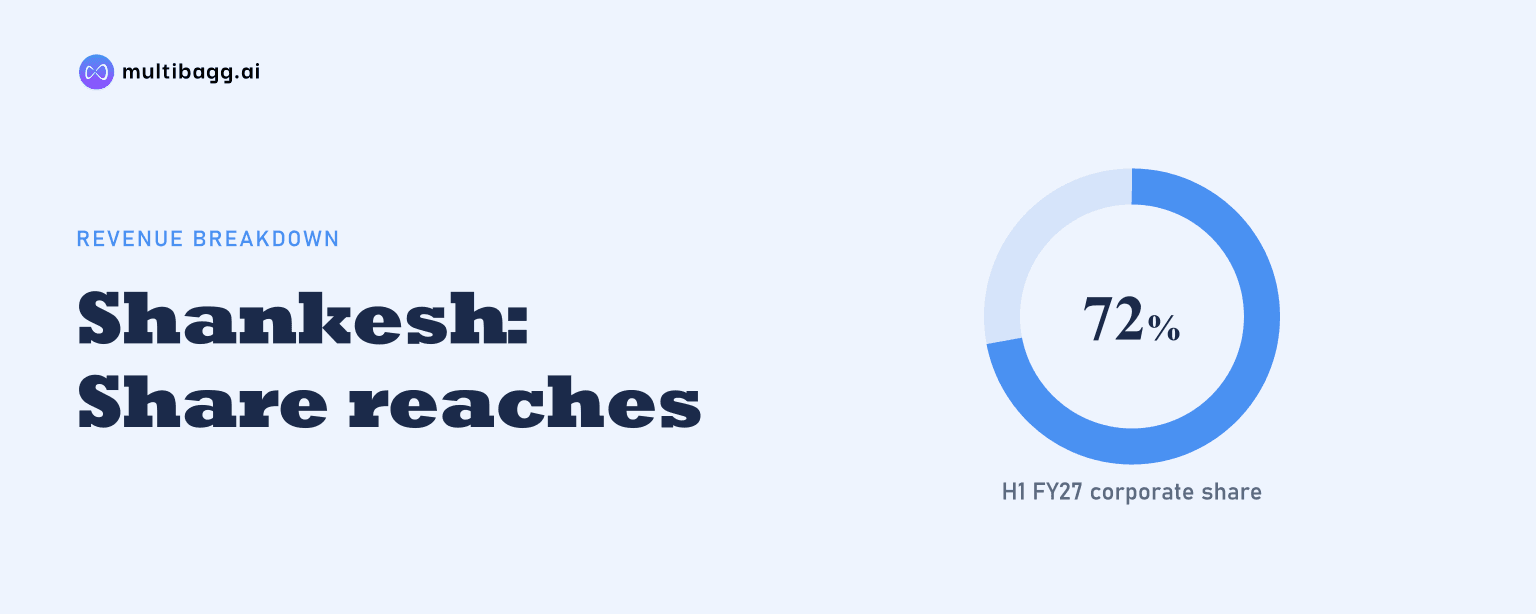
In H1FY27, Shankesh Jewellers Ltd. derived 72% of its Rs 980 crore revenue from corporate clients, up from 55% of Rs 1,062 crore in FY24. Corporate-client revenue was Rs 706 crore in the reported half year, compared with Rs 274 crore from non-corporate customers, reflecting the company’s increasing reliance on corporate relationships.
Know Shankesh Jewellers inside out
Results, valuation, peers and who's buying, in one view.
How did Shankesh’s customer mix change from FY24 to H1FY27?
Shankesh’s corporate-client revenue share increased by 17 percentage points, from 55% in FY24 to 72% in H1FY27, while non-corporate clients’ share fell from 45% to 28%. The corporate share was 56% in FY25 and 64% in FY26, showing that the shift accelerated after FY25.
Corporate-client revenue increased from Rs 585 crore in FY24 to Rs 783 crore in FY25 and Rs 1,048 crore in FY26. Non-corporate revenue rose from Rs 477 crore in FY24 to Rs 620 crore in FY25, before declining to Rs 583 crore in FY26. Total revenue increased from Rs 1,062 crore in FY24 to Rs 1,631 crore in FY26.
H1FY27 is a half-year period rather than a full financial year. Within that period, corporate customers contributed Rs 706 crore of the Rs 980 crore total, while non-corporate customers contributed Rs 274 crore. The H1FY27 total was 60% of FY26 revenue based on the figures disclosed by Shankesh.
What drove the increase in Shankesh’s corporate revenue contribution?
Corporate-client sales accounted for Rs 463 crore of Shankesh’s Rs 569 crore increase in total revenue between FY24 and FY26. Corporate revenue rose by Rs 198 crore in FY25 and by a further Rs 265 crore in FY26, whereas non-corporate revenue increased by Rs 143 crore in FY25 before decreasing by Rs 37 crore in FY26.
The customer shift occurred alongside a change in product mix. Revenue from 18 Karat jewellery increased from Rs 18 crore, or 2% of total revenue, in FY24 to Rs 221 crore, or 13%, in FY26; it was Rs 197 crore, or 20%, in H1FY27. Revenue from 22 Karat jewellery rose from Rs 1,035 crore in FY24 to Rs 1,396 crore in FY26, but its revenue share fell from 97% to 86% over that period and to 79% in H1FY27.
Job-work revenue remained 1% of revenue in every reported period, amounting to Rs 9 crore in FY24, Rs 12 crore in FY25, Rs 14 crore in FY26 and Rs 5 crore in H1FY27. Shankesh describes job work as a service in which clients provide bullion and design requirements, after which karigars make the jewellery for delivery to the client.
Got a follow-up? Ask IRIS
Which capabilities support Shankesh’s corporate-client model?
Shankesh identifies 14 clients in its presentation, including Joyalukkas, P. N. Gadgil & Sons, Kalyan Jewellers, Aditya Birla Novel Jewels, Bhima and D.P Jewellers. It also lists PNG Jewellers, Verma Jewellers, Vaibhav Jewellers and other jewellery businesses, but does not disclose sales, order volumes or revenue concentration for any named client.
Shankesh says it works with select clients on design development, customised requirements and multiple collections. Its Mumbai-based karigar and contractor relationships span 10 to 30 years, according to the presentation. The company says this network provides flexible production for large and bulk orders without disclosing a fixed production-capacity figure.
The operating process starts with procurement of Bureau of Indian Standards, or BIS, marked 995 or 999 purity gold from bullion dealers. Shankesh then receives semi-finished jewellery from karigars, checks designs and weights, conducts metal-pin and purity tests, and completes finishing, quality inspection, labelling and photography. Product details are then uploaded to its app and other marketing channels.
Where did Shankesh generate H1FY27 revenue and plan to expand?
Shankesh reported Rs 980 crore of H1FY27 revenue across four regions, with West India contributing the highest amount at Rs 407 crore. South India contributed Rs 218 crore, East India Rs 203 crore and North India Rs 152 crore. The company stated regional shares of 32% for West India, 21% for South India, 28% for East India and 18% for North India.
Shankesh identifies Maharashtra, Bihar, Odisha, Tamil Nadu and Uttar Pradesh as established core markets. Management’s geographic plan is to build on those markets while increasing penetration in Haryana, Punjab and Himachal Pradesh. It also plans to expand business with existing clients as their store networks grow and increase its wallet share within current relationships.
Management also plans to improve inventory turns, broaden designs, collections and product categories, and strengthen retention through customised designs and execution. Shankesh says its karigar network supports an asset-light model intended to handle higher volumes without a commensurate increase in fixed infrastructure. The presentation does not state a future revenue, regional-sales or customer-mix target.
Conclusion
Shankesh’s reported mix shows that corporate clients became a larger part of revenue, with their share rising from 55% in FY24 to 72% in H1FY27. The shift accompanied corporate revenue growth from Rs 585 crore in FY24 to Rs 1,048 crore in FY26, as well as higher 18 Karat jewellery revenue and a model centred on co-created designs, job work and bulk-order capability.
The next point to watch is execution of management’s plan to deepen client-store penetration, improve inventory turns and expand in Haryana, Punjab and Himachal Pradesh. Future disclosures on customer mix, regional revenue and product mix will indicate whether the H1FY27 corporate share continues, as Shankesh has not disclosed a specific target for any of these measures.