










Share India evaluates Ace Alpha after 84.2% H1 margin
Key highlights
- Share India received in-principle board approval to evaluate amalgamating Ace Alpha Tech, but no transaction terms or closing date were disclosed.
- Ace Alpha Tech reported H1FY27 revenue of Rs 19.81 crore, up 120.6% year on year.
- Ace Alpha Tech reported H1FY27 EBITDA of Rs 16.68 crore, up 109.4% year on year, at an 84.2% margin.
- Share India’s proposed technology stack could serve debt, wealth and insurance, algorithmic trading, institutional equities, unlisted services, PMS and broking.
powered by IRIS
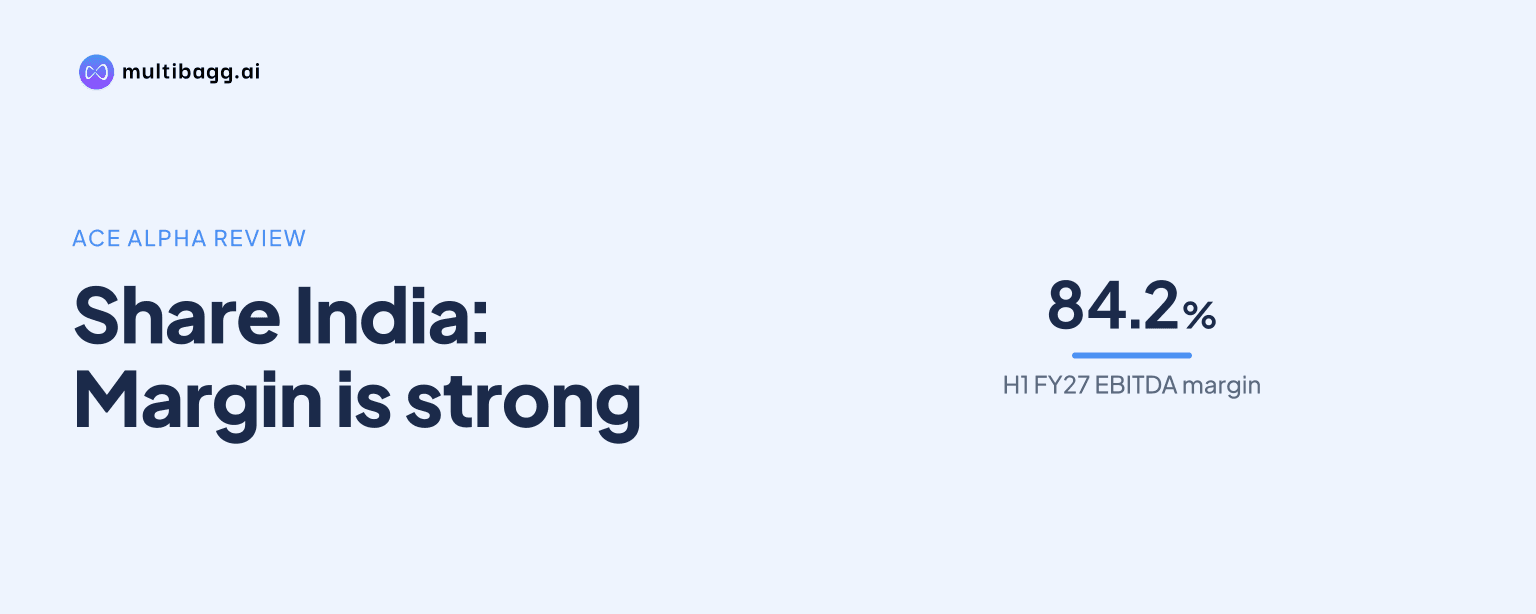
Share India Securities Limited has received in-principle board approval to evaluate amalgamating Ace Alpha Tech Limited, a technology provider that reported Rs 16.68 crore of earnings before interest, tax, depreciation and amortisation (EBITDA) in H1FY27 at an 84.2% margin. The proposed combination would add customised front-end and application programming interface (API) capabilities to Share India’s existing trading technology businesses.
Know Share India Securities inside out
Results, valuation, peers and who's buying, in one view.
Why is Share India evaluating an Ace Alpha Tech amalgamation?
Share India is evaluating Ace Alpha Tech to complete what management describes as a full-stack capital-markets technology ecosystem. The target brings customised front-end development, API integration and end-to-end client solutions, while Share India already identifies uTrade Solutions, Algowire Trading Technologies and Silverleaf Research as technology capabilities within its group. The board has granted only in-principle approval to evaluate the proposal.
The intended stack spans several functions rather than one product. uTrade Solutions provides an algorithmic-trading platform and technology ecosystem; Algowire provides proprietary trading technology and execution; and Silverleaf provides data analytics and quantitative research. Ace Alpha Tech would add product development, analytics, risk management and user management, aiming to link research, strategy development, execution and client interfaces in one platform.
Share India describes possible commercial uses including cross-selling, new products for existing Share India clients and onboarding new clients. Its presentation also identifies Ace Alpha Tech’s client categories as brokers, high-net-worth individuals (HNIs), corporate clients, market makers and quantitative research firms. These categories indicate the target’s stated addressable client groups, not a disclosed count of customers or signed cross-sell opportunities.
What did Ace Alpha Tech report in H1FY27?
Ace Alpha Tech reported revenue of Rs 19.81 crore in H1FY27, up 120.6% year on year, alongside EBITDA of Rs 16.68 crore, up 109.4% year on year. Its reported EBITDA margin was 84.2%, showing that the target’s disclosed financial profile includes operating profitability as well as the proposed strategic technology contribution.
Profit after tax (PAT) was Rs 12.15 crore in H1FY27, a 61.3% year-on-year increase, and the reported PAT margin was 61.3%. The presentation does not provide prior-year absolute revenue, EBITDA or PAT figures, so the disclosed comparison is limited to the stated percentage growth rates and H1FY27 values.
The gap between the growth rates changed across the measures: revenue grew 120.6%, faster than EBITDA at 109.4%, while PAT grew 61.3%. Share India supplies no cost breakdown, tax-rate explanation or prior-period margins for Ace Alpha Tech, so the presentation does not establish the reasons for those different growth rates.
How would Ace Alpha Tech fit Share India’s technology stack?
Ace Alpha Tech would strengthen Share India’s API and platform-integration layer through multi-vendor API integration, custom front-end development and end-to-end technology solutions. This would complement uTrade’s no-code, artificial intelligence-driven strategy development, Silverleaf’s research and model-development role, and Algowire’s latency-optimised execution infrastructure.
The proposed integration is designed to connect broking platforms with wealth, credit, portfolio management services (PMS) and unlisted businesses. Management also cites unified access to APIs, market data and analytics. The presentation frames these as potential synergies, rather than reporting that the systems have already been connected or that revenue from such integration has started.
Risk and user management are another stated integration area. Share India says Ace Alpha Tech could streamline client onboarding, user controls and risk monitoring across margin trading facility (MTF), leverage, wealth, PMS and algorithmic trading. Its existing stack already describes risk controls in strategy testing and live deployment; Ace Alpha Tech is presented as adding onboarding controls and integrated monitoring to that structure.
Got a follow-up? Ask IRIS
Which Share India businesses could use Ace Alpha Tech’s capabilities?
Share India identifies seven potential application areas for Ace Alpha Tech: debt through CRED, wealth and insurance, algo trade, institutional equities, unlisted, PMS and broking. The proposed target is described as a shared technology and product-development capability across the group, rather than a business restricted to the brokerage platform.
In the debt business, Share India Cred Capital raised Rs 334.3 crore in Q2, compared with Rs 74.3 crore in Q1, according to the presentation. That was a 4.5-times increase, and total debt capital raised stood at Rs 408.6 crore as of September 30, 2026. The planned integration of APIs, market data and client interfaces could be relevant to this stated debt application, but no specific deployment schedule is disclosed.
In lending, Share India Fincap had assets under management (AUM) of Rs 288.7 crore in H1FY27, up from Rs 265.3 crore in FY26. The company says Ace Alpha Tech could develop customised interfaces for wealth-management and credit platforms, while integrated workflows could support a seamless client experience. That remains a proposed use case, not a reported operational result for the non-banking financial company (NBFC).
What remains undisclosed about the proposed amalgamation?
Share India has confirmed in-principle board approval to evaluate the amalgamation, but the supplied presentation does not disclose a transaction value, exchange ratio, ownership structure, closing date or regulatory timetable. It therefore presents the combination as a proposal under evaluation, not as a completed amalgamation or an assured operating integration.
The presentation identifies faster product launches as a potential outcome of custom development, API integration and iterative upgrades. It also says the combined capabilities could support domestic and international expansion and enable end-to-end solutions from implementation to ongoing support. No revenue target, cost-synergy target or quantified timetable accompanies these potential outcomes.
Share India’s wider technology platform has more than 200 technology experts and includes a library of 20 approved strategies supported by historical backtesting, risk assessment and risk-testing tools. uTrade reported 73,551 subscriptions and 7,993 paid subscriptions on the following presentation page. Those existing assets provide context for the proposed technology fit, but the source does not quantify what share of users or products would be transferred to Ace Alpha Tech systems.
Conclusion
The disclosed case for evaluating Ace Alpha Tech combines an operating result with a platform objective. Ace Alpha Tech generated Rs 19.81 crore of H1FY27 revenue, Rs 16.68 crore of EBITDA and a reported 84.2% EBITDA margin, while Share India sees its front-end, API, analytics, risk and user-management capabilities as additions to uTrade, Algowire and Silverleaf.
The next point to watch is whether Share India advances beyond the board’s in-principle approval and discloses transaction terms, timing and implementation plans. Management’s stated plan is to use Ace Alpha Tech across debt, wealth and insurance, algorithmic trading, institutional equities, unlisted services, PMS and broking, but the presentation gives no target date or quantified synergy forecast.