










Share India merchant banking revenue reached Rs 23.7 crore
Key highlights
- Merchant banking revenue rose to Rs 23.7 crore in Q2FY27 from Rs 5 crore in Q1FY27 and Rs 14.9 crore in Q2FY26.
- Merchant banking EBIT increased to Rs 15.6 crore, with the EBIT margin reaching 65.7% in Q2FY27.
- Share India completed 4 IPO listings and filed 2 mainboard DRHPs during Q2FY27.
- Consolidated income from operations was Rs 379.5 crore and net profit was Rs 102.5 crore in Q2FY27.
powered by IRIS
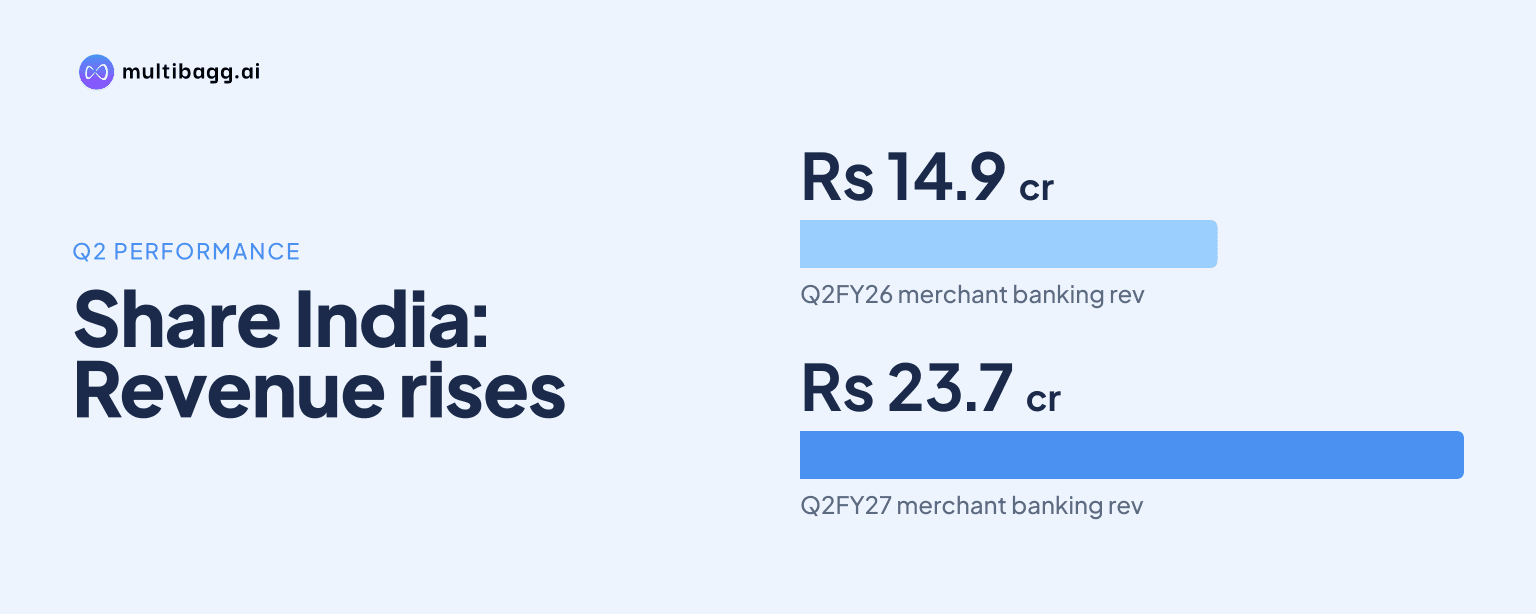
Share India Securities Limited reported merchant banking revenue of Rs 23.7 crore in Q2FY27, up from Rs 5 crore in Q1FY27 and Rs 14.9 crore in Q2FY26. Segment EBIT reached Rs 15.6 crore, while Share India completed four IPO listings and filed two mainboard draft red herring prospectuses, or DRHPs, during the quarter.
Know Share India Securities inside out
Results, valuation, peers and who's buying, in one view.
How much did Share India’s merchant banking revenue increase?
Share India’s merchant banking revenue increased to Rs 23.7 crore in Q2FY27 from Rs 5 crore in Q1FY27, while EBIT rose to Rs 15.6 crore from Rs 3.1 crore. Revenue also exceeded the Rs 14.9 crore reported in Q2FY26, and EBIT was above the year-earlier Rs 6 crore.
Share India’s EBIT margin reached 65.7% in Q2FY27, compared with 61.2% in Q1FY27 and 40.4% in Q2FY26. The sequential increase in revenue of Rs 18.7 crore was accompanied by a Rs 12.5 crore increase in EBIT, reversing the lower Q1FY27 level.
What IPO work did Share India complete in Q2FY27?
Share India completed four IPO listings in Q2FY27, comprising one mainboard listing and three small and medium enterprise, or SME, listings. It also filed two mainboard DRHPs, which the presentation identifies as evidence of merchant banking momentum and a growing deal pipeline.
Share India reported 27 IPO listings to date across 13 sectors and 10 geographies. The presentation does not name the Q2FY27 issuers, disclose their issue sizes or fees, or provide expected dates for the two mainboard issues to open or list.
Share India provides merchant banking through a wholly owned subsidiary focused on end-to-end IPO advisory and execution. The disclosed services include IPO structuring and regulatory compliances, which means the two DRHP filings represent work at a regulatory filing stage rather than completed offerings.
How does merchant banking compare with Share India’s other segments?
Merchant banking remained smaller than Share India’s broking and trading segment in Q2FY27, although its revenue rose while broking revenue declined sequentially. Merchant banking reported Rs 23.7 crore of revenue against broking and trading revenue of Rs 342.9 crore.
Merchant banking revenue was above the Rs 12.3 crore reported by the non-banking financial company, or NBFC, segment and the Rs 3.7 crore reported by technology. Its 65.7% EBIT margin was higher than broking and trading’s 43.6%, but below NBFC’s 68.6% in the same quarter.
At the consolidated level, Share India reported income from operations of Rs 379.5 crore in Q2FY27, up 11.3% from Rs 341 crore in Q2FY26 but down from Rs 462.1 crore in Q1FY27. Reported net profit was Rs 102.5 crore, compared with Rs 93.2 crore a year earlier and Rs 132.4 crore in Q1FY27, so merchant banking’s sequential rise contrasted with lower group income and profit quarter on quarter.
Got a follow-up? Ask IRIS
What does the Q2FY27 result show about the merchant banking pipeline?
The Q2FY27 result shows that merchant banking revenue and EBIT rose alongside four completed listings and two new mainboard DRHP filings. Revenue of Rs 23.7 crore was Rs 8.8 crore above Q2FY26, while EBIT of Rs 15.6 crore was Rs 9.6 crore higher than the year-earlier period.
The presentation does not provide merchant banking revenue for H1FY27, an active-mandate count or a transaction-level revenue breakdown. It consequently does not establish how much Q2FY27 revenue came from mainboard versus SME mandates, or from listing, advisory, structuring or regulatory-compliance work.
Share India identifies merchant banking as an adjacent business within its capital-markets ecosystem, while broking is described as core revenue and a customer-acquisition channel. In Q2FY27, broking and trading revenue fell from Rs 440.4 crore in Q1FY27 to Rs 342.9 crore, whereas merchant banking rose from Rs 5 crore to Rs 23.7 crore.
What should readers watch next in Share India’s merchant banking business?
Readers should watch the progress of the two mainboard DRHPs filed in Q2FY27, as these are the specific future merchant banking transactions disclosed by Share India. The presentation gives no timetable for regulatory observations, issue openings, listings or completion of either proposed offering.
Share India’s record of 27 IPO listings across 13 sectors and 10 geographies provides context for the four Q2FY27 listings. However, management has not disclosed merchant banking revenue guidance, projected fees or the number of mandates beyond the two DRHPs, leaving future transaction execution as the reported indicator of pipeline conversion.
Conclusion
Share India’s merchant banking revenue reached Rs 23.7 crore in Q2FY27, supported by four IPO listings, and segment EBIT increased to Rs 15.6 crore. The segment remained substantially smaller than broking and trading by revenue, but it recorded a higher EBIT margin than broking and trading during the quarter.
The next disclosed milestone is progress on the two mainboard DRHPs filed in Q2FY27. Share India has not stated expected issue dates, listing dates, fees or a wider mandate pipeline, so subsequent regulatory developments and completed IPO transactions will determine how the disclosed pipeline develops.