










Shellz gets 95.91% of FY26 revenue from super stockists
Key highlights
- Super stockists accounted for 95.91% of Shellz revenue from operations in FY26.
- Shellz had 344 super stockists across its network as of March 31, 2026.
- E-commerce and quick commerce contributed 1.88% of Shellz FY26 revenue from operations.
- North India generated 75.34% of Shellz revenue from operations in FY 2025-26.
powered by IRIS
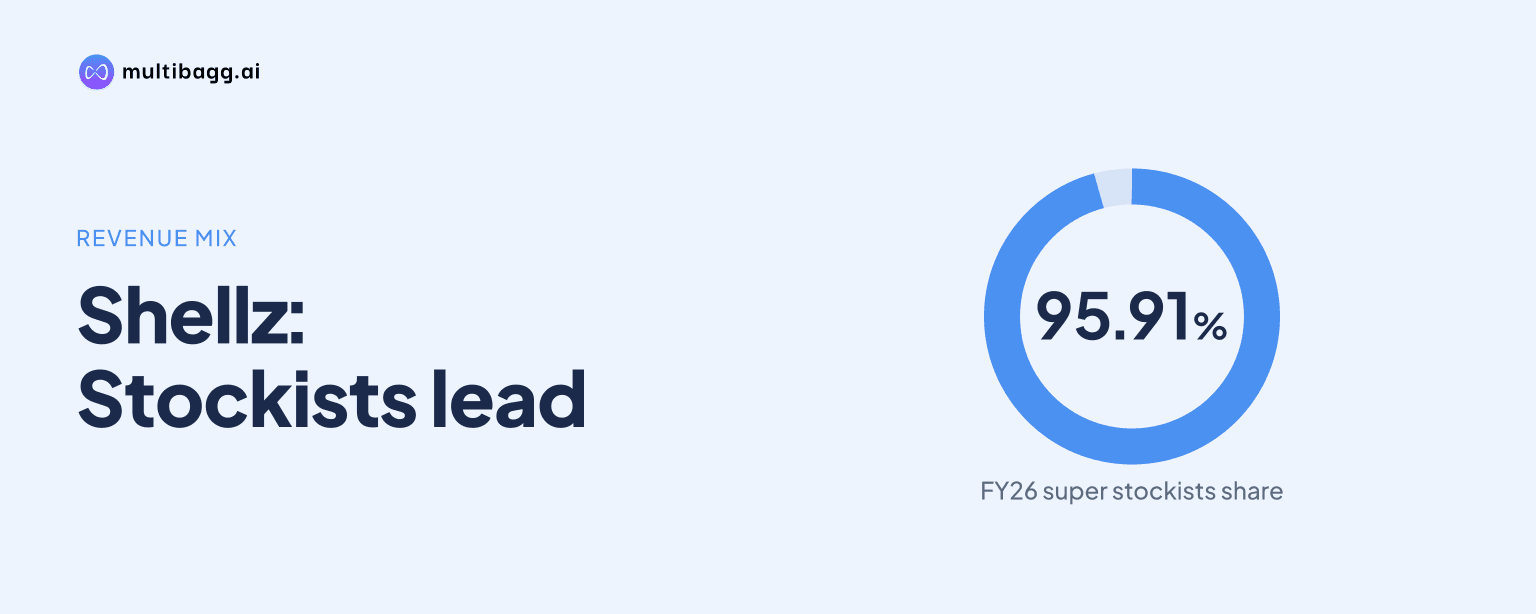
Shellz India Limited received 95.91% of revenue from operations through super stockists in FY26, compared with 1.88% from e-commerce and quick commerce, showing that its Tosca-led digital distribution remained small against its Rs 192.6 crore revenue base.
Know Shellz India inside out
Results, valuation, peers and who's buying, in one view.
How dependent was Shellz on super stockists in FY26?
Shellz was dependent on super stockists for 95.91% of revenue from operations in FY26. The presentation identifies this as its core channel and primary route to kirana retailers in urban, semi-urban and rural markets across about 24 states. As of March 31, 2026, Shellz had 344 super stockists, compared with its broader description of a network of more than 300 partners.
The other channels were individually small in FY26, led by e-commerce and quick commerce at 1.88% of revenue from operations. Exports and private label contributed 1.59%, while modern trade contributed 0.63%. The channel figures are based on consolidated financials disclosed in the prospectus.
The difference in scale between the kirana-led route and developing channels was substantial. E-commerce and quick commerce were the largest non-stockist channel grouping at 1.88%, but their share was less than one-fiftieth of the 95.91% stockist contribution. Shellz classifies online channels as growing, while it describes modern trade as emerging.
How is Shellz’s stockist network distributed by region?
Shellz’s super-stockist network was concentrated in North India, which had 186 of 344 super stockists as of March 31, 2026. South India had 78 stockists, West India had 58, East India had 17 and the export category had five. North India therefore had more than twice the number of stockists in South India, the next-largest region by partner count.
North India also generated the largest revenue contribution in FY 2025-26 at 75.34% of revenue from operations. East India contributed 11.71%, South India 9.30%, West India 3.11% and exports 0.54%. Shellz classifies Bihar and Jharkhand within North India under its internal policy, affecting the disclosed regional mix.
The regional revenue split did not match the partner distribution exactly. North India accounted for 75.34% of revenue with 186 stockists, while South India had 78 stockists but generated 9.30% of revenue. Shellz’s disclosed route to market runs from the company through super stockists, wholesalers, intermediaries and kirana stores to consumers.
Which channels beyond stockists is Shellz building?
Shellz is building quick commerce, exports, private labelling, modern trade and e-commerce alongside its core stockist route. Exports represented 0.54% of FY26 revenue and private labelling represented 1.05%, together forming the disclosed 1.59% exports-and-private-label category. Shellz exports to customers in the Middle East, South Asia and Europe, and manufactures and develops products for third-party brands.
For exports, Shellz says Sonipat's international food-safety alignment is intended to open higher-realisation markets, while lower-realisation markets can support capacity absorption. For private labelling, management says incremental Sonipat capacity can enable scaled arrangements without displacing own-brand production. These are planned next steps rather than disclosed FY26 revenue or volume targets.
Modern trade accounted for 0.63% of FY26 revenue from operations. Shellz supplies Walmart, Metro and Lots through direct-store or designated-delivery-point arrangements, and identifies aspirational consumer reach as the channel’s role. It plans to expand the Tosca range into organised retail as brand recognition builds, although the channel’s current contribution remains below the 1.88% online-channel share.
Got a follow-up? Ask IRIS
How does Tosca fit Shellz’s quick-commerce plan?
Tosca is Shellz’s premium product label for quick commerce, with products supplied to the central fulfilment centres of Swiggy Instamart and Blinkit. Those centres distribute products onwards to dark stores across metro markets. Shellz assigns quick commerce the roles of premium reach and margin expansion and describes the channel as expanding.
Shellz’s next stated step is deeper stock-keeping unit availability and fulfilment reach on Swiggy Instamart and Blinkit, followed by listings on other quick-commerce platforms. A stock-keeping unit is an individual product listing or pack configuration. The disclosed 1.88% FY26 figure combines e-commerce and quick commerce, so Shellz does not separately disclose Tosca sales or quick-commerce revenue.
E-commerce is also a primary route in the Tosca plan. Shellz lists products on Amazon, Flipkart, Meesho and Kirana Club, using central warehouses and marketplace logistics. The company describes e-commerce as supporting brand discovery and pan-India availability, while quick commerce uses metro dark-store fulfilment.
What will Sonipat change for Shellz’s channel mix?
Shellz expects the Sonipat facility to provide capacity and food-safety support for developing channels, although it does not disclose a date-specific channel-revenue target. Installed capacity was 17,100 metric tonnes per annum, or MTPA, in FY26. Sonipat Phase 1 is designed for 26,400 MTPA and the combined Phase 1 and 2 configuration for 34,500 MTPA, an increase of 17,400 MTPA from the FY26 level.
Shellz says Sonipat is designed to work towards certifications such as BRCGS and SQF, alongside ISO 22000 and Food Safety and Standards Authority of India, or FSSAI, requirements. Management says global certifications are entry requirements for manufacturing for global brands and exporting to developed markets. This links the facility to private labelling and exports, which together contributed 1.59% of FY26 revenue.
Management projects a 3% to 4% enhancement in earnings before interest, tax, depreciation and amortisation, or EBITDA, margin from consolidating Delhi operations into Sonipat. The presentation cites lower operating costs, specialised production zones and progressive automation as the mechanisms. This is a management projection, rather than a reported FY26 outcome; Shellz reported a FY26 EBITDA margin of 16.4%.
Conclusion
Shellz’s FY26 channel data show that the business remained anchored in a super-stockist model, which accounted for 95.91% of revenue from operations and linked the company with kirana stores through 344 stockists. Online channels at 1.88%, exports and private label at 1.59%, and modern trade at 0.63% indicate the current scale of the routes intended to broaden distribution.
The next development to watch is Sonipat’s activation and its effect on channels management has identified for expansion. The facility is designed to take capacity from 17,100 MTPA in FY26 to 34,500 MTPA across two phases, while Shellz plans wider Tosca availability through Swiggy Instamart, Blinkit, other quick-commerce platforms, e-commerce marketplaces and organised retail.