










Godawari Power and Ispat Limited targets 290 MW solar by Dec 2026
Key highlights
- GPIL targets 290 MW of captive solar capacity by December 2026, up 53% from 190 MW.
- The 100 MW solar project had incurred Rs 240 crore of its approximate Rs 320 crore cost by 30 September 2026.
- GPIL's 45 MWh captive BESS had incurred Rs 39 crore and is expected to be commissioned by December 2026.
- The 25 MW captive solar plant was commissioned in May 2026 for the Ari Dongri and Boria Tibu mines.
powered by IRIS
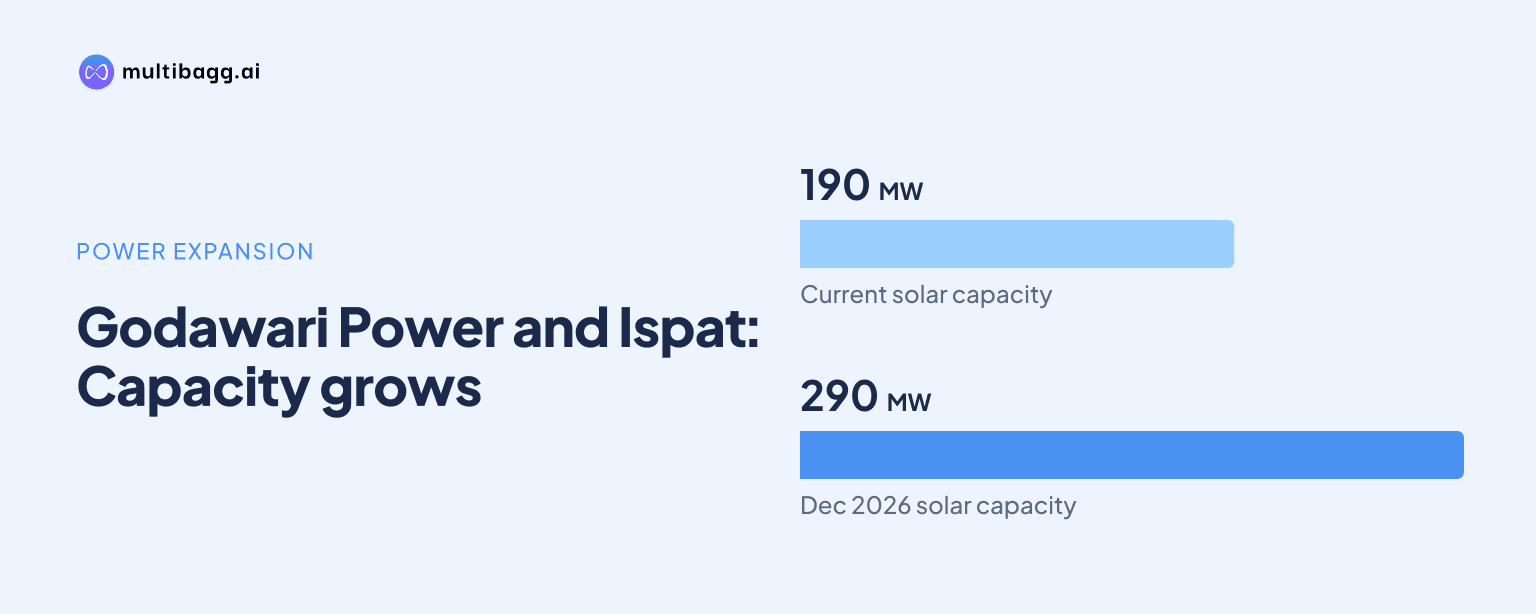
GPIL plans to lift captive solar capacity 53% from 190 megawatts (MW) to 290 MW by December 2026, with a 45 megawatt-hour battery energy storage system also due that month. The company commissioned 25 MW in May 2026, while its 100 MW solar project had incurred Rs 240 crore by 30 September 2026.
Know Godawari Power & Ispat inside out
Results, valuation, peers and who's buying, in one view.
Why is GPIL increasing captive solar capacity?
GPIL is increasing captive solar capacity to supply its iron ore mines and an additional 2 million-tonne pellet plant, replacing higher-cost grid electricity. The company says output from the 25 MW plant will be consumed at the Ari Dongri and Boria Tibu mines, reducing energy costs and carbon footprint while supporting the targeted 290 MW solar total.
The company states that the planned increase is 100 MW, or 53%, from 190 MW to 290 MW. Its project-progress table lists 165 MW of existing solar capacity, a 25 MW addition commissioned in May 2026, and a 100 MW project expected in December 2026. The 165 MW and 25 MW components together explain the stated 190 MW base before the 100 MW project is completed.
The captive-power plan accompanies expansions in GPIL's operating base. Iron ore mining capacity rose from 3.05 million tonnes in FY25 to 6.70 million tonnes in FY26, while pellet capacity increased 74% to 4.7 million tonnes. The presentation links solar expansion specifically to iron ore mines and the additional 2 million-tonne pellet plant, rather than presenting it solely as a clean-energy initiative.
What must GPIL complete to reach 290 MW by December 2026?
GPIL must complete the 100 MW solar project by December 2026 to reach its stated 290 MW installed solar capacity. Construction and module-installation activities were in progress, and the company had incurred Rs 240 crore of capital expenditure by 30 September 2026. The project pipeline puts approximate project cost at Rs 320 crore, with Rs 80 crore shown as the remaining balance.
The completed element is the 25 MW captive solar plant, which GPIL commissioned and synchronized with the grid in May 2026. The company had incurred Rs 73 crore on that plant, while the project pipeline shows an approximate Rs 75 crore cost and no further balance to be incurred. Its designated consumers are the Ari Dongri and Boria Tibu iron ore mines.
The solar completion target falls alongside disclosed mine and pellet ramp-ups. Ari Dongri received Consent to Operate from the Chhattisgarh Environment Conservation Board for capacity of 6 million tonnes in February 2026, up from 2.35 million tonnes, with phased ramp-up beginning in Q4 FY27 and full-scale operations targeted from FY28. Separately, GPIL expects its 4.7 million-tonne pellet plant to reach 75% capacity utilisation in FY27.
Got a follow-up? Ask IRIS
How does the 45 MWh battery system support GPIL's solar plan?
GPIL's 45 MWh battery energy storage system, or BESS, is being installed for its captive solar power plants and is expected to be commissioned by December 2026. The company had incurred Rs 39 crore by 30 September 2026 against an approximate Rs 40 crore project cost. Equipment was on site and installation was in progress, with Rs 1 crore shown as the remaining balance.
The 45 MWh installation is distinct from GPIL's larger BESS manufacturing projects. Godawari New Energy Private Limited, a wholly owned GPIL subsidiary, is executing a 20 gigawatt-hour BESS project with planned capital expenditure of Rs 1,425 crore and expected commissioning in Q1 FY28. GPIL had incurred Rs 609 crore on that project by 30 September 2026, compared with Rs 39 crore on the captive 45 MWh system.
GPIL has also decided to establish 3 gigawatt-hours of BESS capacity for commercial and industrial applications, with planned capital expenditure of Rs 135 crore and commissioning by March 2028. Those projects have different applications and later timelines than the 45 MWh system. The December 2026 BESS milestone is therefore the storage project directly associated with GPIL's captive solar plants.
How much has GPIL spent on its captive solar and storage projects?
GPIL had incurred Rs 352 crore on the 25 MW solar plant, 100 MW solar project and 45 MWh captive BESS by 30 September 2026. This comprises Rs 73 crore for the commissioned solar plant, Rs 240 crore for the 100 MW project and Rs 39 crore for storage. The project pipeline lists approximate combined costs of Rs 435 crore for the three projects.
The source's line-item balances add to Rs 81 crore, although the difference between the listed approximate project costs of Rs 435 crore and incurred expenditure of Rs 352 crore is Rs 83 crore. The difference reflects the 25 MW plant, where the project pipeline records a Rs 75 crore approximate cost, Rs 73 crore incurred and a zero remaining balance. GPIL does not provide an explanation for the difference.
GPIL also approved Rs 26 crore for a 26% stake in Solarcraft Power India 32 Ltd, which is to set up a 50 MW solar project under a group-captive arrangement. The presentation does not state that this 50 MW project is included in the 290 MW captive solar target. It is therefore disclosed separately from the 25 MW and 100 MW projects that underpin the December 2026 capacity objective.
Conclusion
GPIL's captive renewable programme combines a 25 MW solar plant commissioned in May 2026, a 100 MW solar project targeted for December 2026 and a 45 MWh storage system due in the same month. Together, the solar projects are intended to take capacity from 190 MW to 290 MW and replace grid electricity at the Ari Dongri and Boria Tibu mines while supporting mine and pellet operations.
The next stated test is whether the 100 MW solar project and the 45 MWh BESS are commissioned by December 2026. Investors can also watch the planned FY27 ramp-up of the 4.7 million-tonne pellet plant to 75% utilisation, the Ari Dongri ramp-up beginning in Q4 FY27, and the separate 20 gigawatt-hour BESS project's targeted Q1 FY28 commissioning.