










Godawari Power revenue rises 29% as H1 EBITDA margin falls
Key highlights
- GPIL reported H1FY27 revenue of Rs 3,382 crore, up 29% year on year.
- H1FY27 EBITDA was Rs 530 crore, down 9%, while the reported EBITDA margin was 16%.
- Iron ore mining production fell 24% to 9,85,653 metric tons in H1FY27.
- GPIL expects its 5.4 million-tonne beneficiation plant to be commissioned in Q3FY27.
powered by IRIS
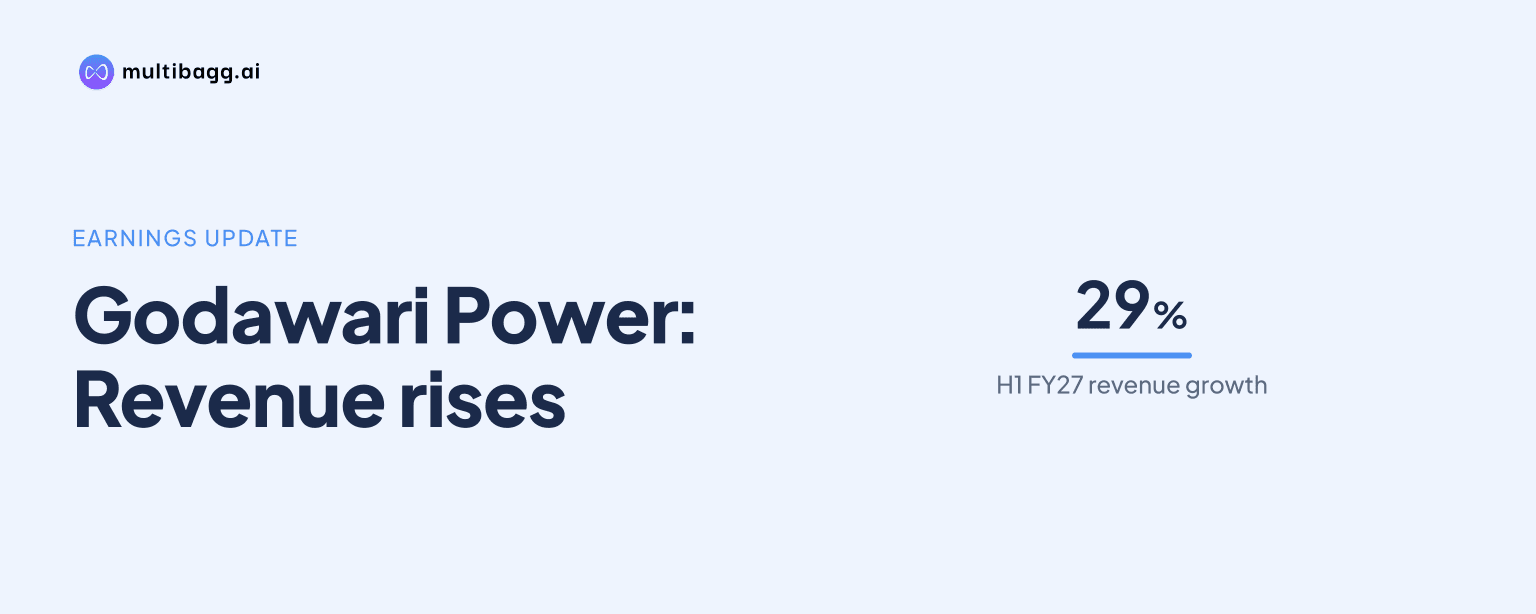
Godawari Power and Ispat Limited reported H1FY27 revenue of Rs 3,382 crore, up 29% year on year, while its EBITDA margin declined by a reported 654 basis points to 16%. GPIL attributed the margin pressure to higher market-sourced iron ore costs caused by mining constraints and elevated coal prices amid the West Asia crisis.
Know Godawari Power & Ispat inside out
Results, valuation, peers and who's buying, in one view.
Why did GPIL’s H1FY27 EBITDA margin fall?
GPIL’s EBITDA margin fell to 16% in H1FY27 from 22% in H1FY26, a reported decline of 654 basis points, because input costs increased. Management said higher iron ore procurement costs followed mining-related constraints, while coal prices rose amid the ongoing West Asia crisis; these factors outweighed improved realisations across key product categories.
The mining constraint reduced captive ore availability in H1FY27. Iron ore mining production fell 24% year on year to 9,85,653 metric tons from 12,90,857 metric tons because of space constraints for overburden dumping. GPIL said the lower mining output required higher market procurement of ore for pellet production, contributing to the increased input-cost base.
How did GPIL’s revenue and profit compare with last year?
GPIL increased H1FY27 revenue by 29% to Rs 3,382 crore from Rs 2,631 crore in H1FY26, but EBITDA declined 9% to Rs 530 crore and profit after tax, or PAT, fell 19% to Rs 307 crore. The comparison shows that higher sales volumes and improved realisations supported turnover without offsetting the higher ore and coal costs.
GPIL’s PAT margin declined to 9% in H1FY27 from 14% a year earlier, while earnings per share fell to Rs 5 from Rs 6. Revenue rose by Rs 751 crore over the same periods, whereas EBITDA declined by Rs 54 crore, reflecting the gap between revenue growth and profitability during the first half.
What did the Q2FY27 result show about the pressure?
GPIL’s Q2FY27 results showed a sequential decline in revenue and earnings, with revenue falling 7% to Rs 1,632 crore from Rs 1,750 crore in Q1FY27 and EBITDA declining 41% to Rs 196 crore from Rs 334 crore. EBITDA margin was 12% in Q2FY27, compared with 19% in Q1FY27.
Management said Q2FY27 pellet realisations declined 10% quarter on quarter, alongside higher market-sourced iron ore and coal costs. Iron ore pellet sales were broadly unchanged at 6,30,922 metric tons in Q2FY27 against 6,33,103 metric tons in Q1FY27, indicating that the disclosed sequential profitability pressure included lower pricing rather than a material decline in pellet sales volume.
Q2FY27 PAT was Rs 85 crore, down from Rs 222 crore in Q1FY27, and PAT margin was 5% versus 13% in the preceding quarter. Against Q2FY26, GPIL reported revenue growth of 25%, but management said year-on-year profitability was affected by higher input costs.
Which operating volumes changed in H1FY27?
GPIL expanded iron ore pellet production by 27% to 17,02,950 metric tons in H1FY27 and increased pellet sales by 39% to 12,64,025 metric tons. This growth contrasted with the 24% fall in iron ore mining production, linking the larger pellet operation with management’s stated need to procure more ore from the market.
Several steel products recorded production growth in H1FY27. Sponge iron production rose 12% to 3,49,533 metric tons, steel billet production increased 10% to 2,53,950 metric tons, and rolled structural product production grew 12% to 51,722 metric tons. Galvanized fabricated product production, however, declined 9% to 39,997 metric tons, which GPIL attributed to heavy rains in the region.
Sales trends also varied by product. Rolled structural product sales rose 139% to 17,732 metric tons in H1FY27, steel billet sales increased 11% to 82,240 metric tons, and M.S. rounds sales grew 6% to 60,422 metric tons. Galvanized fabricated product sales fell 9% to 38,286 metric tons from 42,240 metric tons in H1FY26.
Got a follow-up? Ask IRIS
What is GPIL’s plan for margin recovery?
GPIL expects margins to recover from Q4FY27, subject to receiving permission for overburden dumping and commissioning its beneficiation plant. Management said these actions would support captive iron ore use for pellet production, reducing the reliance on market-sourced ore that contributed to the H1FY27 cost pressure.
The 5.4 million-tonne beneficiation plant was stated to be on track for commissioning in Q3FY27, with management expecting full benefits from expanded pellet capacity and improved profitability from Q4FY27. GPIL’s roadmap also cites captive mining capacity of 6.7 million tonnes and pellet plant capacity of 4.7 million tonnes.
Beyond the beneficiation project, GPIL said its 20 gigawatt-hour battery energy storage system, or BESS, project is slated for commissioning in Q1FY28. The company also approved a Rs 135 crore, 3 gigawatt-hour BESS project for commercial and industrial applications and a Rs 100 crore container manufacturing line for BESS and marine containers.
What other execution milestones should investors track?
GPIL’s proposed 0.7 million-tonne cold rolling mill, or CRM, complex progressed after Maharashtra Industrial Township Limited issued an offer letter for 31.45 acres at AURIC Bidkin, Maharashtra. Godawari New Energy Private Limited also received fresh environmental clearance for an industrial building at the same location for the 20 gigawatt-hour BESS plant.
For the BESS project, GPIL reported sanctioned credit facilities of Rs 2,795 crore, comprising Rs 700 crore of term debt and Rs 2,095 crore of working-capital facilities. Godawari New Energy Private Limited received an additional Rs 50 crore through preference share allotment for proposed BESS plant capital expenditure and working-capital needs.
GPIL received consent to operate for steel melting shop capacity of 5.75 lakh metric tonnes per annum, up from 5.25 lakh metric tonnes per annum, with incremental output intended for captive consumption. It also approved Rs 100 crore of capital expenditure for deploying 50 electric-vehicle dumpers in iron ore mines and the plant.
Conclusion
GPIL’s H1FY27 results show that 29% revenue growth to Rs 3,382 crore did not translate into higher earnings, as EBITDA declined 9% to Rs 530 crore and the reported EBITDA margin fell to 16%. Lower captive iron ore mining output increased dependence on purchased ore, while elevated coal costs and lower Q2FY27 pellet realisations added to the pressure.
The next milestones are the planned Q3FY27 commissioning of the 5.4 million-tonne beneficiation plant, the unresolved permission for overburden dumping, and management’s expectation of margin recovery from Q4FY27. GPIL’s Q1FY28 target for commissioning its 20 gigawatt-hour BESS project and progress on the 0.7 million-tonne CRM complex are also disclosed execution points to watch.