










Shera Energy Limited sees Rs 200-250 crore CTC potential
Key highlights
- Shera estimated Rs 200 crore to Rs 250 crore of annual CTC revenue at 100 tonnes of monthly output.
- The CTC plant has stated optimum capacity of 120 tonnes to 150 tonnes per month.
- Nickel-based alloys could offer Rs 300 crore to Rs 400 crore of revenue after trials and export approvals.
- Shera has installed 200 tonnes per month of solar-ribbon capacity, and 50% of its machines were producing.
powered by IRIS
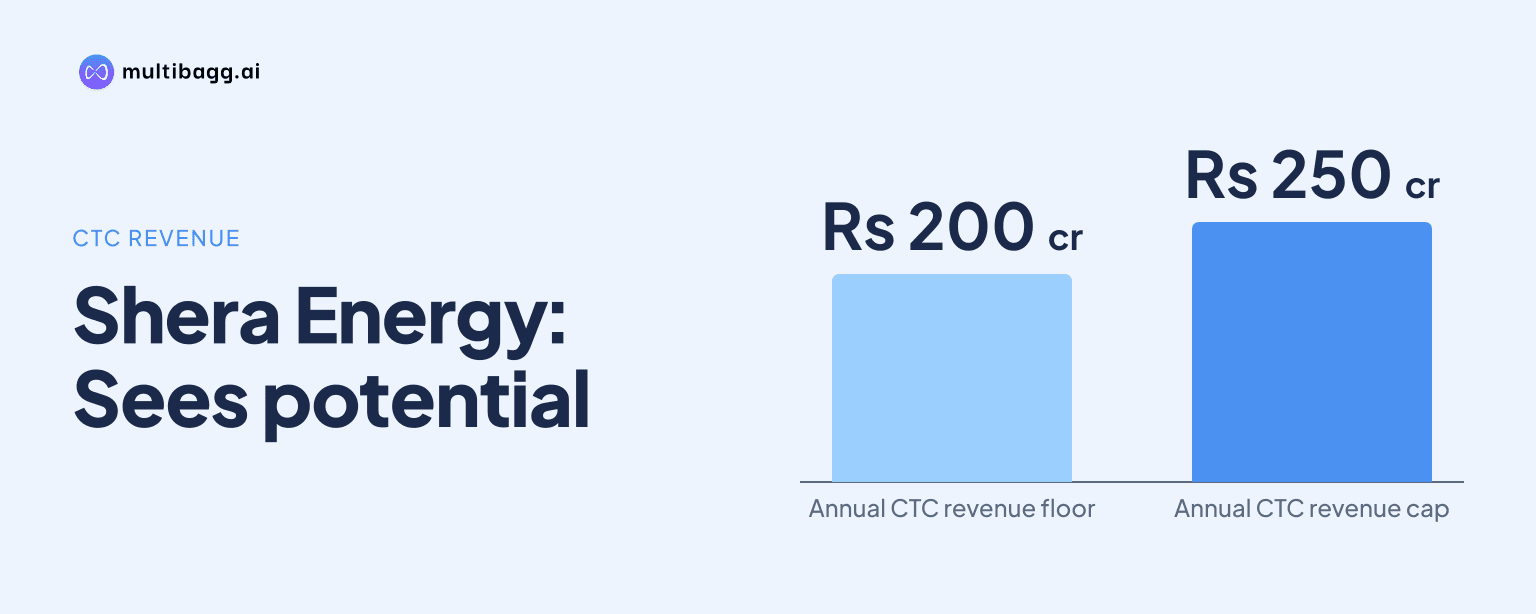
Shera Energy Limited said 100 tonnes of monthly continuously transposed conductor, or CTC, output could generate Rs 200 crore to Rs 250 crore of annual revenue, based on management’s assumed copper price of Rs 1,800 to Rs 2,000 per kilogram. The estimate depends on Power Grid Corporation approval and a capacity ramp-up.
Know Shera Energy inside out
Results, valuation, peers and who's buying, in one view.
What revenue can Shera’s CTC line generate?
Shera’s stated CTC opportunity is Rs 200 crore to Rs 250 crore of annual revenue at 100 tonnes of monthly output. Management calculated the range using an assumed copper price of Rs 1,800 to Rs 2,000 per kilogram for the coming financial year and confirmed that the calculation was on a full-year basis.
The CTC plant’s optimum capacity is roughly 120 tonnes to 150 tonnes a month, placing the Rs 200 crore to Rs 250 crore illustration below the stated maximum output range. This is a management estimate rather than reported CTC sales, because Shera said it must still obtain approval from Power Grid Corporation before reaching higher utilisation.
Shera positioned CTC alongside expansion in its existing winding-wire operations. Management said aluminium sales increased roughly 60% in the first half compared with the prior-year first half after it added aluminium-production machines serving distribution-transformer demand. The reported aluminium comparison shows that the base business was growing while CTC was being developed as an additional conductor product.
When could Shera ramp CTC capacity?
Shera said it expected to reach 30% of installed CTC capacity by the end of 2027, before seeking utilisation of about 80% to 90% after Power Grid Corporation approval. Management said approvals take a sizable period after an application, but did not disclose an application date, customer-order position or approval timetable.
Further CTC investment is also conditional on approvals and operating progress. Management said capacity would be enhanced after the line receives Power Grid and government-agency approvals, rather than disclosing a fixed capital-expenditure amount or an expansion date for the CTC business.
For the wider business, management estimated current utilisation at roughly 70% to 80%, without giving an exact number. It said Shera spent around Rs 60 crore to Rs 70 crore on capital expenditure in the prior year, with that investment now in commercial production, and intends to allow five to six months for products to gain market acceptance before deciding on further additions.
Got a follow-up? Ask IRIS
How large is Shera’s nickel-alloy opportunity?
Shera said nickel-based alloys could eventually contribute Rs 300 crore to Rs 400 crore of revenue from potential volumes of 100 tonnes to 150 tonnes a month, at prices of Rs 3,500 to Rs 4,000 per kilogram. Management said that opportunity depends on completing product trials and export approvals, making it a prospective figure rather than current revenue.
The nickel-alloy operation is at an early scale-up stage. Management said production was then only five tonnes to 10 tonnes a month and expected output of around 25 tonnes to 30 tonnes in the following quarter. Customer samples had been sent and some orders had begun to arrive, but Shera did not disclose a numerical margin target for the product.
Shera described the operation as a combination of recycling and alloy production. Its initial market is specialised welding wires, followed by heating elements, while identified uses also include thermostats, thermocouple wires and nichrome wire. Management said the products are intended mainly for exports, subject to the stated approvals and customer acceptance.
The raw-material mix limits the direct importance of scrap to the group’s overall sales. Management said recycled scrap is used for alloy products, which account for no more than 15% to 20% of total sales, while base-metal products are sourced mainly from domestic suppliers. Shera said it does not directly import scrap and named Vedanta, Birla, Adani and Nalco among domestic base-metal suppliers.
What is the status of Shera’s solar-ribbon line?
Shera has installed solar-ribbon capacity of roughly 200 tonnes a month, with machines representing 50% of the investment already producing. Management said the remaining 50% of the machinery was expected to begin production in the coming quarter, but it did not provide a solar-ribbon revenue, price or margin forecast.
The next solar-ribbon expansion could add another 200 tonnes to 300 tonnes of monthly capacity after the existing 200-tonne line reaches operating volume. Management identified roughly 80% utilisation as the point for planning the next expansion, while separately citing a 70% to 80% utilisation range for acting quickly on additional capacity.
Solar ribbons are therefore at an earlier commercial stage than the CTC revenue calculation. CTC has a stated annual sales illustration at 100 tonnes of monthly output, whereas solar ribbons have operating machinery but no disclosed sales estimate. Both products are part of Shera’s plan to increase value-added output, but their disclosed ramp-up conditions differ.
Conclusion
Shera has disclosed three product additions at different stages of development. CTC has the clearest revenue calculation, at Rs 200 crore to Rs 250 crore annually at 100 tonnes of monthly output, but requires Power Grid Corporation approval. Nickel-based alloys carry a stated Rs 300 crore to Rs 400 crore potential but are scaling from five tonnes to 10 tonnes a month, while only 50% of solar-ribbon machinery had started production.
The next disclosed milestones are the start-up of the remaining solar-ribbon machines in the coming quarter, progress in nickel-alloy trials and export approvals, and CTC approval from Power Grid Corporation. Management also said it may consider further CTC and solar-ribbon capacity after utilisation reaches roughly 70% to 80%, following a five- to six-month period for new products to establish themselves in the market.