










Shera targets Q4 Zambia start as recovery reaches 55%-60%
Key highlights
- Shera said Zambia copper recovery rose from 30% to around 55%-60% during trial production.
- Management targets Rs 90 crore to Rs 130 crore of Zambia revenue in the first financial year after commercial production.
- Shera estimated Zambia EBITDA of roughly Rs 20 crore to Rs 30 crore on Rs 90 crore to Rs 100 crore of sales.
- A China-ordered machine is expected in four to five months and is intended to support 70%-80% recovery.
powered by IRIS
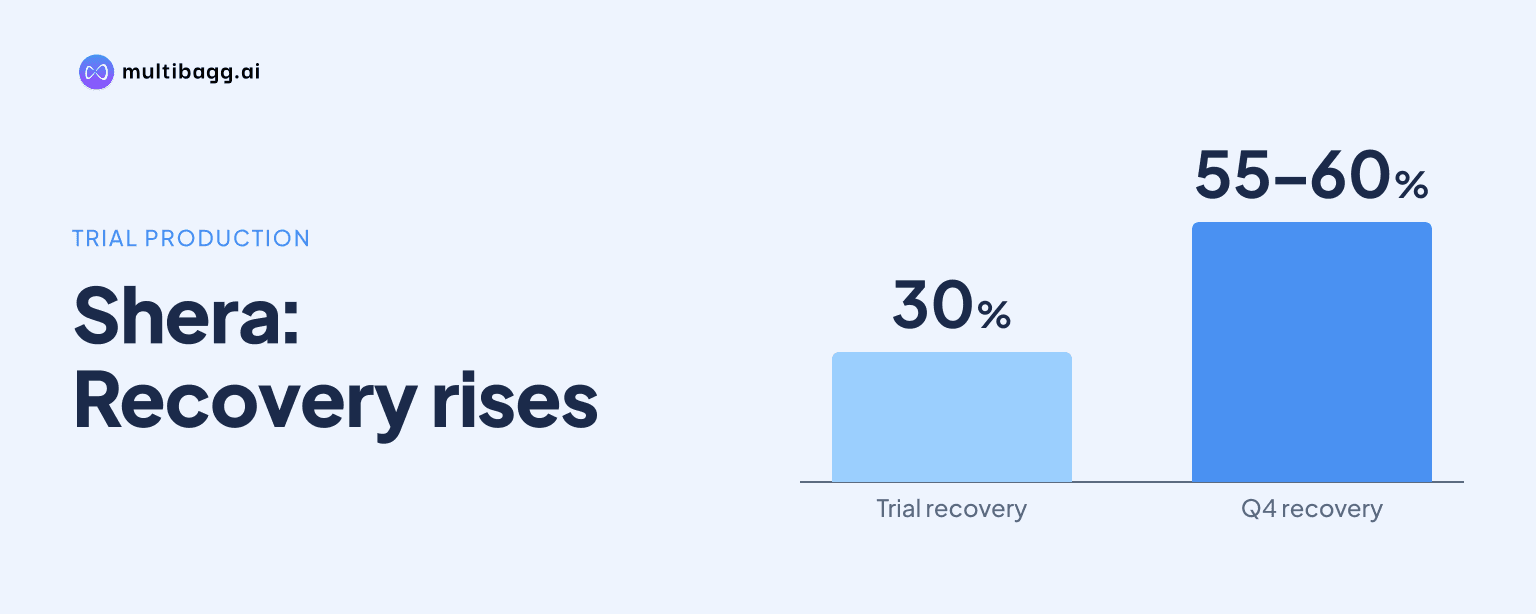
Shera said its Zambia copper-cathode plant lifted recovery from 30% to around 55%-60% during trial production and remains targeted for a Q4 commercial start. Management said the first financial year after commercial production could generate Rs 90 crore to Rs 130 crore of revenue, subject to recovery improvements, plant modifications and further machinery installation.
Know Shera Energy inside out
Results, valuation, peers and who's buying, in one view.
Why has Shera delayed Zambia commercial production?
Shera has delayed full commercial production because it is improving recovery at a second-hand plant rather than operating at a lower rate. Management said the Zambia facility was acquired as a used plant and is being started in phases, with machines still required to improve the conversion of copper-bearing ore into finished cathodes.
Recovery determines how much of the copper in ore can be turned into saleable cathode. Shera said recovery began at 30% and rose to around 55%-60%, but management did not want to run the plant while leaving a substantial part of the copper unrecovered. It has therefore continued trials while addressing operational issues step by step.
Management gave more than one recovery reference for commercial operation. It said full commercial production would come when recovery reached the 70%-80% range, while separately saying the immediate benchmark was 60%, followed by technical additions intended to lift recovery to 80% and above. The reported 55%-60% level is consequently close to the lower benchmark but below the longer-term target.
How does Shera's recovery compare with Zambia benchmarks?
Shera said Chinese plants operating in Zambia typically achieve recovery of roughly 60% to 70%-75%, compared with its current 55%-60% level. Management described Shera as having reached 80% of the applicable standard, while identifying a consistent 60% recovery rate as the first operating milestone.
The move from 30% to 55%-60% is the reported improvement during the trial phase. Yet the comparison also explains why Shera has not declared full commercial operation: management expects further gains from modifications and new machinery, rather than treating the current recovery rate as sufficient for its planned scale.
Shera said modifications from the previous operating run would be completed by December, followed by another production run. It also said it had ordered a machine from China, expected in four to five months, which management linked to recovery in the 70%-80% range. The Q4 target therefore depends on both the December modifications and the recovery achieved in subsequent runs.
What revenue and EBITDA does Shera expect from Zambia?
Shera expects Rs 90 crore to Rs 130 crore of annual revenue in the first financial year after Zambia commercial production begins. Management described the existing facility as a small plant and said it was considering expansion in the same product line after arranging funds.
Management said EBITDA, or earnings before interest, tax, depreciation and amortisation, in the Zambia geography could be above roughly 15%-20%. In a separate discussion of Rs 90 crore to Rs 100 crore of sales, it estimated EBITDA of roughly Rs 20 crore to Rs 30 crore. These are management projections, not reported Zambia earnings, because commercial production had not started.
The Rs 400 crore to Rs 500 crore revenue figure is conditional on expansion and funding, rather than a forecast for the current plant alone. Shera also said its arrangement with the prior plant stakeholders requires a production-linked share. In response to an investor's question, management agreed that the expected Zambia earnings would be reflected in Shera's books.
Got a follow-up? Ask IRIS
What must Shera achieve before scaling Zambia output?
Shera said it plans to scale the Zambia operation to 5,000 tons once recovery reaches 80% and above. The disclosed sequence puts recovery ahead of volume expansion, meaning output growth depends on the technical performance of the processing plant rather than demand alone.
Management said it was spending more than 15 to 20 days in Zambia each month and had been visiting the operation for 1.5 years. It attributed the focus to the potential for higher margins and value addition in the copper-cathode business, while saying Shera's Indian operations were being handled by management's son.
The stated near-term steps are completion of modifications by December, a resumed production run and installation of the China-ordered machine after its expected four-to-five-month delivery period. Shera did not disclose production volume at the present 55%-60% recovery rate, a firm commissioning date beyond Q4, or a date for the proposed 5,000-ton scale-up.
How does Zambia fit with Shera's other growth plans?
Shera presented Zambia alongside growth plans in continuously transposed conductor, or CTC, aluminium products and nickel-based alloys. For CTC, management said installed capacity is about 120 to 150 tons a month and it expects to reach 30% of installed capacity by the first end of 2027.
Shera said CTC utilisation could reach 80%-90% after Power Grid Corporation approvals are obtained. Management estimated that 100 tons of CTC output, using a copper-price assumption of Rs 1,800 to Rs 2,000 per kilogram, could generate roughly Rs 200 crore to Rs 250 crore of annual revenue. That is a separate business line from Zambia's projected first-year Rs 90 crore to Rs 130 crore revenue.
In winding wires, Shera said aluminium sales rose roughly 60% from H1 last year after it inducted aluminium-production machines. It also said nickel-based alloy samples had gone to customers and orders had begun to arrive. Management cited potential demand of 100 to 150 tons a month and revenue potential of Rs 300 crore to Rs 400 crore after trials and export approvals.
Conclusion
Shera has improved Zambia recovery by roughly 25 to 30 percentage points from its 30% starting point, but management's 60% to 70%-75% benchmark comparison shows that the project is still in a technical ramp-up phase. The potential financial contribution is based on management projections of Rs 90 crore to Rs 130 crore in first-year revenue and roughly Rs 20 crore to Rs 30 crore of EBITDA on Rs 90 crore to Rs 100 crore of sales.
The next milestones are completion of modifications by December, the next production run and arrival of the China-ordered machine in four to five months. Investors should watch whether those steps take recovery beyond the 60% benchmark and toward the 80%-plus level at which management said Shera would scale the Zambia operation to 5,000 tons.