










Shilpa sees four CDMO programs commercialize over two years
Key highlights
- Shilpa has 25-plus CDMO programs with partners across multiple manufacturing modalities.
- Shilpa expects at least 1 of 4 registration-stage CDMO programs to commercialize next year and 3 in the subsequent year.
- Shilpa expects to supply APIs in 3 of its 4 registration-stage CDMO programs.
- Non-captive API revenue reached Rs 255 crore in Q2 FY '27, up 24% year on year.
powered by IRIS
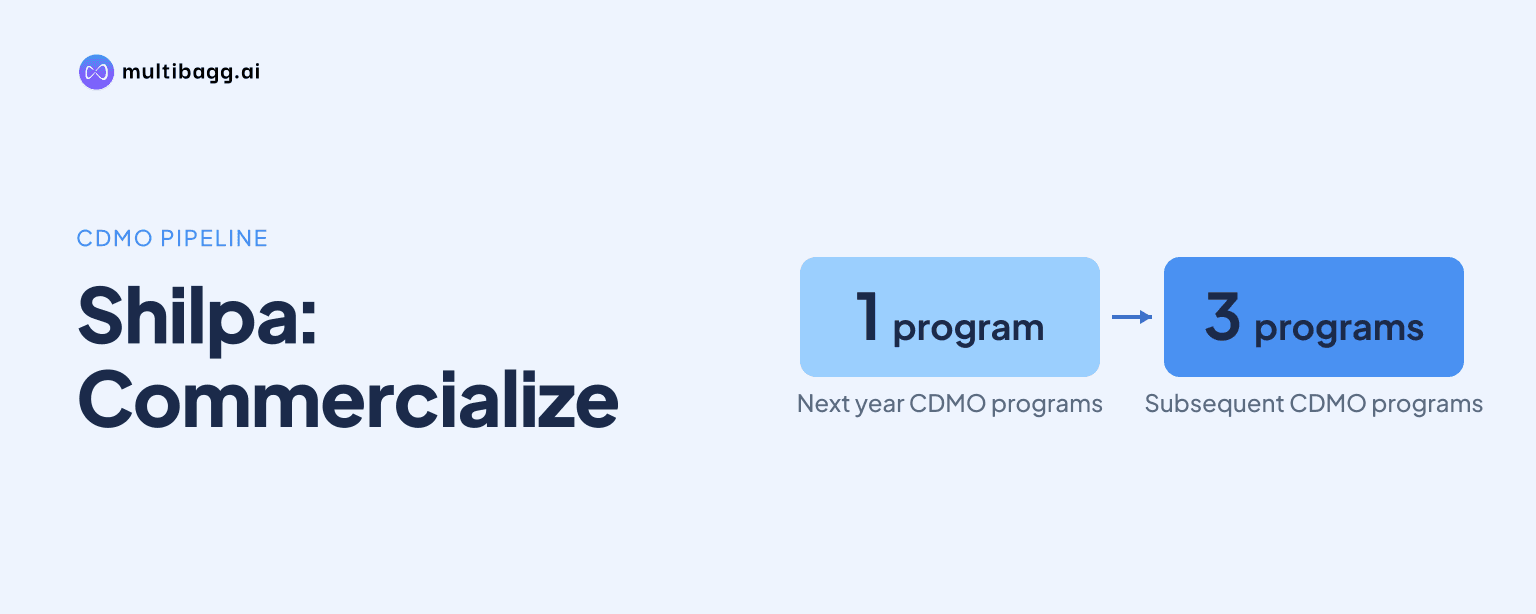
Shilpa expects at least one of four registration-stage contract development and manufacturing organization, or CDMO, programs to commercialize next year and three to commercialize in the subsequent year, management said on its Q2 FY '27 call. The platform has more than 25 client programs, and Shilpa expects to supply active pharmaceutical ingredients, or APIs, in three of the four registration-stage projects.
Know Shilpa Medicare inside out
Results, valuation, peers and who's buying, in one view.
What is Shilpa’s CDMO commercialization timetable?
Shilpa’s stated timetable is for at least one of four registration-stage CDMO programs to commercialize next year and three to commercialize in the subsequent year. Management described the four projects as late-stage programs under registration with partners, providing a specific expected conversion schedule for this part of the CDMO portfolio.
The four registration-stage programs sit alongside two more partner programs in Phase III. An analyst referred to six late-stage programs, but management separated them into four under registration and two in Phase III. The nearer-term commercialization expectations therefore apply to the four-program registration cohort, while no launch timing was disclosed for the Phase III pair.
Management did not provide revenue guidance for the prospective launches or disclose their therapeutic areas. It said each of the four programs is a significant opportunity, but added that specialty CDMO growth depends on partners’ uptake each year. Commercialization of a product therefore does not by itself establish the volume of customer purchases.
How broad is Shilpa’s CDMO platform?
Shilpa said its dedicated CDMO platform has more than 25 programs with partners and was carved out to serve CDMO clients more effectively. Management said the platform can provide integrated development and manufacturing across several modalities, allowing clients to use one supplier for multiple stages of a program.
For small molecules, Shilpa said it can work from key starting materials, or KSMs, through to final API. In peptides, it cited amino acids, fermentation and final peptide API production. In biologics, it cited clone development through fill-finish, describing capabilities that span development and manufacturing rather than only final-product supply.
The platform also covers antibody-drug conjugates, or ADCs, for which Shilpa said it makes the payload, linker and antibody and performs conjugation. The Q2 FY '27 call did not disclose CDMO revenue, margins, client names or program counts by modality, but management used these capabilities to explain the 25-plus-program portfolio.
Why does API supply matter to Shilpa’s CDMO pipeline?
API supply matters because Shilpa expects to supply API directly to end customers in three of its four registration-stage CDMO programs. Management said API would represent a large part of overall purchasing for those products, linking the expected commercialization events to potential manufacturing demand as well as development work.
Shilpa already supplies one commercial new chemical entity, or NCE, through its specialty CDMO operation. Management said the partner launched that product about one year ago and that volumes should grow year on year. It did not disclose the product, its indication or revenue because of confidentiality obligations.
The platform also includes Japanese CDMO programs for which Shilpa is manufacturing and supplying registration-batch quantities to partners. Registration batches are distinct from routine commercial supply, and management did not provide commercial launch dates for these programs. That contrasts with the four registration-stage programs, for which it gave next-year and subsequent-year expectations.
Got a follow-up? Ask IRIS
How does CDMO fit within Shilpa’s Q2 FY '27 performance?
CDMO was part of a quarter in which Shilpa reported record revenue of Rs 538 crore, up 35% year on year, and earnings before interest, tax, depreciation and amortization, or EBITDA, of Rs 151 crore, up 37%. Management said non-captive API revenue rose 24% to Rs 255 crore, aided by expanded-capacity uptake and steady specialty CDMO performance.
For H1 FY '27, Shilpa reported total revenue of Rs 1,007 crore, up 44% year on year, and EBITDA of Rs 290 crore, up 40%. Non-captive API revenue grew 20% to Rs 470 crore, while formulation revenue grew 70% to Rs 407 crore and biologics revenue grew 92% to Rs 117 crore. Formulations and biologics therefore grew faster than non-captive API during the half year.
Management said the Q2 gross-margin movement reflected a higher API share of sales, since formulations have higher gross margins than API. It also cited higher global API raw-material costs. The CDMO pipeline is consequently a prospective contributor within the non-captive API business, not revenue already separately reported in Q2 FY '27.
What capacity plans support Shilpa’s CDMO programs?
Shilpa is adding two peptide manufacturing lines to its existing four lines, and management said its first peptide-capacity expansion is expected to be commissioned by the end of FY '27. The planned facility is intended for a mix of CDMO, glucagon-like peptide-1, or GLP-1, opportunities and high-potency APIs, rather than one named product category.
Management said the facility is being built for annual tonnage-scale peptide production but did not disclose a utilization target. It said utilization will depend on customer uptake and that it could provide better visibility in the second half of next year. Shilpa also said customer indications helped shape its capacity plan, while clarifying that it did not have orders in hand.
Further peptide investment is phased and depends on utilization of capacity already funded, partner programs and program uptake. This keeps the capacity expansion separate from a committed revenue schedule. The disclosed commercialization expectations cover four registration-stage CDMO programs, while the timing and scale of peptide orders remain dependent on customer demand.
Conclusion
Shilpa has disclosed a defined expected commercialization sequence for four registration-stage CDMO programs: at least one next year and three in the year after. The programs are within a 25-plus-program platform spanning APIs, peptides, biologics and ADCs, and API supply in three of the four registration-stage projects could represent a substantial part of product purchasing.
The next milestones to watch are commercialization of the first registration-stage program next year, progress of the other three in the subsequent year, and commissioning of the first peptide expansion by the end of FY '27. Management also said it expects better visibility on peptide utilization in the second half of next year, while maintaining that actual orders and revenue depend on partner uptake.